QUESTION IMAGE
Question
document 7
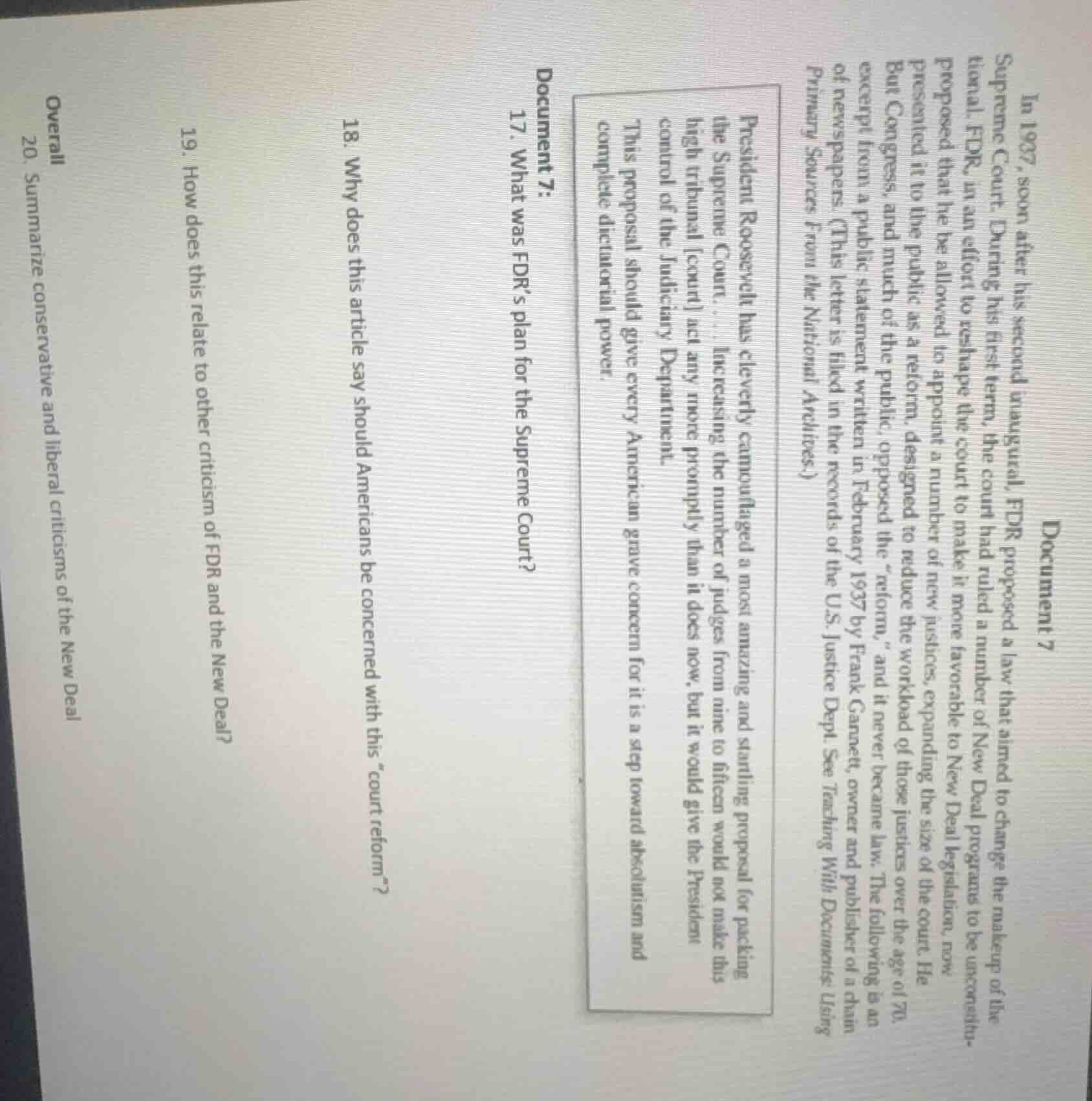
in 1937, soon after his second inaugural, fdr proposed a law that aimed to change the makeup of the supreme court. during his first term, the court had ruled a number of new deal programs to be unconstitu - tional. fdr, in an effort to reshape the court to make it more favorable to new deal legislation, now proposed that he be allowed to appoint a number of new justices, expanding the size of the court. he presented it to the public as a reform, designed to reduce the workload of those justices over the age of 70. but congress, and much of the public, opposed the “reform,” and it never became law. the following is an excerpt from a public statement written in february 1937 by frank gannett, owner and publisher of a chain of newspapers. (this letter is filed in the records of the u.s. justice dept. see teaching with documents: using primary sources from the national archives)
document 7:
president roosevelt has cleverly camouflaged a most amazing and startling proposal for packing the supreme court... increasing the number of judges from nine to fifteen would not make this high tribunal court act any more promptly than it does now, but it would give the president control of the judiciary department.
this proposal should give every american grave concern for it is a step toward absolutism and complete dictatorial power.
- what was fdr’s plan for the supreme court?
- why does this article say should americans be concerned with this “court reform”?
- how does this relate to other criticism of fdr and the new deal?
- summarize conservative and liberal criticisms of the new deal
overall
- The plan aimed to expand the Supreme Court size by allowing FDR to appoint new justices for each sitting justice over age 70, to make the court more favorable to New Deal legislation.
- The article frames the plan as a deceptive power grab: it claims FDR's proposal would give him control over the Judiciary Department, describing it as a step toward absolute, dictatorial power, not just a workload reform.
- Like other New Deal criticisms, it argues FDR is overstepping presidential authority, expanding executive power beyond acceptable limits, similar to critiques that the New Deal gave the federal government too much control over the economy and daily life.
20.
- Conservative criticisms: Argue the New Deal expanded federal government power too greatly, violated states' rights, and was a step toward socialism/authoritarianism (as seen in this court plan critique framing it as dictatorial).
- Liberal criticisms: Argue the New Deal did not go far enough to address economic inequality, failed to fully end the Great Depression, and did not provide enough support to marginalized groups like Black Americans or labor unions.

Snap & solve any problem in the app
Get step-by-step solutions on Sovi AI
Photo-based solutions with guided steps
Explore more problems and detailed explanations
- FDR proposed appointing new Supreme Court justices for each justice over age 70, expanding the court's size to make it more supportive of New Deal laws.
- The article says the plan is a deceptive power grab that would give FDR control of the Judiciary, moving the U.S. toward absolutism and dictatorial power.
- It aligns with other criticisms that FDR was overextending executive/federal government authority beyond constitutional bounds, similar to claims the New Deal overreached in economic and regulatory power.
20.
- Conservative: Claimed the New Deal expanded federal power excessively, undermined states' rights, and risked authoritarianism.
- Liberal: Argue the New Deal was too moderate, failing to sufficiently address poverty, inequality, and the root causes of the Great Depression, and neglecting marginalized groups.