QUESTION IMAGE
Question
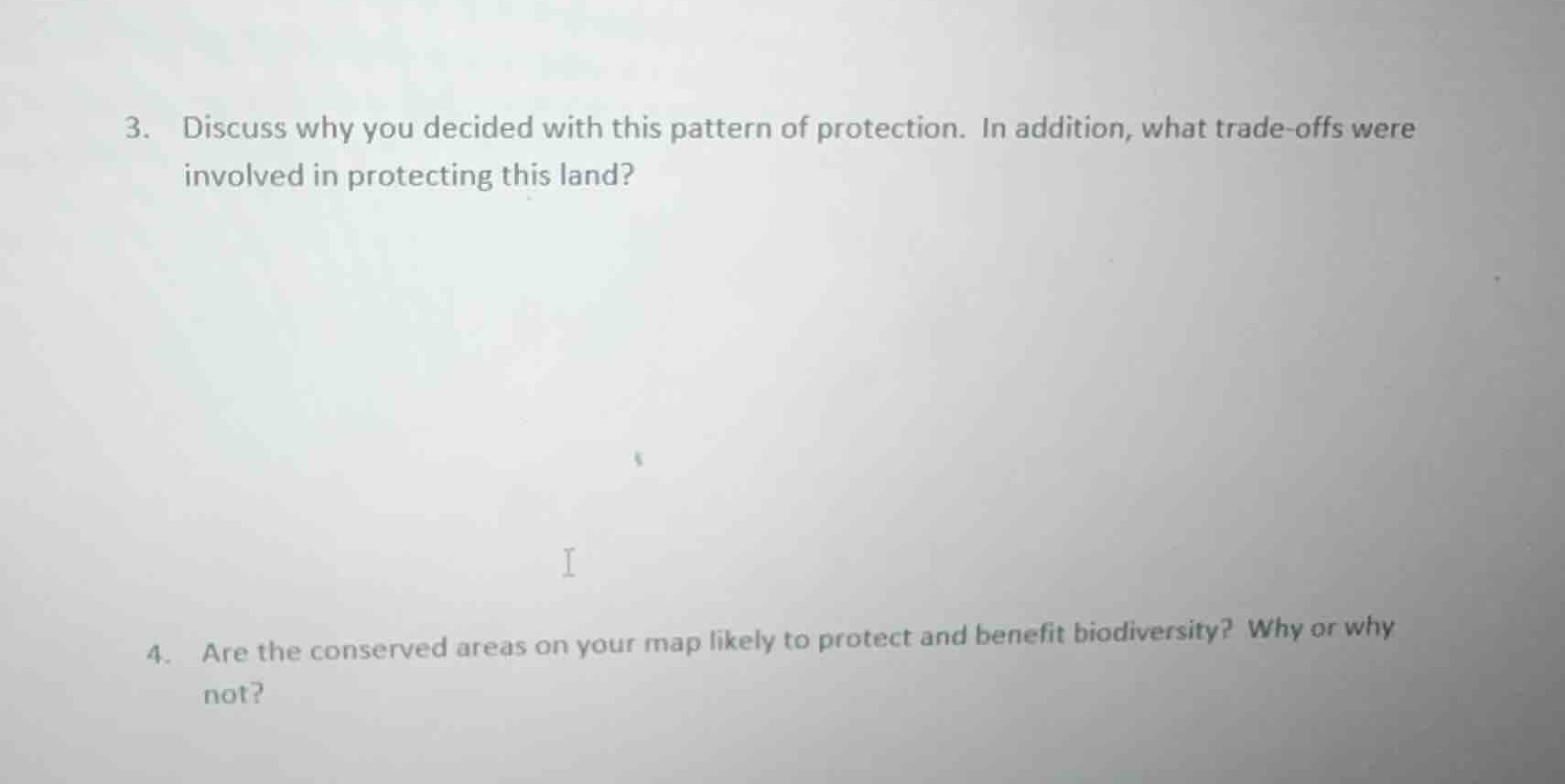
- discuss why you decided with this pattern of protection. in addition, what trade-offs were involved in protecting this land?
- are the conserved areas on your map likely to protect and benefit biodiversity? why or why not?
<pre_analysis>
{
"quality": "clear",
"question_count": 2,
"skills_matched": [
"direct_cot",
"explain_then_answer",
"tutor"
],
"needs_drawing": false,
"concepts_used": [
"Conservation Biology",
"Half-Earth Design",
"Socio-Environmental Challenges"
],
"new_concepts": [],
"current_concepts": [
"Conservation Biology",
"Half-Earth Design",
"Socio-Environmental Challenges",
"Protected Area Coverage"
]
}
</pre_analysis>
<reasoning>
Rationale for protection patterns
In Half-Earth Design, selecting specific areas for protection involves prioritizing regions with high species richness, endemism, or critical habitats. This systematic approach ensures that the most ecologically valuable lands are safeguarded to maximize species preservation.
Trade-offs in land conservation
Protecting land introduces significant Socio-Environmental Challenges. Economic trade-offs include the loss of agricultural production, resource extraction, or urban development. Socially, it can restrict local community access, while ecologically, focusing on one region may leave other vulnerable ecosystems unprotected.
Biodiversity benefits of conserved areas
Under the principles of Conservation Biology, conserved areas are highly likely to protect biodiversity if they are large, contiguous, and ecologically diverse. Large reserves minimize edge effects and support viable populations of wide-ranging species, facilitating natural evolutionary and ecological processes.
Limitations of the conservation design
If the conserved areas are fragmented, isolated, or fail to cover distinct ecological niches, their ability to sustain biodiversity long-term is compromised. Small, disconnected pockets of land make species vulnerable to localized extinctions, genetic drift, and the impacts of climate change.
</reasoning>
<answer>
Question 3
The pattern of protection is typically decided by prioritizing areas of high biodiversity, species richness, and critical habitats to maximize ecological preservation. The trade-offs involved include:
- Economic: Loss of land for agriculture, forestry, urban development, or resource extraction.
- Social: Potential displacement of local communities or restrictions on land use and recreational access.
- Ecological: Allocating limited resources to specific zones while leaving other moderately biodiverse areas vulnerable.
Question 4
Yes, the conserved areas are likely to protect and benefit biodiversity if they are large, contiguous, and cover diverse ecosystems, as this supports viable population sizes and reduces edge effects. However, if the protected areas are highly fragmented or isolated, their effectiveness is reduced because species cannot easily migrate, making them more vulnerable to localized extinctions and climate pressures.
</answer>
<post_analysis>
{
"subject": "Natural Science",
"question_type": "Multi-part",
"knowledge_point": [
"Natural Science",
"Environmental Science",
"Conservation Biology"
]
}
</post_analysis>
Snap & solve any problem in the app
Get step-by-step solutions on Sovi AI
Photo-based solutions with guided steps
Explore more problems and detailed explanations
<pre_analysis>
{
"quality": "clear",
"question_count": 2,
"skills_matched": [
"direct_cot",
"explain_then_answer",
"tutor"
],
"needs_drawing": false,
"concepts_used": [
"Conservation Biology",
"Half-Earth Design",
"Socio-Environmental Challenges"
],
"new_concepts": [],
"current_concepts": [
"Conservation Biology",
"Half-Earth Design",
"Socio-Environmental Challenges",
"Protected Area Coverage"
]
}
</pre_analysis>
<reasoning>
Rationale for protection patterns
In Half-Earth Design, selecting specific areas for protection involves prioritizing regions with high species richness, endemism, or critical habitats. This systematic approach ensures that the most ecologically valuable lands are safeguarded to maximize species preservation.
Trade-offs in land conservation
Protecting land introduces significant Socio-Environmental Challenges. Economic trade-offs include the loss of agricultural production, resource extraction, or urban development. Socially, it can restrict local community access, while ecologically, focusing on one region may leave other vulnerable ecosystems unprotected.
Biodiversity benefits of conserved areas
Under the principles of Conservation Biology, conserved areas are highly likely to protect biodiversity if they are large, contiguous, and ecologically diverse. Large reserves minimize edge effects and support viable populations of wide-ranging species, facilitating natural evolutionary and ecological processes.
Limitations of the conservation design
If the conserved areas are fragmented, isolated, or fail to cover distinct ecological niches, their ability to sustain biodiversity long-term is compromised. Small, disconnected pockets of land make species vulnerable to localized extinctions, genetic drift, and the impacts of climate change.
</reasoning>
<answer>
Question 3
The pattern of protection is typically decided by prioritizing areas of high biodiversity, species richness, and critical habitats to maximize ecological preservation. The trade-offs involved include:
- Economic: Loss of land for agriculture, forestry, urban development, or resource extraction.
- Social: Potential displacement of local communities or restrictions on land use and recreational access.
- Ecological: Allocating limited resources to specific zones while leaving other moderately biodiverse areas vulnerable.
Question 4
Yes, the conserved areas are likely to protect and benefit biodiversity if they are large, contiguous, and cover diverse ecosystems, as this supports viable population sizes and reduces edge effects. However, if the protected areas are highly fragmented or isolated, their effectiveness is reduced because species cannot easily migrate, making them more vulnerable to localized extinctions and climate pressures.
</answer>
<post_analysis>
{
"subject": "Natural Science",
"question_type": "Multi-part",
"knowledge_point": [
"Natural Science",
"Environmental Science",
"Conservation Biology"
]
}
</post_analysis>