QUESTION IMAGE
Question
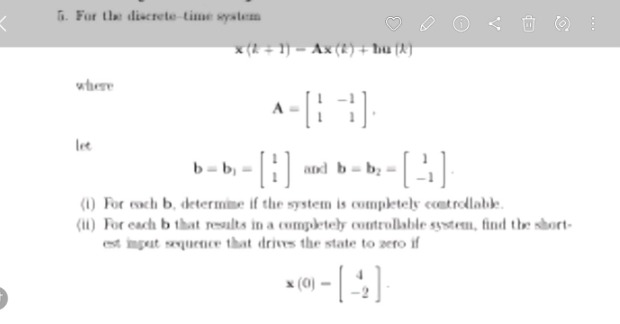
- for the discrete-time system
\\ \mathbf{x}(k+1) = \mathbf{a}\mathbf{x}(k) + \mathbf{b}u(k) \\
where
\\ \mathbf{a} = \
, \\
let
\\ \mathbf{b} = \mathbf{b}_1 = \
\quad \text{and} \quad \mathbf{b} = \mathbf{b}_2 = \
. \\
(i) for each \\(\mathbf{b}\\), determine if the system is completely controllable.
(ii) for each \\(\mathbf{b}\\) that results in a completely controllable system, find the shortest input sequence that drives the state to zero if
\\ \mathbf{x}(0) = \
. \\
🆕 New Concept Discovered: Controllability of Discrete-Time Systems
Checking if we can steer any state to any other state
Step 1: Define the Controllability Matrix
For a second-order discrete-time system (\(n = 2\)) given by:
The system is completely controllable if and only if the controllability matrix \(\mathbf{C}\) has full rank (rank equal to \(2\)):
Given:
Step 2: Test Controllability for \(\mathbf{b}_1\)
Let \(\mathbf{b} = \mathbf{b}_1 =
\).
Compute \(\mathbf{A}\mathbf{b}_1\):
Construct the controllability matrix \(\mathbf{C}_1\):
Calculate the determinant of \(\mathbf{C}_1\):
Since \(\det(\mathbf{C}_1)
eq 0\), the matrix \(\mathbf{C}_1\) has full rank (\(\text{rank} = 2\)).
Thus, the system is completely controllable for \(\mathbf{b} = \mathbf{b}_1\).
Step 3: Test Controllability for \(\mathbf{b}_2\)
Let \(\mathbf{b} = \mathbf{b}_2 =
\).
Compute \(\mathbf{A}\mathbf{b}_2\):
Construct the controllability matrix \(\mathbf{C}_2\):
Calculate the determinant of \(\mathbf{C}_2\):
Since \(\det(\mathbf{C}_2)
eq 0\), the matrix \(\mathbf{C}_2\) has full rank (\(\text{rank} = 2\)).
Thus, the system is also completely controllable for \(\mathbf{b} = \mathbf{b}_2\).
Step 4: Find the Shortest Input Sequence to Drive State to Zero
We want to find the shortest sequence of inputs \(u(0), u(1), \dots, u(N-1)\) that drives the initial state \(\mathbf{x}(0) =
\) to the origin \(\mathbf{x}(N) =
\).
The state equation propagates as:
Setting \(\mathbf{x}(2) = \mathbf{0}\):
Since the system is controllable in 2 steps, the shortest sequence length is at most \(N = 2\). Let's check if it can be done in \(N = 1\) step:
For \(N = 1\), \(\mathbf{x}(1) = \mathbf{A}\mathbf{x}(0) + \mathbf{b}u(0) = \mathbf{0} \implies \mathbf{b}u(0) = -\mathbf{A}\mathbf{x}(0)\). This requires \(-\mathbf{A}\math…

Snap & solve any problem in the app
Get step-by-step solutions on Sovi AI
Photo-based solutions with guided steps
Explore more problems and detailed explanations
(i) Controllability
- For \(\mathbf{b} = \mathbf{b}_1 =
\): Completely controllable (since \(\det(\mathbf{C}_1) = 2
eq 0\)).
- For \(\mathbf{b} = \mathbf{b}_2 =
\): Completely controllable (since \(\det(\mathbf{C}_2) = 2
eq 0\)).
(ii) Shortest Input Sequence to Drive State to Zero
The shortest sequence length is \(N = 2\) steps.
- For \(\mathbf{b}_1\):
- For \(\mathbf{b}_2\):