QUESTION IMAGE
Question
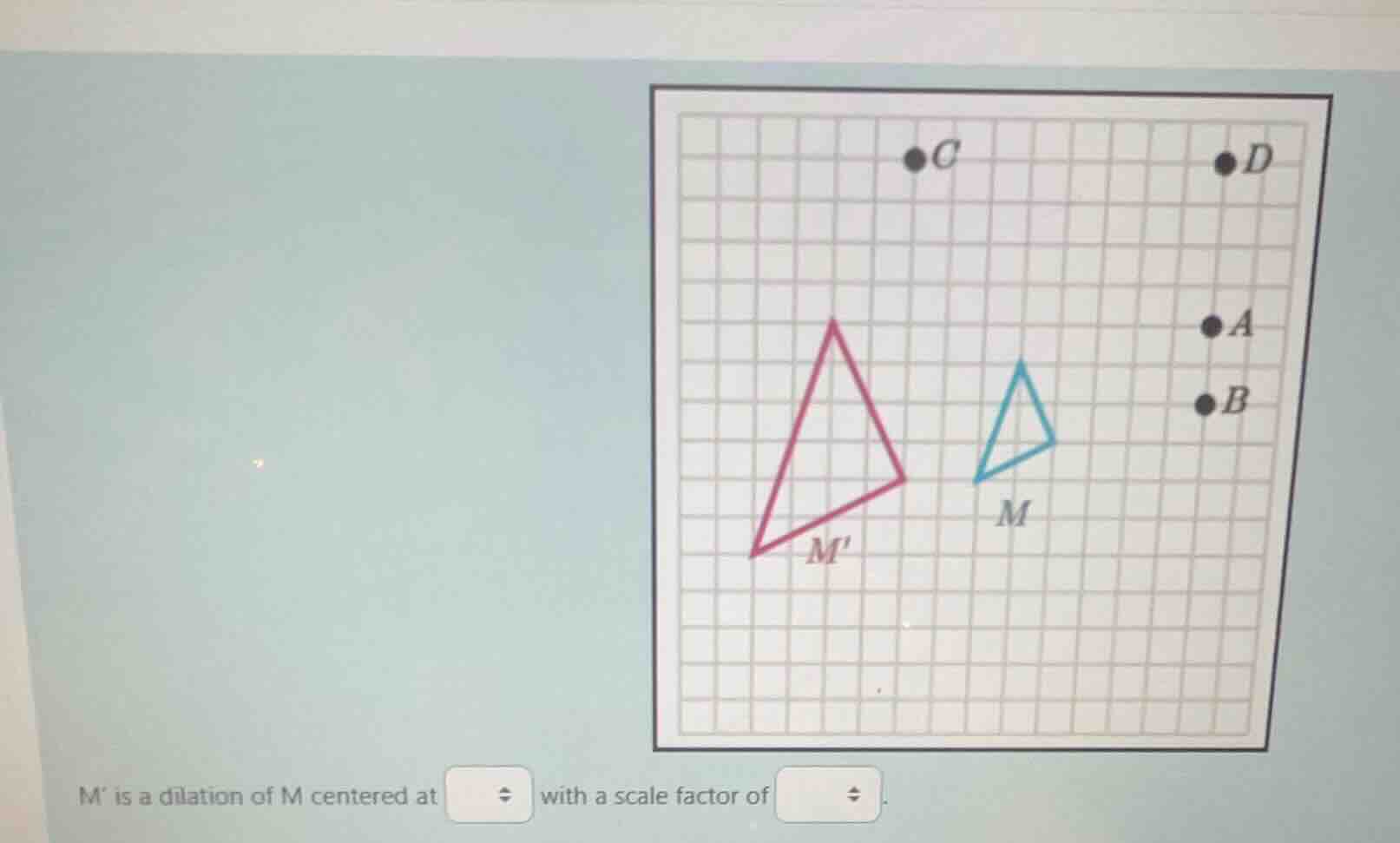
m is a dilation of m centered at with a scale factor of .
⚡ Using what you learned: dilations and scale factors
Step 1: Find the scale factor
Compare the corresponding side lengths or dimensions of the original triangle \(M\) (blue) and the dilated image \(M'\) (pink).
- The base of the original triangle \(M\) spans from its bottom-left vertex to its bottom-right vertex:
- Horizontal distance = \(2\) grid units.
- Vertical distance = \(1\) grid unit.
- The base of the dilated triangle \(M'\) spans from its bottom-left vertex to its bottom-right vertex:
- Horizontal distance = \(4\) grid units.
- Vertical distance = \(2\) grid units.
Step 2: Determine the center of dilation
Let the coordinates of the grid be defined by setting an arbitrary origin, or use the projection lines connecting corresponding vertices of \(M'\) and \(M\). The lines must intersect at the center of dilation.
Let's trace the lines through corresponding vertices:
- Top vertices:
- Top vertex of \(M'\) is at some position.
- Top vertex of \(M\) is to its right and lower.
- Line through top vertices: passes through point \(D\).
- Bottom-left vertices:
- Bottom-left vertex of \(M'\) to bottom-left vertex of \(M\).
- Line through these vertices: passes through point \(D\).
- Bottom-right vertices:
- Bottom-right vertex of \(M'\) to bottom-right vertex of \(M\).
- Line through these vertices: passes through point \(D\).
Since all lines connecting corresponding vertices of the pre-image and image intersect at point \(D\), \(D\) is the center of dilation.

Snap & solve any problem in the app
Get step-by-step solutions on Sovi AI
Photo-based solutions with guided steps
Explore more problems and detailed explanations
\(M'\) is a dilation of \(M\) centered at D with a scale factor of 2.