QUESTION IMAGE
Question
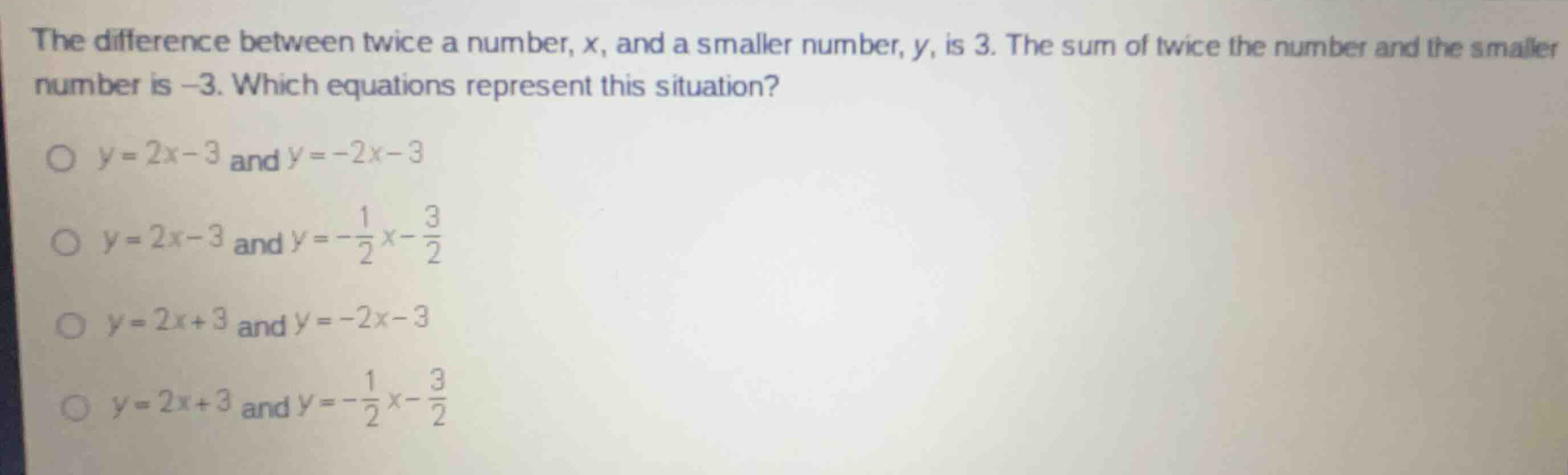
the difference between twice a number, \\(x\\), and a smaller number, \\(y\\), is 3. the sum of twice the number and the smaller number is \\(-3\\). which equations represent this situation?
\\(y = 2x - 3\\) and \\(y = -2x - 3\\)
\\(y = 2x - 3\\) and \\(y = -\frac{1}{2}x - \frac{3}{2}\\)
\\(y = 2x + 3\\) and \\(y = -2x - 3\\)
\\(y = 2x + 3\\) and \\(y = -\frac{1}{2}x - \frac{3}{2}\\)
Identify variables and translate the first statement
Using the Variable Identification and Algebraic Translation knowledge points
The problem defines:
- Larger number: \(x\)
- Smaller number: \(y\)
The first statement is: "The difference between twice a number, \(x\), and a smaller number, \(y\), is 3."
Translate the second statement
Using the Algebraic Translation knowledge point
The second statement is: "The sum of twice the number and the smaller number is \(-3\)."
Convert the first equation to slope-intercept form
Using the Slope-Intercept Form knowledge point
Convert the second equation to slope-intercept form
Using the Slope-Intercept Form knowledge point
Match with the given options
Using the Slope-Intercept Form knowledge point
The system of equations in slope-intercept form is:
This matches the first option.

Snap & solve any problem in the app
Get step-by-step solutions on Sovi AI
Photo-based solutions with guided steps
Explore more problems and detailed explanations
- (A) \(y = 2x - 3\) and \(y = -2x - 3\) (Correct answer)
- (B) \(y = 2x - 3\) and \(y = -\frac{1}{2}x - \frac{3}{2}\)
- (C) \(y = 2x + 3\) and \(y = -2x - 3\)
- (D) \(y = 2x + 3\) and \(y = -\frac{1}{2}x - \frac{3}{2}\)