QUESTION IMAGE
Question
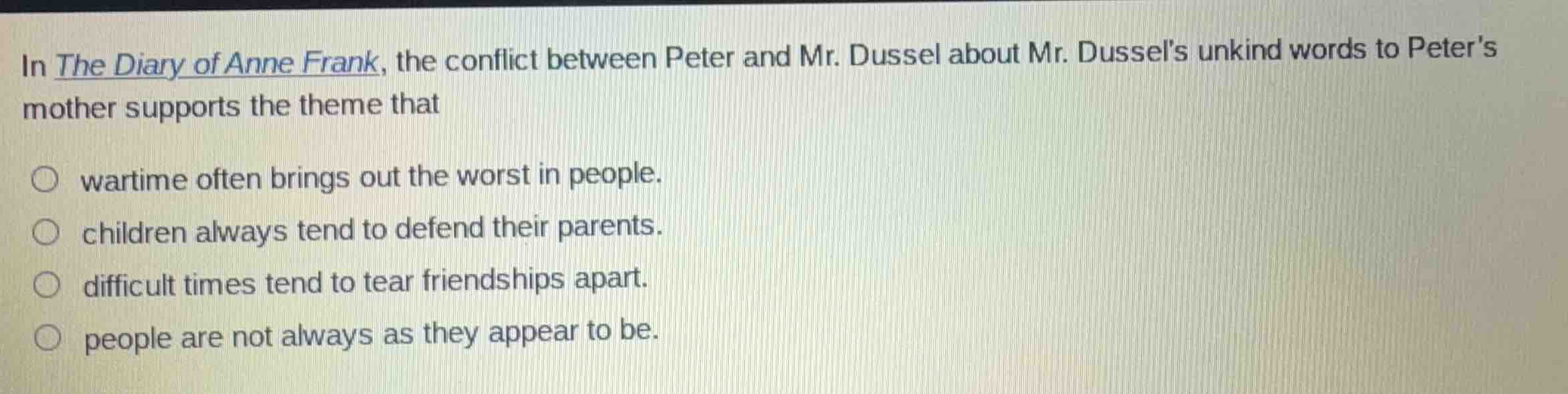
in the diary of anne frank, the conflict between peter and mr. dussel about mr. dussels unkind words to peters mother supports the theme that
wartime often brings out the worst in people.
children always tend to defend their parents.
difficult times tend to tear friendships apart.
people are not always as they appear to be.
<pre_analysis>
{
"quality": "clear",
"question_count": 1,
"skills_matched": [
"direct_cot",
"multiple_choice_formatter",
"explain_then_answer",
"tutor"
],
"needs_drawing": false,
"concepts_used": [
"Interpersonal Conflict",
"Theme Analysis"
],
"new_concepts": [],
"current_concepts": [
"Interpersonal Conflict",
"Theme Analysis",
"Drama Analysis"
]
}
</pre_analysis>
<reasoning>
Analyze the conflict
The question asks about the conflict in The Diary of Anne Frank between Peter and Mr. Dussel regarding Mr. Dussel's unkind words to Peter's mother (Mrs. Van Daan). This is a clear example of Interpersonal Conflict within the play, where the high-stress environment of the Secret Annex causes friction between the residents.
Connect conflict to theme
When analyzing how this specific conflict supports a broader theme, we look at the underlying message of the play. The constant bickering, unkind remarks, and defensive reactions among the characters in hiding demonstrate how the extreme pressure of living in hiding during a war degrades people's patience and kindness. This directly supports the Theme Analysis that wartime and confinement often bring out the worst in people.
Evaluate the options
- Option 1 ("wartime often brings out the worst in people"): This aligns perfectly with how the stress of war and confinement causes normally decent people to lash out and speak unkindly to one another.
- Option 2 ("children always tend to defend their parents"): While Peter defends his mother, the word "always" makes this too broad and not the primary thematic focus of this specific, stress-induced conflict.
- Option 3 ("difficult times tend to tear friendships apart"): Peter and Mr. Dussel were never friends, so this conflict does not represent a torn friendship.
- Option 4 ("people are not always as they appear to be"): This option is about deception or hidden character traits, which is not the primary focus of this direct confrontation.
</reasoning>
<answer>
<mcq-correct>(A) wartime often brings out the worst in people.</mcq-correct>
<mcq-option>(B) children always tend to defend their parents.</mcq-option>
<mcq-option>(C) difficult times tend to tear friendships apart.</mcq-option>
<mcq-option>(D) people are not always as they appear to be.</mcq-option>
</answer>
<post_analysis>
{
"subject": "Arts",
"question_type": "Multiple Choice",
"knowledge_point": [
"Arts",
"Drama Analysis",
"Theme Analysis"
]
}
</post_analysis>
Snap & solve any problem in the app
Get step-by-step solutions on Sovi AI
Photo-based solutions with guided steps
Explore more problems and detailed explanations
<pre_analysis>
{
"quality": "clear",
"question_count": 1,
"skills_matched": [
"direct_cot",
"multiple_choice_formatter",
"explain_then_answer",
"tutor"
],
"needs_drawing": false,
"concepts_used": [
"Interpersonal Conflict",
"Theme Analysis"
],
"new_concepts": [],
"current_concepts": [
"Interpersonal Conflict",
"Theme Analysis",
"Drama Analysis"
]
}
</pre_analysis>
<reasoning>
Analyze the conflict
The question asks about the conflict in The Diary of Anne Frank between Peter and Mr. Dussel regarding Mr. Dussel's unkind words to Peter's mother (Mrs. Van Daan). This is a clear example of Interpersonal Conflict within the play, where the high-stress environment of the Secret Annex causes friction between the residents.
Connect conflict to theme
When analyzing how this specific conflict supports a broader theme, we look at the underlying message of the play. The constant bickering, unkind remarks, and defensive reactions among the characters in hiding demonstrate how the extreme pressure of living in hiding during a war degrades people's patience and kindness. This directly supports the Theme Analysis that wartime and confinement often bring out the worst in people.
Evaluate the options
- Option 1 ("wartime often brings out the worst in people"): This aligns perfectly with how the stress of war and confinement causes normally decent people to lash out and speak unkindly to one another.
- Option 2 ("children always tend to defend their parents"): While Peter defends his mother, the word "always" makes this too broad and not the primary thematic focus of this specific, stress-induced conflict.
- Option 3 ("difficult times tend to tear friendships apart"): Peter and Mr. Dussel were never friends, so this conflict does not represent a torn friendship.
- Option 4 ("people are not always as they appear to be"): This option is about deception or hidden character traits, which is not the primary focus of this direct confrontation.
</reasoning>
<answer>
<mcq-correct>(A) wartime often brings out the worst in people.</mcq-correct>
<mcq-option>(B) children always tend to defend their parents.</mcq-option>
<mcq-option>(C) difficult times tend to tear friendships apart.</mcq-option>
<mcq-option>(D) people are not always as they appear to be.</mcq-option>
</answer>
<post_analysis>
{
"subject": "Arts",
"question_type": "Multiple Choice",
"knowledge_point": [
"Arts",
"Drama Analysis",
"Theme Analysis"
]
}
</post_analysis>