QUESTION IMAGE
Question
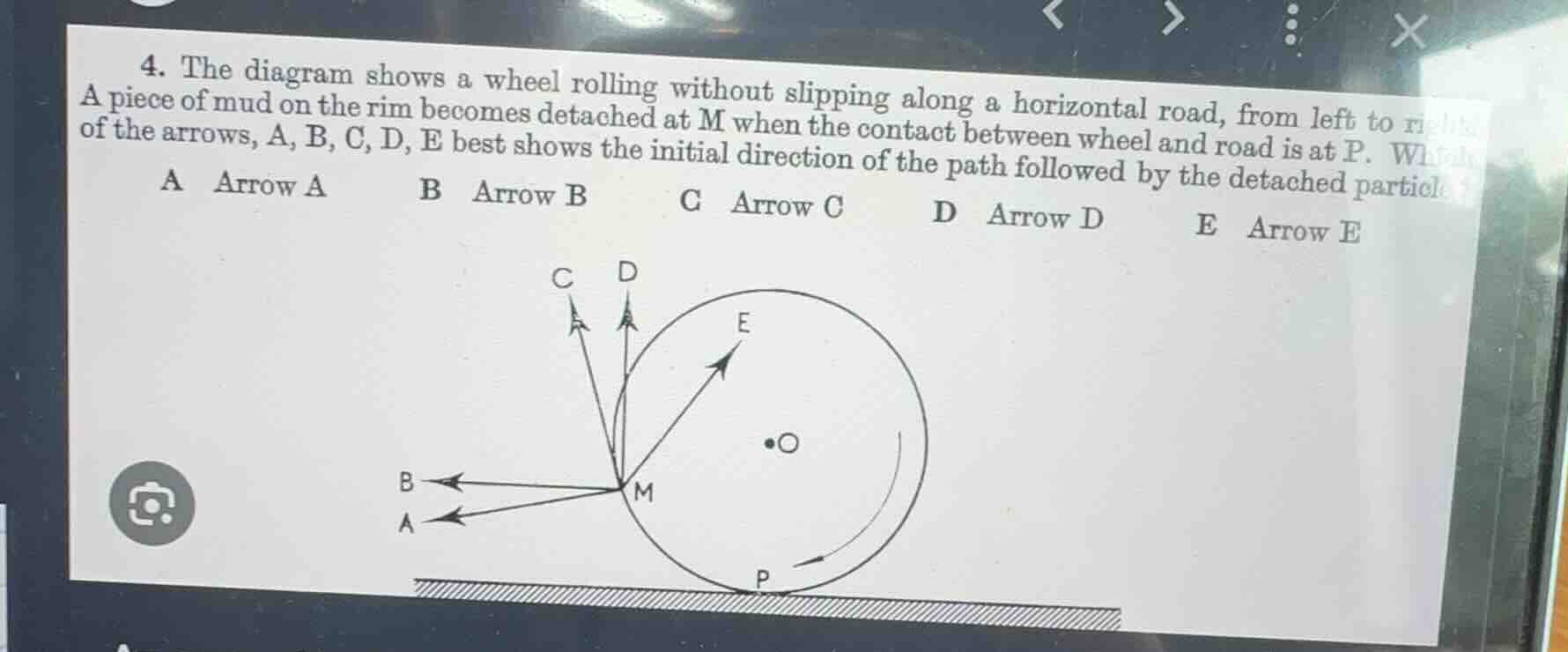
- the diagram shows a wheel rolling without slipping along a horizontal road, from left to right. a piece of mud on the rim becomes detached at m when the contact between wheel and road is at p. which of the arrows, a, b, c, d, e best shows the initial direction of the path followed by the detached particle?
a arrow a
b arrow b
c arrow c
d arrow d
e arrow e
Identify the instantaneous center of rotation
The wheel rolls without slipping on the horizontal road.
The point of contact with the ground is \(P\).
Therefore, \(P\) is the instantaneous center of rotation (ICR).
Determine the velocity vector of point M
Every point on the wheel rotates instantaneously about \(P\).
The velocity vector of any point is perpendicular to the line connecting that point to \(P\).
For point \(M\), the line segment is \(PM\).
The velocity vector \(\vec{v}_M\) must be perpendicular to \(PM\).
Analyze the direction of rotation
The wheel rolls from left to right.
This means the wheel rotates clockwise about its center \(O\).
The instantaneous rotation about \(P\) is also clockwise.
Therefore, the velocity vector \(\vec{v}_M\) must point upwards and to the left.
Match the perpendicular direction to the options
The line segment \(PM\) goes upwards and to the left from \(P\) to \(M\).
A vector perpendicular to \(PM\) pointing in the direction of clockwise rotation must point upwards and to the left.
Looking at the arrows at \(M\):
- Arrow \(C\) is perpendicular to the line segment \(PM\).
- Arrow \(D\) is vertical.
- Arrow \(B\) is horizontal.
- Arrow \(A\) points downwards and to the left.
- Arrow \(E\) points inwards.
Thus, Arrow \(C\) represents the direction perpendicular to \(PM\).

Snap & solve any problem in the app
Get step-by-step solutions on Sovi AI
Photo-based solutions with guided steps
Explore more problems and detailed explanations
- A Arrow A
- B Arrow B
- C Arrow C (Correct answer)
- D Arrow D
- E Arrow E