QUESTION IMAGE
Question
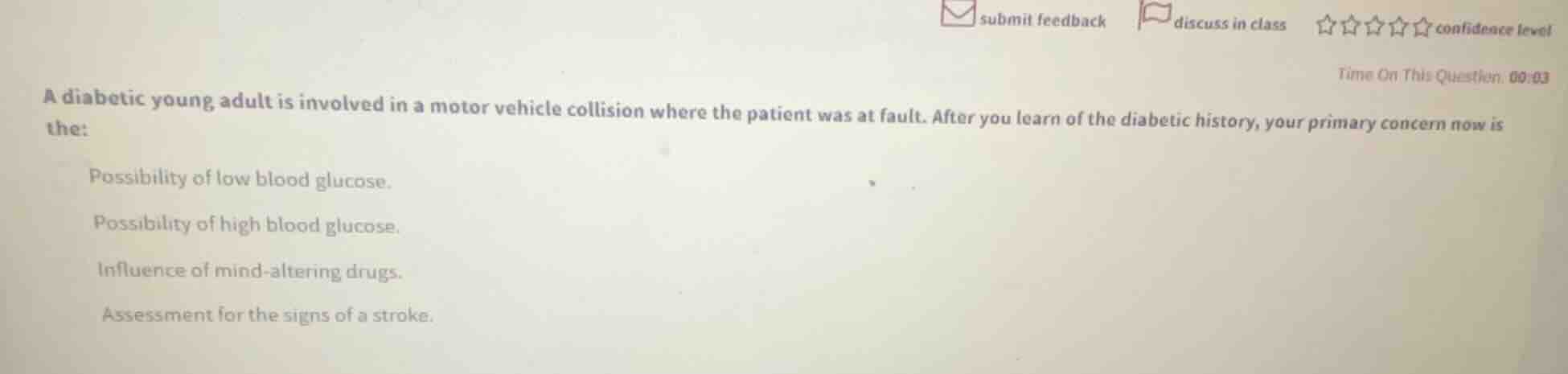
a diabetic young adult is involved in a motor vehicle collision where the patient was at fault. after you learn of the diabetic history, your primary concern now is the:
possibility of low blood glucose.
possibility of high blood glucose.
influence of mind-altering drugs.
assessment for the signs of a stroke.
Analyze the clinical scenario
Using the Diabetic Emergencies Onset and Hypoglycemia Pathophysiology knowledge points
- Hypoglycemia (low blood glucose) has a rapid onset and can quickly cause altered mental status, confusion, disorientation, or loss of consciousness.
- A sudden drop in blood glucose can impair a driver's cognitive and motor functions, leading to erratic driving and causing a motor vehicle collision.
- Hyperglycemia (high blood glucose) typically develops much more slowly over hours or days, making it less likely to cause a sudden, acute driving impairment without prior warning signs.
Evaluate the options
Using the Hypoglycemia Pathophysiology knowledge point
- Possibility of low blood glucose: This is the primary concern because acute hypoglycemia can immediately impair driving ability and explain why the patient was at fault.
- Possibility of high blood glucose: Less likely to cause sudden, acute impairment leading to a crash compared to rapid-onset hypoglycemia.
- Influence of mind-altering drugs: While possible, the known medical history of diabetes points directly to a metabolic cause first.
- Assessment for the signs of a stroke: Although stroke can cause acute impairment, the patient's known history of diabetes makes hypoglycemia the most immediate and easily treatable differential diagnosis to rule out.

Snap & solve any problem in the app
Get step-by-step solutions on Sovi AI
Photo-based solutions with guided steps
Explore more problems and detailed explanations
- Possibility of low blood glucose. (Correct answer)
- Possibility of high blood glucose.
- Influence of mind-altering drugs.
- Assessment for the signs of a stroke.