QUESTION IMAGE
Question
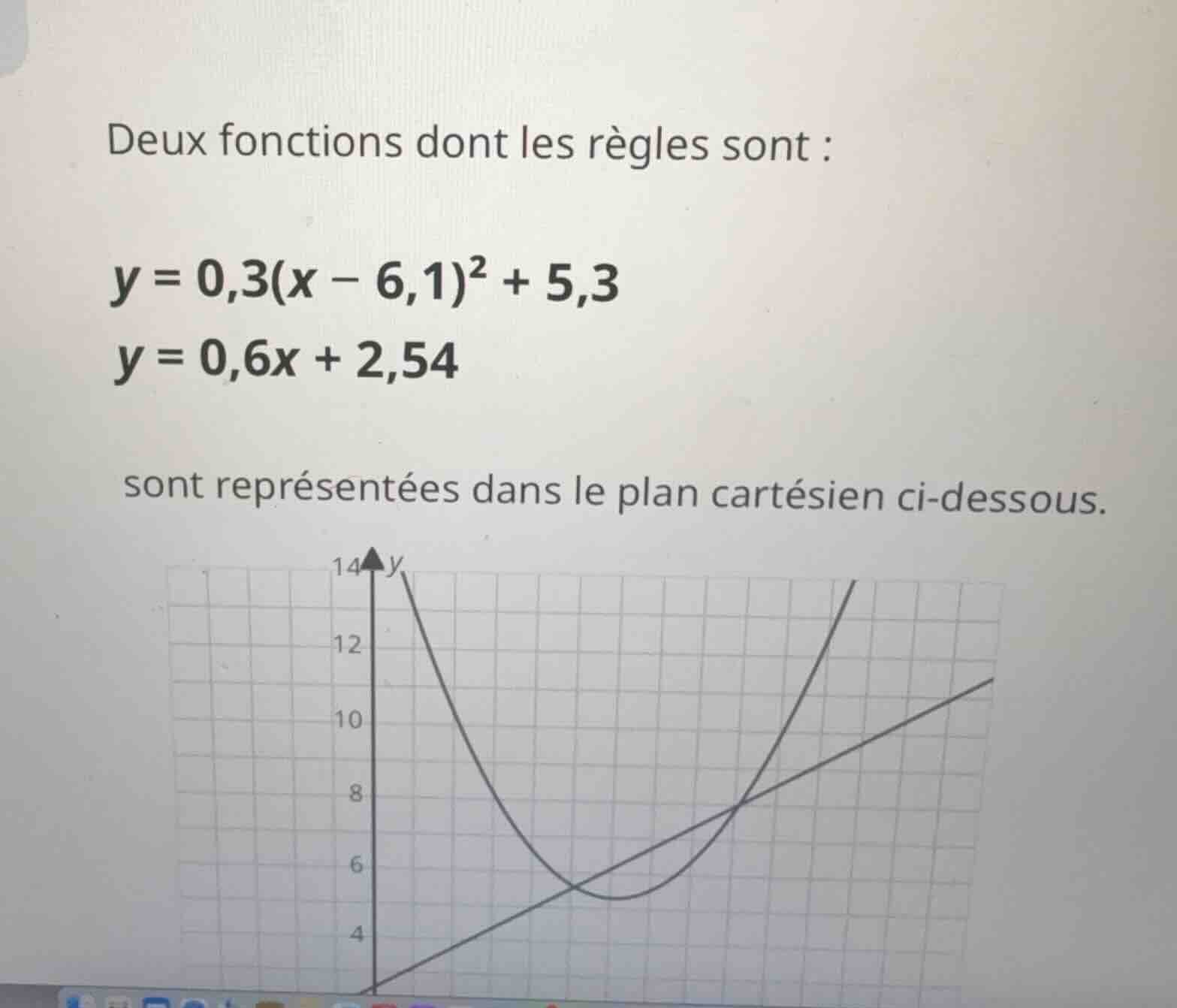
deux fonctions dont les règles sont :
y = 0,3(x - 6,1)² + 5,3
y = 0,6x + 2,54
sont représentées dans le plan cartésien ci-dessous.
To find the intersection points of the two functions \( y = 0.3(x - 6.1)^2 + 5.3 \) and \( y = 0.6x + 2.54 \), we set them equal to each other:
Step 1: Set the equations equal
Step 2: Expand the square
First, expand \( (x - 6.1)^2 \):
Substitute back into the equation:
Step 3: Distribute the 0.3
Step 4: Combine like terms
Subtract \( 0.6x \) and \( 2.54 \) from both sides:
Step 5: Multiply through by 1000 to eliminate decimals (optional, but easier)
We can simplify by dividing by 3:
Step 6: Use the quadratic formula \( x = \frac{-b \pm \sqrt{b^2 - 4ac}}{2a} \)
Here, \( a = 100 \), \( b = -1420 \), \( c = 4641 \)
First, calculate the discriminant \( \Delta \):
Then, find \( x \):
Step 7: Calculate the two solutions for \( x \)
First solution:
Second solution:
Step 8: Find the corresponding \( y \)-values
For \( x = 9.1 \):
For \( x = 5.1 \):
So the intersection points are \( (5.1, 5.6) \) and \( (9.1, 8) \).

Snap & solve any problem in the app
Get step-by-step solutions on Sovi AI
Photo-based solutions with guided steps
Explore more problems and detailed explanations
Les points d'intersection sont \( \boldsymbol{(5.1, 5.6)} \) et \( \boldsymbol{(9.1, 8)} \)