Sovi.AI - AI Math Tutor

Scan to solve math questions

QUESTION IMAGE

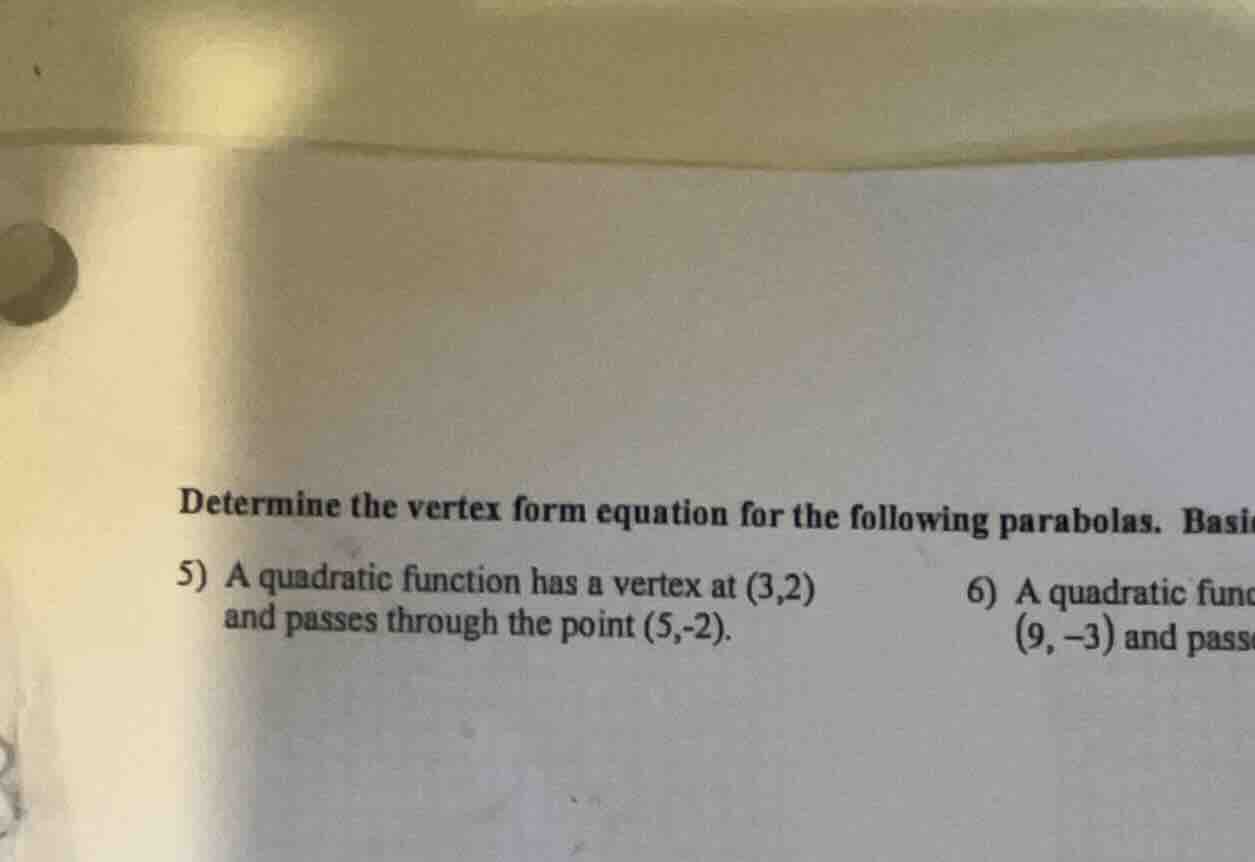
determine the vertex form equation for the following parabolas. 5) a qu…

Question

determine the vertex form equation for the following parabolas.

  1. a quadratic function has a vertex at (3,2) and passes through the point (5,-2).

Explanation:

Response

<pre_analysis>
{
"quality": "clear",
"question_count": 1,
"skills_matched": [
"step_cot",
"explain_then_answer",
"tutor"
],
"needs_drawing": true,
"concepts_used": [
"Quadratic Vertex Form"
],
"new_concepts": [
"Determining Quadratic Equations"
],
"current_concepts": [
"Quadratic Vertex Form",
"Determining Quadratic Equations"
]
}
</pre_analysis>

<reasoning>

Identify the vertex form equation

We need to find the vertex form of a quadratic function.
The standard vertex form of a parabola is:
\[y = a(x - h)^2 + k\]
where \((h, k)\) represents the coordinates of the vertex.
We are given the vertex \((h, k) = (3, 2)\).
Substituting these values into our equation yields:
\[y = a(x - 3)^2 + 2\]

Substitute the given point to find the leading coefficient

To find the value of the leading coefficient \(a\), we use the given point \((5, -2)\) that lies on the parabola.
We substitute \(x = 5\) and \(y = -2\) into the equation:
\[-2 = a(5 - 3)^2 + 2\]

Solve for the coefficient a

Now we simplify the equation to solve for \(a\):
\[-2 = a(2)^2 + 2\]
\[-2 = 4a + 2\]
Subtract 2 from both sides:
\[-4 = 4a\]
Divide by 4:
\[a = -1\]

Write the final quadratic equation

Now we substitute the value of \(a = -1\) back into our vertex form equation:
\[y = -(x - 3)^2 + 2\]
This represents the final equation of the parabola.
</reasoning>

<answer>
\[y = -(x - 3)^2 + 2\]
</answer>

<plot>
{
"elements": [
{
"type": "point",
"params": [[3, 2]],
"properties": {
"name": "Vertex (3,2)",
"size": 4,
"color": "#8C55F2",
"withLabel": true
}
},
{
"type": "point",
"params": [[5, -2]],
"properties": {
"name": "Point (5,-2)",
"size": 4,
"color": "#F2557F",
"withLabel": true
}
},
{
"type": "functiongraph",
"params": [{"js": "-1*Math.pow(x-3, 2) + 2", "latex": "y = -(x-3)^2 + 2"}, -1, 7],
"properties": {
"strokeColor": "#8C55F2",
"strokeWidth": 2
}
}
]
}
</plot>

<post_analysis>
{
"subject": "Mathematics",
"question_type": "Free Response",
"knowledge_point": [
"Mathematics",
"Algebra",
"Quadratic Vertex Form"
]
}
</post_analysis>

Answer:

<pre_analysis>
{
"quality": "clear",
"question_count": 1,
"skills_matched": [
"step_cot",
"explain_then_answer",
"tutor"
],
"needs_drawing": true,
"concepts_used": [
"Quadratic Vertex Form"
],
"new_concepts": [
"Determining Quadratic Equations"
],
"current_concepts": [
"Quadratic Vertex Form",
"Determining Quadratic Equations"
]
}
</pre_analysis>

<reasoning>

Identify the vertex form equation

We need to find the vertex form of a quadratic function.
The standard vertex form of a parabola is:
\[y = a(x - h)^2 + k\]
where \((h, k)\) represents the coordinates of the vertex.
We are given the vertex \((h, k) = (3, 2)\).
Substituting these values into our equation yields:
\[y = a(x - 3)^2 + 2\]

Substitute the given point to find the leading coefficient

To find the value of the leading coefficient \(a\), we use the given point \((5, -2)\) that lies on the parabola.
We substitute \(x = 5\) and \(y = -2\) into the equation:
\[-2 = a(5 - 3)^2 + 2\]

Solve for the coefficient a

Now we simplify the equation to solve for \(a\):
\[-2 = a(2)^2 + 2\]
\[-2 = 4a + 2\]
Subtract 2 from both sides:
\[-4 = 4a\]
Divide by 4:
\[a = -1\]

Write the final quadratic equation

Now we substitute the value of \(a = -1\) back into our vertex form equation:
\[y = -(x - 3)^2 + 2\]
This represents the final equation of the parabola.
</reasoning>

<answer>
\[y = -(x - 3)^2 + 2\]
</answer>

<plot>
{
"elements": [
{
"type": "point",
"params": [[3, 2]],
"properties": {
"name": "Vertex (3,2)",
"size": 4,
"color": "#8C55F2",
"withLabel": true
}
},
{
"type": "point",
"params": [[5, -2]],
"properties": {
"name": "Point (5,-2)",
"size": 4,
"color": "#F2557F",
"withLabel": true
}
},
{
"type": "functiongraph",
"params": [{"js": "-1*Math.pow(x-3, 2) + 2", "latex": "y = -(x-3)^2 + 2"}, -1, 7],
"properties": {
"strokeColor": "#8C55F2",
"strokeWidth": 2
}
}
]
}
</plot>

<post_analysis>
{
"subject": "Mathematics",
"question_type": "Free Response",
"knowledge_point": [
"Mathematics",
"Algebra",
"Quadratic Vertex Form"
]
}
</post_analysis>