QUESTION IMAGE
Question
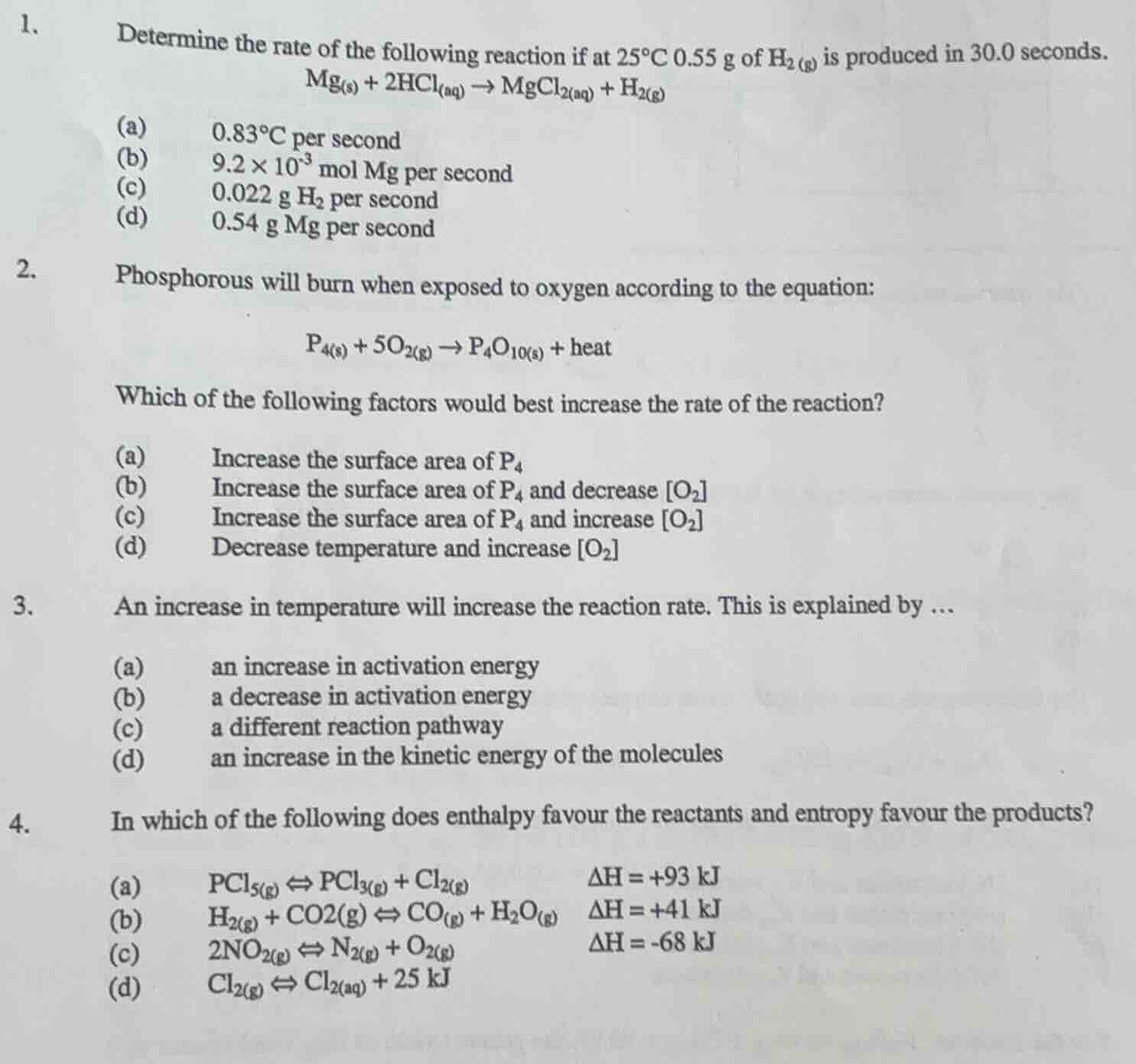
- determine the rate of the following reaction if at 25°c 0.55 g of \\(\text{h}_{2(g)}\\) is produced in 30.0 seconds.
\\(\text{mg}_{(s)} + 2\text{hcl}_{(aq)} \
ightarrow \text{mgcl}_{2(aq)} + \text{h}_{2(g)}\\)
(a) \\(0.83^\circ\text{c}\\) per second
(b) \\(9.2 \times 10^{-3}\text{ mol mg}\\) per second
(c) \\(0.022\text{ g h}_2\\) per second
(d) \\(0.54\text{ g mg}\\) per second
- phosphorous will burn when exposed to oxygen according to the equation:
\\(\text{p}_{4(s)} + 5\text{o}_{2(g)} \
ightarrow \text{p}_4\text{o}_{10(s)} + \text{heat}\\)
which of the following factors would best increase the rate of the reaction?
(a) increase the surface area of \\(\text{p}_4\\)
(b) increase the surface area of \\(\text{p}_4\\) and decrease \\(\text{o}_2\\)
(c) increase the surface area of \\(\text{p}_4\\) and increase \\(\text{o}_2\\)
(d) decrease temperature and increase \\(\text{o}_2\\)
- an increase in temperature will increase the reaction rate. this is explained by ...
(a) an increase in activation energy
(b) a decrease in activation energy
(c) a different reaction pathway
(d) an increase in the kinetic energy of the molecules
- in which of the following does enthalpy favour the reactants and entropy favour the products?
(a) \\(\text{pcl}_{5(g)} \leftrightarrow \text{pcl}_{3(g)} + \text{cl}_{2(g)}\\) \\(\delta h = +93\text{ kj}\\)
(b) \\(\text{h}_{2(g)} + \text{co}_{2(g)} \leftrightarrow \text{co}_{(g)} + \text{h}_2\text{o}_{(g)}\\) \\(\delta h = +41\text{ kj}\\)
(c) \\(2\text{no}_{2(g)} \leftrightarrow \text{n}_{2(g)} + \text{o}_{2(g)}\\) \\(\delta h = -68\text{ kj}\\)
(d) \\(\text{cl}_{2(g)} \leftrightarrow \text{cl}_{2(aq)} + 25\text{ kj}\\)
Calculate rate for Question 1
We are given \(0.55\text{ g}\) of \(\text{H}_2\) produced in \(30.0\text{ s}\).
First, calculate the rate in \(\text{g H}_2/\text{s}\):
This does not match option (c).
Next, convert the mass of \(\text{H}_2\) to moles of \(\text{Mg}\) using stoichiometry:
Since the mole ratio of \(\text{Mg}\) to \(\text{H}_2\) is \(1:1\):
Now, calculate the rate in \(\text{mol Mg/s}\):
This closely matches option (b) (\(9.2 \times 10^{-3}\text{ mol Mg per second}\)).
Analyze factors for Question 2
The reaction is:
To increase the rate of a heterogeneous reaction involving a solid reactant (\(\text{P}_4\)) and a gaseous reactant (\(\text{O}_2\)):
- Increasing the surface area of the solid (\(\text{P}_4\)) increases collision frequency.
- Increasing the concentration of the gas (\([\text{O}_2]\)) increases collision frequency.
Thus, increasing both will best increase the rate, matching option (c).
Analyze temperature effect for Question 3
An increase in temperature increases the average kinetic energy of the molecules.
This increases the fraction of molecules with energy greater than the activation energy, thereby increasing the reaction rate.
This matches option (d).
Analyze thermodynamic favorability for Question 4
We need to find where enthalpy (\(\Delta H\)) favors reactants and entropy (\(\Delta S\)) favors products:
- Enthalpy favors reactants when the reaction is endothermic (\(\Delta H > 0\)).
- Entropy favors products when the products have more disorder (e.g., more moles of gas) than the reactants (\(\Delta S > 0\)).
Let's evaluate the options:
- (a) \(\text{PCl}_{5(g)}
ightleftharpoons \text{PCl}_{3(g)} + \text{Cl}_{2(g)}\), \(\Delta H = +93\text{ kJ}\)
- \(\Delta H > 0\) (endothermic, favors reactants).
- Reactants: \(1\text{ mol}\) of gas. Products: \(2\text{ mol}\) of gas. Thus, \(\Delta S > 0\) (favors products).
- This matches both conditions.

Snap & solve any problem in the app
Get step-by-step solutions on Sovi AI
Photo-based solutions with guided steps
Explore more problems and detailed explanations
Question 1
- (a) \(0.83^\circ\text{C}\) per second
- (b) \(9.2 \times 10^{-3}\text{ mol Mg}\) per second (Correct answer)
- (c) \(0.022\text{ g H}_2\) per second
- (d) \(0.54\text{ g Mg}\) per second
Question 2
- (a) Increase the surface area of \(\text{P}_4\)
- (b) Increase the surface area of \(\text{P}_4\) and decrease \([\text{O}_2]\)
- (c) Increase the surface area of \(\text{P}_4\) and increase \([\text{O}_2]\) (Correct answer)
- (d) Decrease temperature and increase \([\text{O}_2]\)
Question 3
- (a) an increase in activation energy
- (b) a decrease in activation energy
- (c) a different reaction pathway
- (d) an increase in the kinetic energy of the molecules (Correct answer)
Question 4
- **(a) \(\text{PCl}_{5(g)}
ightleftharpoons \text{PCl}_{3(g)} + \text{Cl}_{2(g)} \quad \Delta H = +93\text{ kJ}\) (Correct answer)**
- (b) \(\text{H}_{2(g)} + \text{CO}_{2(g)}
ightleftharpoons \text{CO}_{g} + \text{H}_2\text{O}_{(g)} \quad \Delta H = +41\text{ kJ}\)
- (c) \(2\text{NO}_{2(g)}
ightleftharpoons \text{N}_{2(g)} + \text{O}_{2(g)} \quad \Delta H = -68\text{ kJ}\)
- (d) \(\text{Cl}_{2(g)}
ightleftharpoons \text{Cl}_{2(aq)} + 25\text{ kJ}\)