QUESTION IMAGE
Question
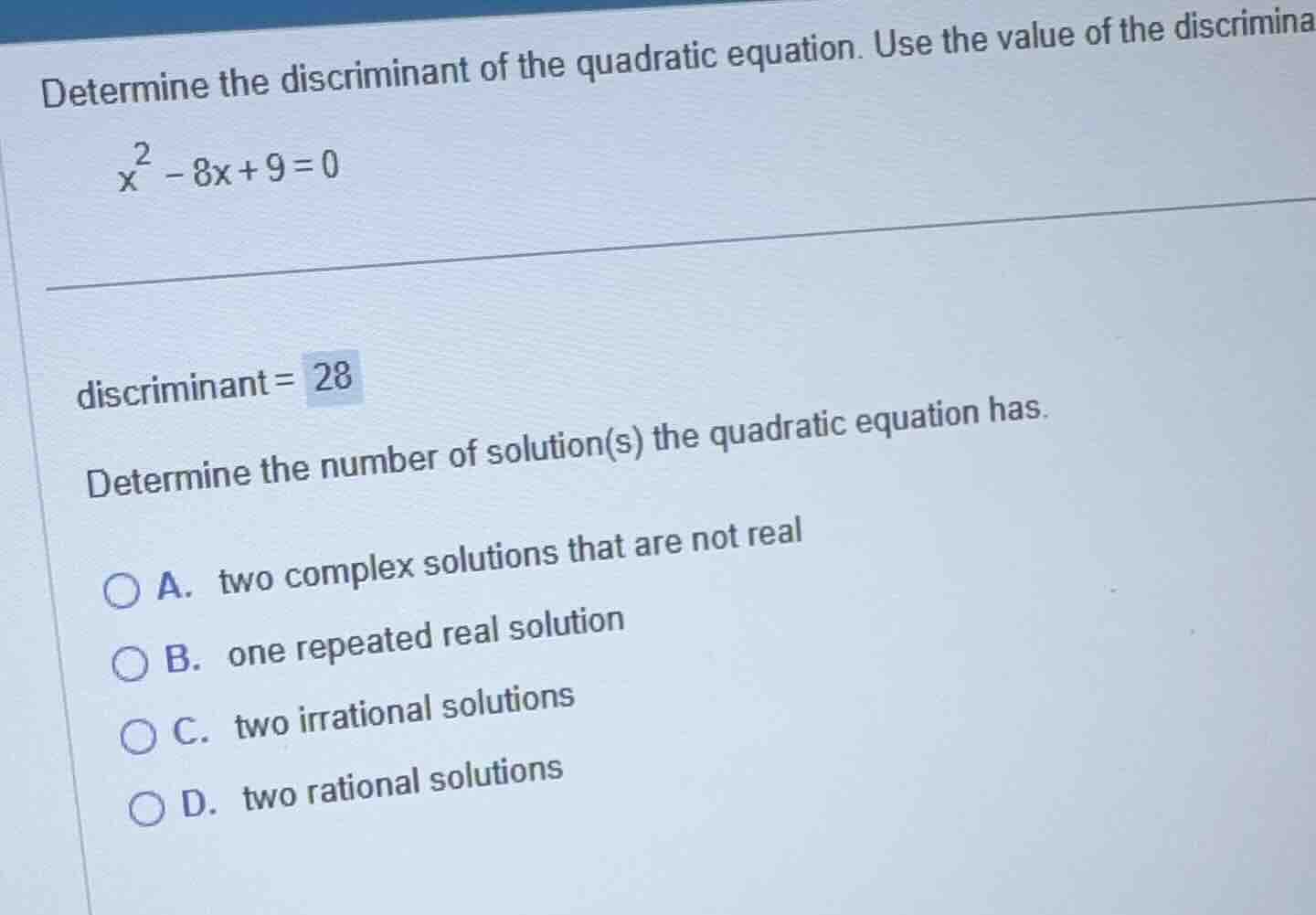
determine the discriminant of the quadratic equation. use the value of the discriminant to determine the number of solution(s) the quadratic equation has.
(x^2 - 8x + 9 = 0)
discriminant = 28
determine the number of solution(s) the quadratic equation has.
a. two complex solutions that are not real
b. one repeated real solution
c. two irrational solutions
d. two rational solutions
⚡ Using what you learned: quadratic formula and its applications
Step 1: Identify coefficients
For the quadratic equation \(x^2 - 8x + 9 = 0\):
Step 2: Calculate the discriminant
The discriminant formula is \(D = b^2 - 4ac\):
Step 3: Determine the nature of the solutions
Since the discriminant \(D = 28\) is:
- Positive (\(D > 0\)): There are two distinct real solutions.
- Not a perfect square: The square root of the discriminant, \(\sqrt{28}\), is irrational, which means the solutions will be irrational.
Therefore, the equation has two irrational solutions.

Snap & solve any problem in the app
Get step-by-step solutions on Sovi AI
Photo-based solutions with guided steps
Explore more problems and detailed explanations
- discriminant = \(28\)
- Number of solution(s): C. two irrational solutions