QUESTION IMAGE
Question
describing limitations of kinetic-molecular theory
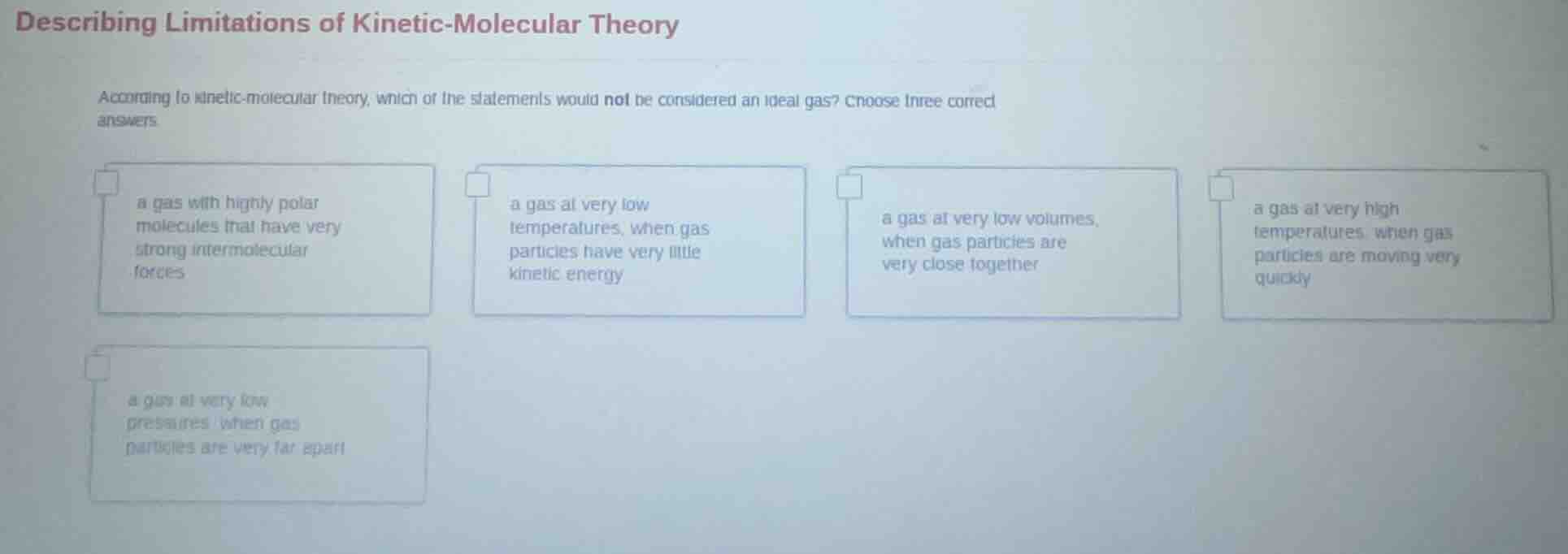
according to kinetic-molecular theory, which of the statements would not be considered an ideal gas? choose three correct answers.
- a gas with highly polar molecules that have very strong intermolecular forces
- a gas at very low temperatures, when gas particles have very little kinetic energy
- a gas at very low volumes, when gas particles are very close together
- a gas at very high temperatures, when gas particles are moving very quickly
- a gas at very low pressures, when gas particles are very far apart
Identify ideal gas assumptions
According to Kinetic Molecular Theory, ideal gases assume particles have negligible volume and no intermolecular attractions.
Analyze polar molecules
Using the Ideal Gas Behavior concept, highly polar molecules with strong intermolecular forces deviate from ideal behavior because they attract each other.
Analyze low temperature
At very low temperatures, particles move slowly, allowing intermolecular attractions to pull them together, causing non-ideal behavior.
Analyze low volume
At very low volumes, gas particles are forced close together, making their actual molecular volume significant, which violates ideal assumptions.
Evaluate remaining options
High temperatures and low pressures keep particles moving fast and far apart, which perfectly maintains ideal gas behavior.

Snap & solve any problem in the app
Get step-by-step solutions on Sovi AI
Photo-based solutions with guided steps
Explore more problems and detailed explanations
- a gas with highly polar molecules that have very strong intermolecular forces (Correct answer)
- a gas at very low temperatures, when gas particles have very little kinetic energy (Correct answer)
- a gas at very low volumes, when gas particles are very close together (Correct answer)
- a gas at very high temperatures, when gas particles are moving very quickly
- a gas at very low pressures, when gas particles are very far apart