QUESTION IMAGE
Question
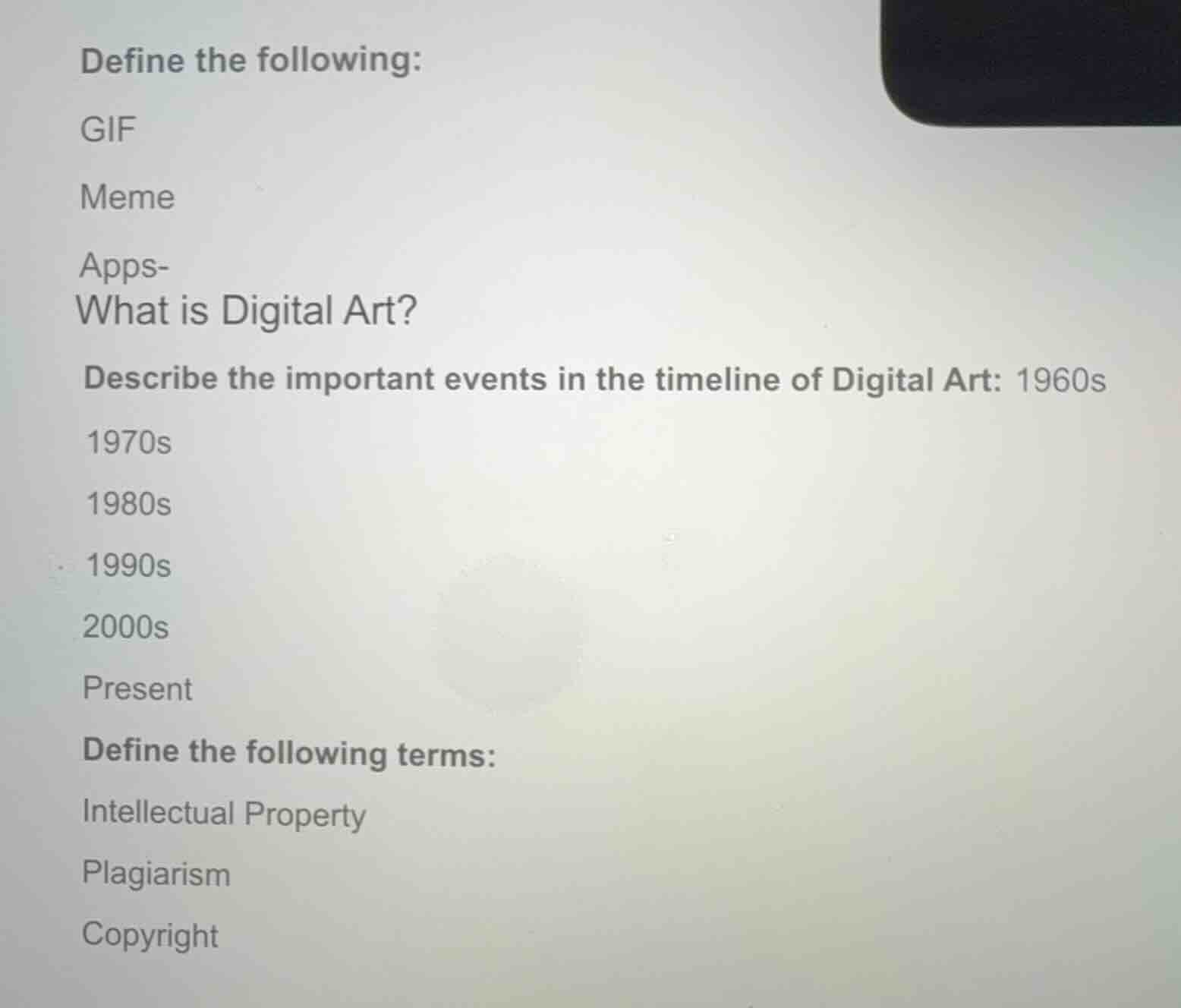
define the following:
gif
meme
apps-
what is digital art?
describe the important events in the timeline of digital art: 1960s
1970s
1980s
1990s
2000s
present
define the following terms:
intellectual property
plagiarism
copyright
Define media terms
We define GIF, Meme, and Apps in the context of digital art and communication. A GIF (Graphics Interchange Format) is a bitmap image format supporting animated and static images. A Meme is a cultural item shared and modified online. Apps are software applications designed for specific tasks, including digital creation.
Define Digital Art
Digital art is any artistic work or practice that uses digital technology as an essential part of the creative or presentation process.
Outline timeline events
We summarize key milestones in digital art history by decade:
- 1960s: Early computer art experiments by pioneers like Frieder Nake and A. Michael Noll using mainframes and plotters.
- 1970s: Introduction of early paint programs (e.g., SuperPaint) and the birth of 3D computer graphics.
- 1980s: Personal computers (like the Macintosh) democratize digital art; launch of early digital paint software.
- 1990s: Rise of the World Wide Web leads to Net Art; introduction of Photoshop and digital photography.
- 2000s: Proliferation of digital illustration, 3D modeling, and interactive installations.
- Present: Integration of AI-generated art, mobile art creation, and blockchain-based digital ownership (NFTs).
Define legal terms
We define intellectual property, plagiarism, and copyright:
- Intellectual Property: Creations of the mind protected by law.
- Plagiarism: Passing off someone else's work or ideas as one's own.
- Copyright: Legal right granting creators exclusive control over their original works.

Snap & solve any problem in the app
Get step-by-step solutions on Sovi AI
Photo-based solutions with guided steps
Explore more problems and detailed explanations
Question 1: Define the following
- GIF: Graphics Interchange Format; a digital image format supporting both static and animated images, widely used for short, looping animations online.
- Meme: An image, video, piece of text, or digital artwork, typically humorous in nature, that is copied and spread rapidly by internet users, often with slight variations.
- Apps: Software applications designed for mobile devices or computers, enabling users to perform specific tasks, such as creating, editing, or sharing digital art.
Question 2: What is Digital Art?
Digital art is an artistic work or practice that uses digital technology as an essential part of the creative, production, or presentation process.
Question 3: Describe the important events in the timeline of Digital Art
- 1960s: Early pioneers (like Frieder Nake and A. Michael Noll) use mainframe computers and pen plotters to generate algorithmic, geometric drawings.
- 1970s: Development of the first digital paint systems (such as SuperPaint) and early 3D computer graphics rendering techniques.
- 1980s: The introduction of personal computers (like the Apple Macintosh) and software like MacPaint democratizes digital creation.
- 1990s: The launch of Adobe Photoshop and the rise of the internet spark the "Net Art" movement and digital photo manipulation.
- 2000s: Digital tools become industry standards; 3D animation, digital painting tablets, and interactive digital installations flourish.
- Present: Mobile art creation apps, virtual/augmented reality (VR/AR), artificial intelligence (AI) art generators, and digital ownership via blockchain technology.
Question 4: Define the following terms
- Intellectual Property: A category of property that includes intangible creations of the human intellect, protected by law to enable creators to earn recognition or financial benefit.
- Plagiarism: The practice of taking someone else's work, ideas, or artistic creations and passing them off as one's own without proper acknowledgment or permission.
- Copyright: A legal right that grants the creator of an original work exclusive rights to its use, distribution, and adaptation, usually for a limited time.