QUESTION IMAGE
Question
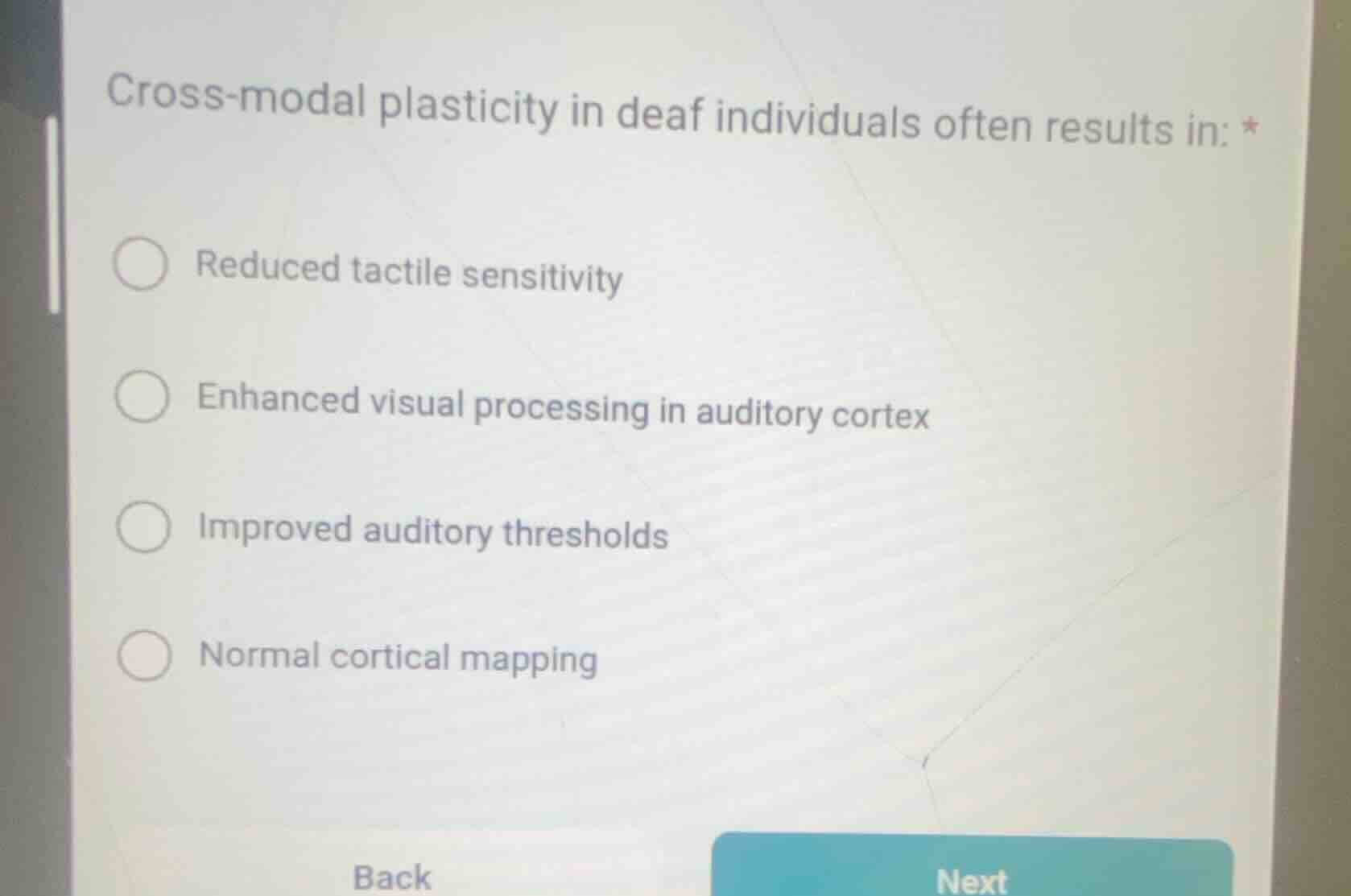
cross-modal plasticity in deaf individuals often results in: *
reduced tactile sensitivity
enhanced visual processing in auditory cortex
improved auditory thresholds
normal cortical mapping
<pre_analysis>
{
"quality": "clear",
"question_count": 1,
"skills_matched": [
"direct_cot",
"multiple_choice_formatter",
"explain_then_answer",
"tutor"
],
"needs_drawing": false,
"concepts_used": [],
"new_concepts": [
"Cross-modal Plasticity",
"Cortical Reorganization",
"Deafness Neurobiology"
],
"current_concepts": [
"Cross-modal Plasticity",
"Cortical Reorganization",
"Deafness Neurobiology"
]
}
</pre_analysis>
<reasoning>
Define cross-modal plasticity
Cross-modal plasticity is the adaptive reorganization of the brain where deafferented sensory cortices (such as the auditory cortex in deaf individuals) are recruited to process information from remaining intact sensory modalities, such as vision or touch.
Analyze the options
- Reduced tactile sensitivity: Incorrect. Cross-modal plasticity typically leads to enhanced or preserved tactile sensitivity, as tactile processing can recruit the auditory cortex.
- Enhanced visual processing in auditory cortex: Correct. In deaf individuals, the auditory cortex is deprived of acoustic input. Through neural reorganization, it becomes responsive to visual stimuli, enhancing visual processing capabilities (such as peripheral vision and motion detection).
- Improved auditory thresholds: Incorrect. Deaf individuals have profound hearing loss, and cross-modal reorganization does not restore or improve physical auditory thresholds.
- Normal cortical mapping: Incorrect. The cortical mapping is significantly altered (reorganized) rather than remaining normal.
</reasoning>
<answer>
<mcq-option>Reduced tactile sensitivity</mcq-option>
<mcq-correct>Enhanced visual processing in auditory cortex</mcq-correct>
<mcq-option>Improved auditory thresholds</mcq-option>
<mcq-option>Normal cortical mapping</mcq-option>
</answer>
<post_analysis>
{
"subject": "Natural Science",
"question_type": "Multiple Choice",
"knowledge_point": [
"Natural Science",
"Biology",
"Neurobiology"
]
}
</post_analysis>
Snap & solve any problem in the app
Get step-by-step solutions on Sovi AI
Photo-based solutions with guided steps
Explore more problems and detailed explanations
<pre_analysis>
{
"quality": "clear",
"question_count": 1,
"skills_matched": [
"direct_cot",
"multiple_choice_formatter",
"explain_then_answer",
"tutor"
],
"needs_drawing": false,
"concepts_used": [],
"new_concepts": [
"Cross-modal Plasticity",
"Cortical Reorganization",
"Deafness Neurobiology"
],
"current_concepts": [
"Cross-modal Plasticity",
"Cortical Reorganization",
"Deafness Neurobiology"
]
}
</pre_analysis>
<reasoning>
Define cross-modal plasticity
Cross-modal plasticity is the adaptive reorganization of the brain where deafferented sensory cortices (such as the auditory cortex in deaf individuals) are recruited to process information from remaining intact sensory modalities, such as vision or touch.
Analyze the options
- Reduced tactile sensitivity: Incorrect. Cross-modal plasticity typically leads to enhanced or preserved tactile sensitivity, as tactile processing can recruit the auditory cortex.
- Enhanced visual processing in auditory cortex: Correct. In deaf individuals, the auditory cortex is deprived of acoustic input. Through neural reorganization, it becomes responsive to visual stimuli, enhancing visual processing capabilities (such as peripheral vision and motion detection).
- Improved auditory thresholds: Incorrect. Deaf individuals have profound hearing loss, and cross-modal reorganization does not restore or improve physical auditory thresholds.
- Normal cortical mapping: Incorrect. The cortical mapping is significantly altered (reorganized) rather than remaining normal.
</reasoning>
<answer>
<mcq-option>Reduced tactile sensitivity</mcq-option>
<mcq-correct>Enhanced visual processing in auditory cortex</mcq-correct>
<mcq-option>Improved auditory thresholds</mcq-option>
<mcq-option>Normal cortical mapping</mcq-option>
</answer>
<post_analysis>
{
"subject": "Natural Science",
"question_type": "Multiple Choice",
"knowledge_point": [
"Natural Science",
"Biology",
"Neurobiology"
]
}
</post_analysis>