QUESTION IMAGE
Question
a. countries in oceania were colonized by european countries.
b. disease nearly wiped out the entire indigenous population.
c. european whalers started to explore the region.
d. several countries gained independence.
<pre_analysis>
{
"quality": "clear",
"question_count": 1,
"skills_matched": [
"direct_cot",
"multiple_choice_formatter",
"explain_then_answer",
"tutor",
"mastery_adaptive_brevity"
],
"needs_drawing": false,
"concepts_used": [
"Oceania History",
"European Exploration",
"Impact of Colonization"
],
"new_concepts": [
"Timeline Analysis"
],
"current_concepts": [
"Oceania History",
"European Exploration",
"Impact of Colonization",
"Timeline Analysis"
]
}
</pre_analysis>
<reasoning>
Analyze the Modern Era section
Using the Oceania History knowledge point
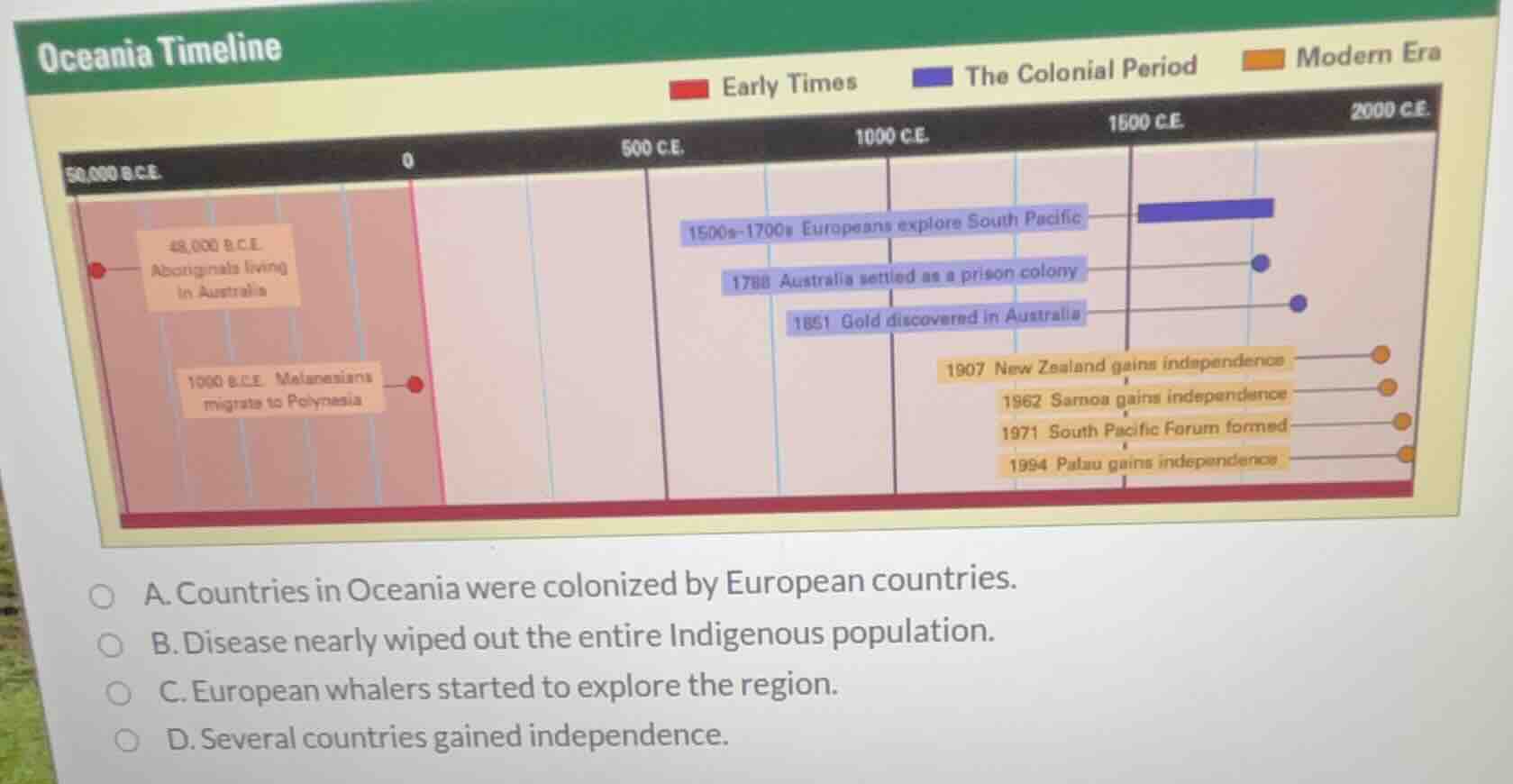
The timeline categorizes historical events into three distinct periods: "Early Times" (red), "The Colonial Period" (blue), and the "Modern Era" (orange). The orange section on the far right spans from approximately 1900 C.E. to 2000 C.E.
Evaluate the events in the Modern Era
Using the Oceania History and Impact of Colonization knowledge points
The events listed under the orange "Modern Era" are:
- 1907: New Zealand gains independence
- 1962: Samoa gains independence
- 1971: South Pacific Forum formed
- 1994: Palau gains independence
Match events to the multiple-choice options
Using the Oceania History knowledge point
- Option A refers to the Colonial Period (blue section).
- Option B is not mentioned or supported by the timeline data.
- Option C refers to European exploration (blue section, 1500s–1700s).
- Option D directly summarizes the events of New Zealand, Samoa, and Palau gaining independence during this era.
</reasoning>
<answer>
<mcq-option>A. Countries in Oceania were colonized by European countries.</mcq-option>
<mcq-option>B. Disease nearly wiped out the entire Indigenous population.</mcq-option>
<mcq-option>C. European whalers started to explore the region.</mcq-option>
<mcq-correct>D. Several countries gained independence.</mcq-correct>
</answer>
<post_analysis>
{
"subject": "Social Science",
"question_type": "Multiple Choice",
"knowledge_point": [
"Social Science",
"History",
"Oceania History"
]
}
</post_analysis>
Snap & solve any problem in the app
Get step-by-step solutions on Sovi AI
Photo-based solutions with guided steps
Explore more problems and detailed explanations
<pre_analysis>
{
"quality": "clear",
"question_count": 1,
"skills_matched": [
"direct_cot",
"multiple_choice_formatter",
"explain_then_answer",
"tutor",
"mastery_adaptive_brevity"
],
"needs_drawing": false,
"concepts_used": [
"Oceania History",
"European Exploration",
"Impact of Colonization"
],
"new_concepts": [
"Timeline Analysis"
],
"current_concepts": [
"Oceania History",
"European Exploration",
"Impact of Colonization",
"Timeline Analysis"
]
}
</pre_analysis>
<reasoning>
Analyze the Modern Era section
Using the Oceania History knowledge point
The timeline categorizes historical events into three distinct periods: "Early Times" (red), "The Colonial Period" (blue), and the "Modern Era" (orange). The orange section on the far right spans from approximately 1900 C.E. to 2000 C.E.
Evaluate the events in the Modern Era
Using the Oceania History and Impact of Colonization knowledge points
The events listed under the orange "Modern Era" are:
- 1907: New Zealand gains independence
- 1962: Samoa gains independence
- 1971: South Pacific Forum formed
- 1994: Palau gains independence
Match events to the multiple-choice options
Using the Oceania History knowledge point
- Option A refers to the Colonial Period (blue section).
- Option B is not mentioned or supported by the timeline data.
- Option C refers to European exploration (blue section, 1500s–1700s).
- Option D directly summarizes the events of New Zealand, Samoa, and Palau gaining independence during this era.
</reasoning>
<answer>
<mcq-option>A. Countries in Oceania were colonized by European countries.</mcq-option>
<mcq-option>B. Disease nearly wiped out the entire Indigenous population.</mcq-option>
<mcq-option>C. European whalers started to explore the region.</mcq-option>
<mcq-correct>D. Several countries gained independence.</mcq-correct>
</answer>
<post_analysis>
{
"subject": "Social Science",
"question_type": "Multiple Choice",
"knowledge_point": [
"Social Science",
"History",
"Oceania History"
]
}
</post_analysis>