QUESTION IMAGE
Question
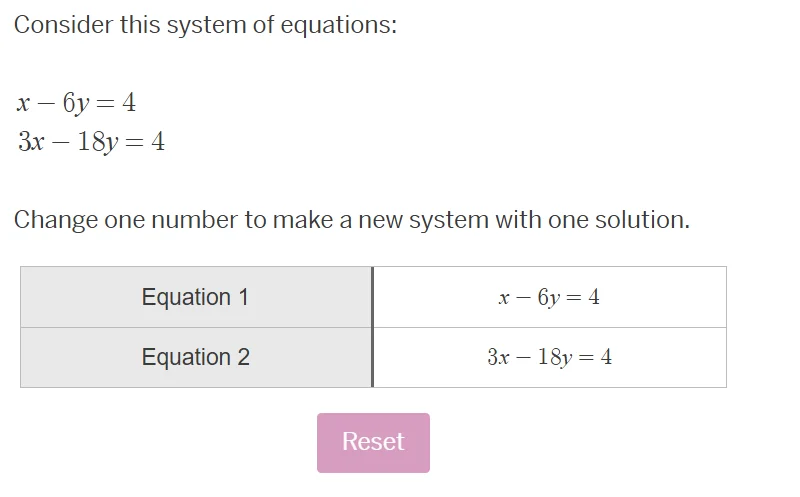
consider this system of equations:
x - 6y = 4
3x - 18y = 4
change one number to make a new system with one solution.
| equation 1 | x - 6y = 4 |
| equation 2 | 3x - 18y = 4 |
reset
Step1: Analyze the original system
The first equation is \(x - 6y = 4\). The second equation is \(3x - 18y = 4\). Notice that if we multiply the first equation by 3, we get \(3x - 18y = 12\). But the second equation is \(3x - 18y = 4\), which means the two lines are parallel (same slope, different y - intercepts) and have no solution. For a system of linear equations \(a_1x + b_1y = c_1\) and \(a_2x + b_2y = c_2\) to have one solution, the slopes must be different, i.e., \(\frac{a_1}{a_2}
eq\frac{b_1}{b_2}\).
Step2: Modify the second equation
Let's change the coefficient of \(x\) in the second equation. Let's change the \(3\) in \(3x-18y = 4\) to a number other than \(3\) (or we can change the coefficient of \(y\) or the constant term). Let's change the second equation to \(2x-18y = 4\). Now, for the first equation \(x - 6y=4\) (or \(2x-12y = 8\) when multiplied by 2) and the second equation \(2x-18y = 4\), the slopes are \(\frac{1}{6}\) (from \(x - 6y = 4\), slope \(m_1=-\frac{1}{-6}=\frac{1}{6}\)) and \(\frac{2}{18}=\frac{1}{9}\) (from \(2x - 18y=4\), slope \(m_2 =-\frac{2}{-18}=\frac{1}{9}\)). Since \(\frac{1}{6}
eq\frac{1}{9}\), the two lines will intersect at one point. Another way: change the constant term of the second equation. If we change the \(4\) in \(3x - 18y = 4\) to \(12\), then the second equation becomes \(3x - 18y=12\), which is the same as the first equation multiplied by 3, and the system will have infinitely many solutions. So a better way is to change the coefficient of \(x\) or \(y\) in the second equation. Let's change the second equation to \(2x-18y = 4\). Now the system is:
\(
\)
We can also change the coefficient of \(y\) in the second equation. For example, change \(- 18y\) to \(-17y\) in the second equation, so the second equation becomes \(3x-17y = 4\). Now, for the first equation \(x-6y = 4\) (slope \(\frac{1}{6}\)) and the second equation \(3x - 17y=4\) (slope \(\frac{3}{17}\)), since \(\frac{1}{6}
eq\frac{3}{17}\) (\(1\times17 = 17\), \(3\times6=18\), \(17
eq18\)), the system has one solution.
Let's take a simple modification: change the \(3\) in the second equation \(3x - 18y = 4\) to \(2\). So the new second equation is \(2x-18y = 4\). Now we can solve the system:
From the first equation \(x=4 + 6y\). Substitute into the second equation: \(2(4 + 6y)-18y=4\)
\(8+12y-18y = 4\)
\(8 - 6y=4\)
\(-6y=4 - 8=-4\)
\(y=\frac{-4}{-6}=\frac{2}{3}\)
Then \(x=4+6\times\frac{2}{3}=4 + 4 = 8\). So the system has one solution \((8,\frac{2}{3})\).

Snap & solve any problem in the app
Get step-by-step solutions on Sovi AI
Photo-based solutions with guided steps
Explore more problems and detailed explanations
One possible new system is \(
\) (by changing the coefficient of \(x\) in the second equation from \(3\) to \(2\)). There are other valid modifications, such as changing the coefficient of \(y\) in the second equation or the constant term, as long as the two lines have different slopes.