Sovi.AI - AI Math Tutor

Scan to solve math questions

QUESTION IMAGE

consider the excerpts from anthem that appeared earlier in this lesson …

Question

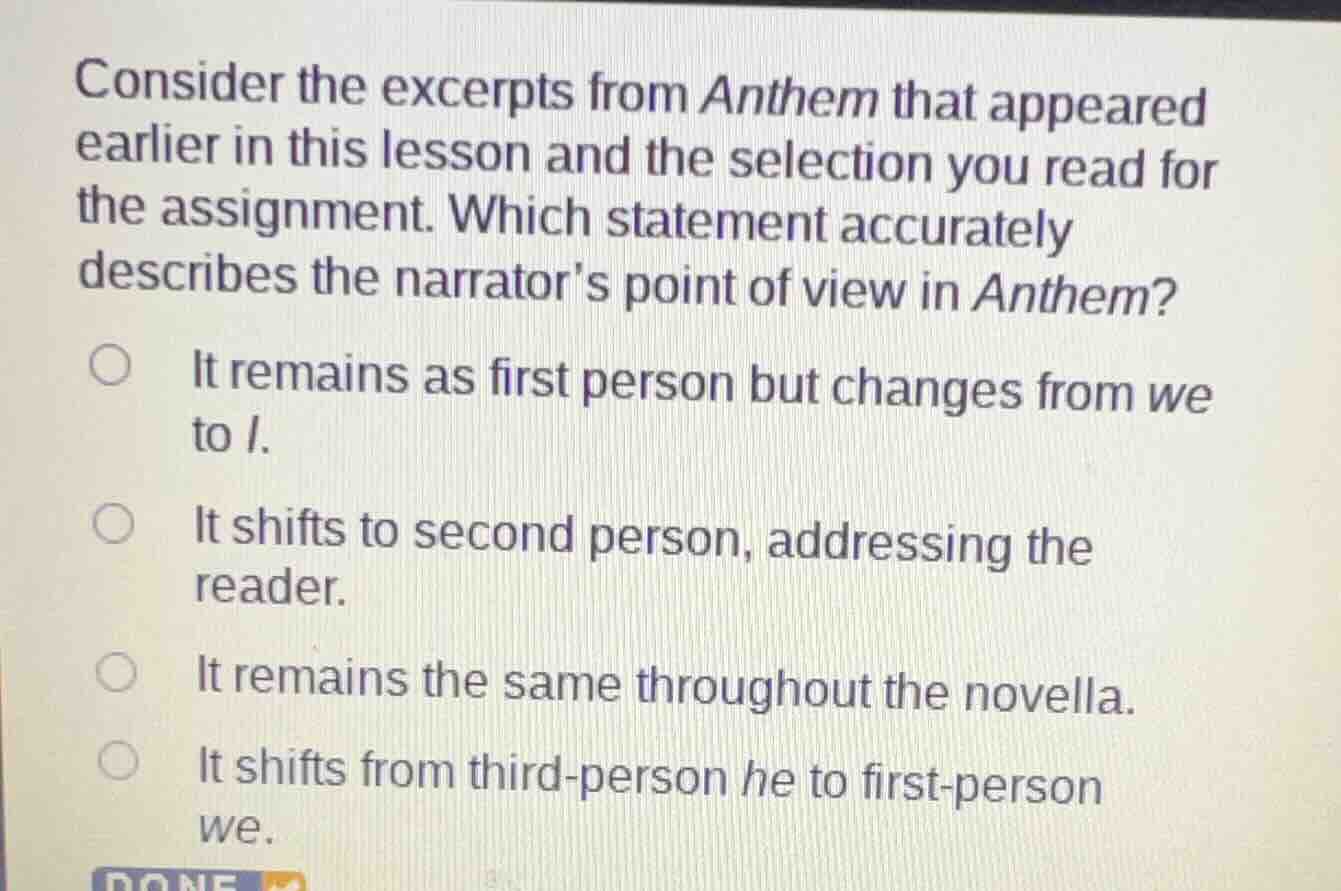
consider the excerpts from anthem that appeared earlier in this lesson and the selection you read for the assignment. which statement accurately describes the narrators point of view in anthem?

it remains as first person but changes from we to i.
it shifts to second person, addressing the reader.
it remains the same throughout the novella.
it shifts from third-person he to first-person we.

Explanation:

Response

<pre_analysis>
{
"quality": "clear",
"question_count": 1,
"skills_matched": [
"direct_cot",
"multiple_choice_formatter",
"explain_then_answer",
"tutor"
],
"needs_drawing": false,
"concepts_used": [
"Literary Analysis"
],
"new_concepts": [
"Point of View Shift",
"Anthem Analysis"
],
"current_concepts": [
"Literary Analysis",
"Point of View Shift",
"Anthem Analysis"
]
}
</pre_analysis>

<reasoning>

Identify the narrative structure of Anthem

In Ayn Rand's novella Anthem, the society depicted is a collectivist dystopia where the concept of individuality has been eliminated. To reflect this, the narrator, Equality 7-2521, initially writes in the first-person plural, using pronouns like "we," "our," and "us" to refer to himself, as the word "I" has been outlawed and forgotten. This is a core element of Literary Analysis when studying the novella's narrative perspective.

Analyze the shift in point of view

As Equality 7-2521 escapes into the Uncharted Forest and discovers ancient books from the Unmentionable Times, he learns the forbidden word "I." In Chapter XI, he experiences a profound realization of his own individuality. Consequently, the narrative point of view shifts from using the collective "we" to the individual "I," while remaining in the first-person perspective.

Evaluate the given options

  • Option 1: "It remains as first person but changes from we to I." This accurately describes the transition from collective first-person plural to individual first-person singular.
  • Option 2: "It shifts to second person, addressing the reader." Incorrect; the story is not told using "you" as the primary narrative perspective.
  • Option 3: "It remains the same throughout the novella." Incorrect; the discovery of the word "I" marks a major linguistic and psychological shift.
  • Option 4: "It shifts from third-person he to first-person we." Incorrect; the story is never narrated in the third person.

</reasoning>

<answer>
<mcq-correct>(A) It remains as first person but changes from we to I.</mcq-correct>
<mcq-option>(B) It shifts to second person, addressing the reader.</mcq-option>
<mcq-option>(C) It remains the same throughout the novella.</mcq-option>
<mcq-option>(D) It shifts from third-person he to first-person we.</mcq-option>
</answer>

<post_analysis>
{
"subject": "Arts",
"question_type": "Multiple Choice",
"knowledge_point": [
"Arts",
"Literary Analysis",
"Point of View Shift"
]
}
</post_analysis>

Answer:

<pre_analysis>
{
"quality": "clear",
"question_count": 1,
"skills_matched": [
"direct_cot",
"multiple_choice_formatter",
"explain_then_answer",
"tutor"
],
"needs_drawing": false,
"concepts_used": [
"Literary Analysis"
],
"new_concepts": [
"Point of View Shift",
"Anthem Analysis"
],
"current_concepts": [
"Literary Analysis",
"Point of View Shift",
"Anthem Analysis"
]
}
</pre_analysis>

<reasoning>

Identify the narrative structure of Anthem

In Ayn Rand's novella Anthem, the society depicted is a collectivist dystopia where the concept of individuality has been eliminated. To reflect this, the narrator, Equality 7-2521, initially writes in the first-person plural, using pronouns like "we," "our," and "us" to refer to himself, as the word "I" has been outlawed and forgotten. This is a core element of Literary Analysis when studying the novella's narrative perspective.

Analyze the shift in point of view

As Equality 7-2521 escapes into the Uncharted Forest and discovers ancient books from the Unmentionable Times, he learns the forbidden word "I." In Chapter XI, he experiences a profound realization of his own individuality. Consequently, the narrative point of view shifts from using the collective "we" to the individual "I," while remaining in the first-person perspective.

Evaluate the given options

  • Option 1: "It remains as first person but changes from we to I." This accurately describes the transition from collective first-person plural to individual first-person singular.
  • Option 2: "It shifts to second person, addressing the reader." Incorrect; the story is not told using "you" as the primary narrative perspective.
  • Option 3: "It remains the same throughout the novella." Incorrect; the discovery of the word "I" marks a major linguistic and psychological shift.
  • Option 4: "It shifts from third-person he to first-person we." Incorrect; the story is never narrated in the third person.

</reasoning>

<answer>
<mcq-correct>(A) It remains as first person but changes from we to I.</mcq-correct>
<mcq-option>(B) It shifts to second person, addressing the reader.</mcq-option>
<mcq-option>(C) It remains the same throughout the novella.</mcq-option>
<mcq-option>(D) It shifts from third-person he to first-person we.</mcq-option>
</answer>

<post_analysis>
{
"subject": "Arts",
"question_type": "Multiple Choice",
"knowledge_point": [
"Arts",
"Literary Analysis",
"Point of View Shift"
]
}
</post_analysis>