QUESTION IMAGE
Question
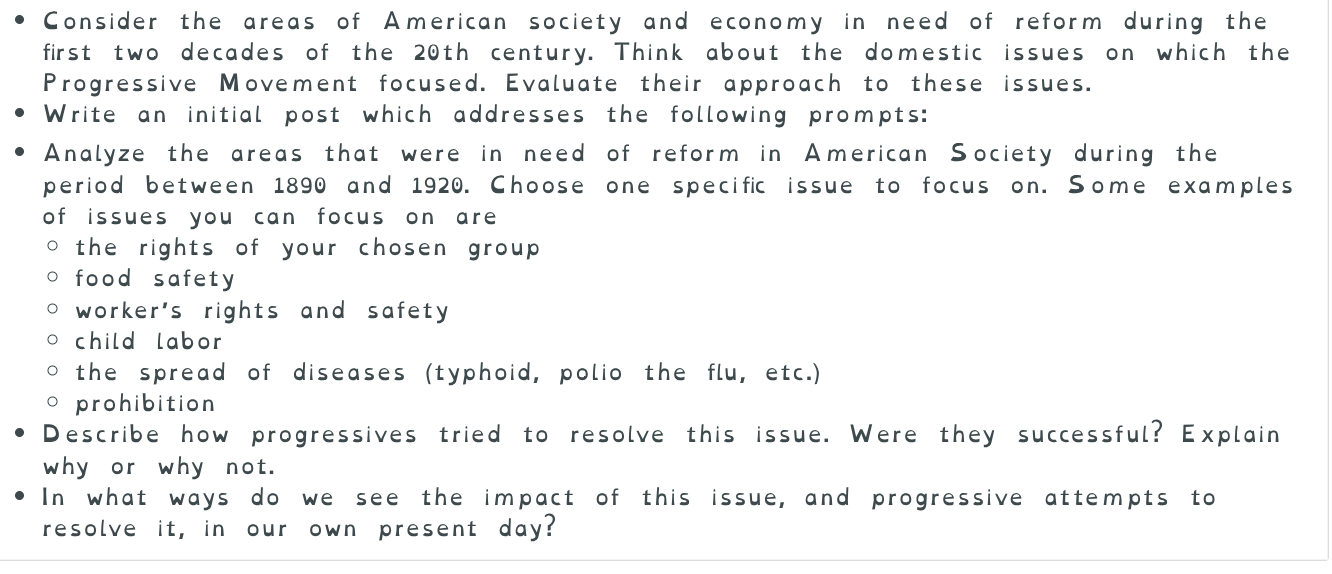
- consider the areas of american society and economy in need of reform during the first two decades of the 20th century. think about the domestic issues on which the progressive movement focused. evaluate their approach to these issues.
- write an initial post which addresses the following prompts:
- analyze the areas that were in need of reform in american society during the period between 1890 and 1920. choose one specific issue to focus on. some examples of issues you can focus on are
o the rights of your chosen group
o food safety
o workers rights and safety
o child labor
o the spread of diseases (typhoid, polio the flu, etc.)
o prohibition
- describe how progressives tried to resolve this issue. were they successful? explain why or why not.
- in what ways do we see the impact of this issue, and progressive attempts to resolve it, in our own present day?
🆕 New Concept Discovered: Progressive Era Reforms
Analyzing historical social movements and their modern legacies.
Step 1: Identify the Issue and Historical Context
During the Progressive Era (1890–1920), rapid industrialization and urbanization in the United States led to severe social and economic problems. One of the most critical issues was worker's rights and safety.
At the turn of the 20th century, American laborers faced grueling 10-to-12-hour workdays, six days a week, in highly hazardous environments. Factories, steel mills, and coal mines lacked basic safety regulations, leading to high rates of industrial accidents, permanent injuries, and deaths. The issue was thrust into the national spotlight by the tragic Triangle Shirtwaist Factory fire of 1911, where 146 garment workers died due to locked exit doors and inadequate fire escapes.
Step 2: Analyze the Progressive Response and Success
Progressives tackled worker safety and labor rights through a combination of grassroots activism, investigative journalism (muckraking), and legislative action:
- How they tried to resolve it: Activists and labor unions lobbied state and federal governments to pass protective legislation. Muckraking journalists published exposés on dangerous working conditions to build public support.
- Were they successful? Yes, they achieved significant, though gradual, success. At the state level, Progressives successfully pushed for workers' compensation laws, which required employers to pay medical expenses and lost wages to injured workers. They also established maximum hour laws for women and children and created state factory inspection departments to enforce safety codes. At the federal level, early attempts to regulate labor were sometimes struck down by a conservative Supreme Court, but the groundwork was laid for the sweeping national labor reforms of the 1930s New Deal.
Step 3: Connect to the Present Day
The struggle for worker safety and rights during the Progressive Era directly shaped the modern American workplace:
- Regulatory Agencies: The Progressive push for government oversight eventually led to the creation of the Occupational Safety and Health Administration (OSHA) in 1970, which enforces the safety standards we rely on today.
- Workplace Standards: Modern concepts like the 40-hour workweek, overtime pay, workers' compensation insurance, and mandatory fire drills/emergency exits are direct legacies of Progressive Era advocacy.
- Modern Relevance: Today, we see this issue continue in debates over the gig economy (e.g., rights for rideshare drivers), remote work safety, and protections for warehouse and delivery workers demanding safer pacing and heat-illness prevention.

Snap & solve any problem in the app
Get step-by-step solutions on Sovi AI
Photo-based solutions with guided steps
Explore more problems and detailed explanations
Discussion Post: Worker's Rights and Safety in the Progressive Era
1. Reform Area: Worker's Rights and Safety (1890–1920)
During the rapid industrial expansion of the Progressive Era, American laborers faced incredibly hazardous working conditions. Employees routinely worked 60 to 72 hours a week in poorly ventilated, overcrowded factories and mines with no safety guards on heavy machinery. The lack of regulation meant that industrial accidents were treated as the worker's personal misfortune rather than the employer's responsibility. This crisis of safety was tragically highlighted by the 1911 Triangle Shirtwaist Factory fire, which claimed the lives of 146 workers due to locked exit doors and a lack of emergency preparation.
2. Progressive Actions and Outcomes
Progressives responded to these conditions by mobilizing public outrage and lobbying for legislative intervention. Muckraking journalists exposed factory conditions, while organizations like the National Consumers League pressured businesses. These efforts were highly successful at the state level; by 1920, the vast majority of states had passed workers' compensation laws, established factory inspection systems, and limited working hours for women and minors. While the federal courts initially resisted some of these regulations, the Progressive Era successfully shifted the public consensus to accept that the government has a duty to protect citizens from corporate exploitation and unsafe working environments.
3. Modern-Day Impact
The legacy of Progressive labor reform is deeply embedded in our daily lives. Every time we see a marked emergency exit, participate in a workplace fire drill, or receive overtime pay, we are experiencing the direct results of Progressive Era advocacy. Today, this legacy continues through the work of the Occupational Safety and Health Administration (OSHA). Furthermore, the debate remains highly relevant as modern society grapples with defining labor rights and safety standards for gig-economy workers, warehouse staff, and remote employees.