QUESTION IMAGE
Question
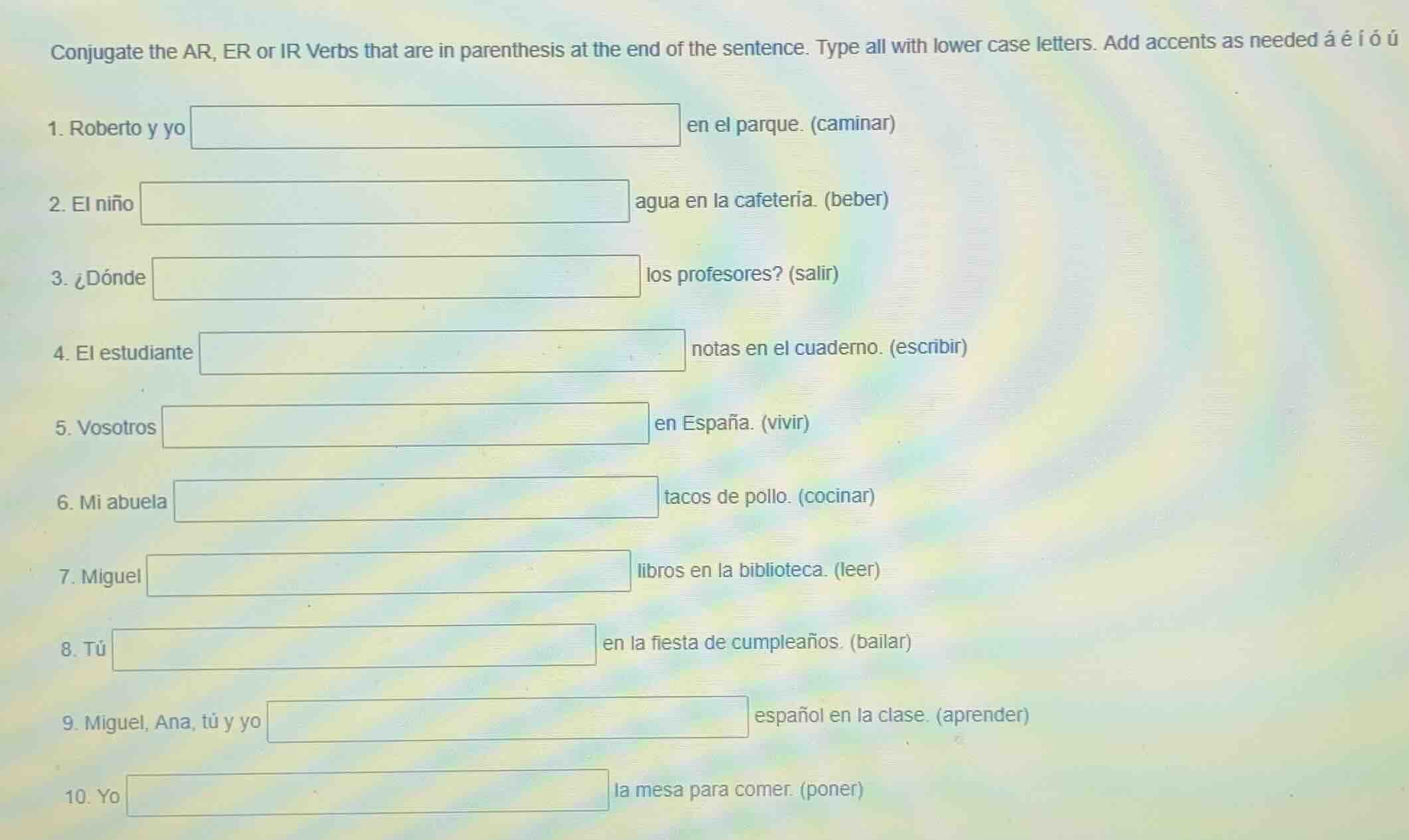
conjugate the ar, er or ir verbs that are in parenthesis at the end of the sentence. type all with lower case letters. add accents as needed á é í ó ú
- roberto y yo \boxed{} en el parque. (caminar)
- el niño \boxed{} agua en la cafetería. (beber)
- ¿dónde \boxed{} los profesores? (salir)
- el estudiante \boxed{} notas en el cuaderno. (escribir)
- vosotros \boxed{} en españa. (vivir)
- mi abuela \boxed{} tacos de pollo. (cocinar)
- miguel \boxed{} libros en la biblioteca. (leer)
- tú \boxed{} en la fiesta de cumpleaños. (bailar)
- miguel, ana, tú y yo \boxed{} español en la clase. (aprender)
- yo \boxed{} la mesa para comer. (poner)
Brief Explanations
Each verb is conjugated to match its subject in the present tense (lowercase, with correct accents as required):
- Subject "Roberto y yo" is first-person plural, so the -ar verb caminar becomes caminamos.
- Subject "El niño" is third-person singular, so the -er verb beber becomes bebe.
- Subject "los profesores" is third-person plural, so the -ir verb salir becomes salen.
- Subject "El estudiante" is third-person singular, so the -ir verb escribir becomes escribe.
- Subject "Vosotros" is informal second-person plural (Spain), so the -ir verb vivir becomes vivís.
- Subject "Mi abuela" is third-person singular, so the -ar verb cocinar becomes cocina.
- Subject "Miguel" is third-person singular, so the -er verb leer becomes lee.
- Subject "Tú" is informal second-person singular, so the -ar verb bailar becomes bailas.
- Subject "Miguel, Ana, tú y yo" is first-person plural, so the -er verb aprender becomes aprendemos.
- Subject "Yo" is first-person singular, so the -er verb poner becomes pongo.

Snap & solve any problem in the app
Get step-by-step solutions on Sovi AI
Photo-based solutions with guided steps
Explore more problems and detailed explanations
- caminamos
- bebe
- salen
- escribe
- vivís
- cocina
- lee
- bailas
- aprendemos
- pongo