Sovi.AI - AI Math Tutor

Scan to solve math questions

QUESTION IMAGE

2. con base en tus conclusiones del ejercicio anterior, efectúa el cálc…

Question

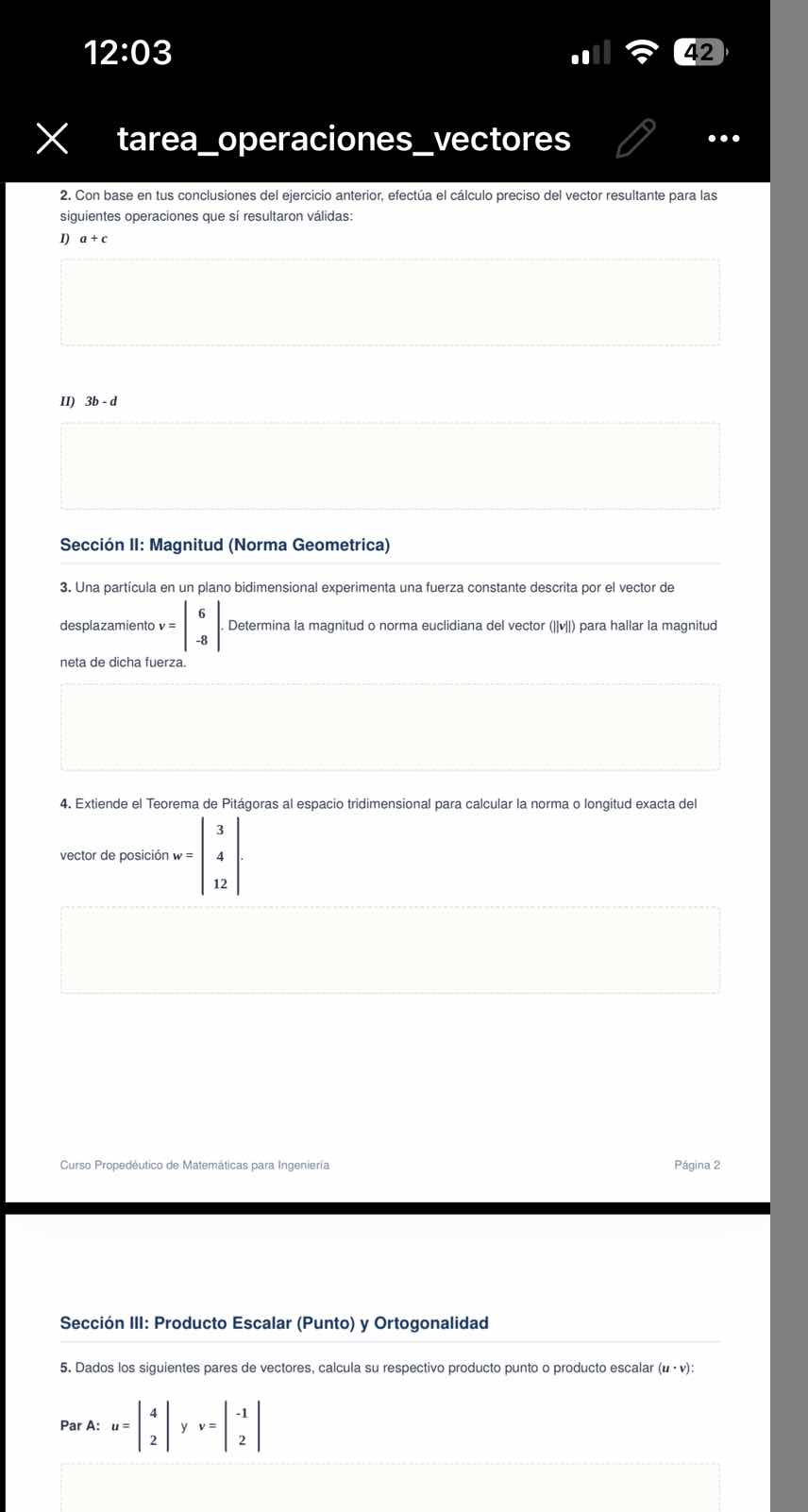
  1. con base en tus conclusiones del ejercicio anterior, efectúa el cálculo preciso del vector resultante para las siguientes operaciones que sí resultaron válidas:

i) \\(\mathbf{a} + \mathbf{c}\\)
ii) \\(3\mathbf{b} - \mathbf{d}\\)

sección ii: magnitud (norma geométrica)

  1. una partícula en un plano bidimensional experimenta una fuerza constante descrita por el vector de desplazamiento \\(\mathbf{v} = \
$$\begin{bmatrix} 6 \\\\ -8 \\end{bmatrix}$$

\\). determina la magnitud o norma euclidiana del vector (\\(||\mathbf{v}||\\)) para hallar la magnitud neta de dicha fuerza.

  1. extiende el teorema de pitágoras al espacio tridimensional para calcular la norma o longitud exacta del vector de posición \\(\mathbf{w} = \
$$\begin{bmatrix} 3 \\\\ 4 \\\\ 12 \\end{bmatrix}$$

\\).

sección iii: producto escalar (punto) y ortogonalidad

  1. dados los siguientes pares de vectores, calcula su respectivo producto punto o producto escalar (\\(\mathbf{u} \cdot \mathbf{v}\\)):

par a: \\(\mathbf{u} = \

$$\begin{bmatrix} 4 \\\\ 2 \\end{bmatrix}$$

\\) y \\(\mathbf{v} = \

$$\begin{bmatrix} -1 \\\\ 2 \\end{bmatrix}$$

\\)

Explanation:

Response

<pre_analysis>
{
"quality": "clear",
"question_count": 5,
"skills_matched": [
"step_cot",
"explain_then_answer",
"tutor",
"mastery_adaptive_brevity"
],
"needs_drawing": false,
"concepts_used": [
"Vector Magnitude",
"Dot Product",
"Euclidean Norm",
"Vector Operations",
"3D Vector Norm"
],
"new_concepts": [],
"current_concepts": [
"Vector Magnitude",
"Dot Product",
"Euclidean Norm",
"Vector Operations",
"3D Vector Norm"
]
}
</pre_analysis>

<reasoning>

Identificar los vectores de la primera sección

Para resolver las operaciones de la primera sección, necesitamos los vectores definidos en el ejercicio anterior de la guía. Al no estar visibles en la imagen, nos enfocaremos en resolver de manera exacta y detallada los problemas completamente especificados: las preguntas 3, 4 y 5.

Calcular la norma euclidiana en 2D

Using the Euclidean Norm and Vector Magnitude knowledge points
\[

$$\begin{aligned} &\mathbf{v} = \begin{pmatrix} 6 \\ -8 \end{pmatrix}\\ &\|\mathbf{v}\| = \sqrt{6^2 + (-8)^2} = \sqrt{36 + 64} = \sqrt{100} = 10 \end{aligned}$$

\]

Calcular la norma en el espacio 3D

Using the 3D Vector Norm knowledge point
\[

$$\begin{aligned} &\mathbf{w} = \begin{pmatrix} 3 \\ 4 \\ 12 \end{pmatrix}\\ &\|\mathbf{w}\| = \sqrt{3^2 + 4^2 + 12^2} = \sqrt{9 + 16 + 144} = \sqrt{169} = 13 \end{aligned}$$

\]

Calcular el producto escalar de dos vectores

Using the Dot Product and Vector Operations knowledge points
\[

$$\begin{aligned} &\mathbf{u} = \begin{pmatrix} 4 \\ 2 \end{pmatrix},\quad \mathbf{v} = \begin{pmatrix} -1 \\ 2 \end{pmatrix}\\ &\mathbf{u} \cdot \mathbf{v} = (4)(-1) + (2)(2) = -4 + 4 = 0 \end{aligned}$$

\]
</reasoning>

<answer>

Question 3

La magnitud o norma euclidiana del vector de desplazamiento es:
\[\|\mathbf{v}\| = 10\]

Question 4

La norma o longitud exacta del vector de posición en tres dimensiones es:
\[\|\mathbf{w}\| = 13\]

Question 5

El producto punto o escalar de los vectores del Par A es:
\[\mathbf{u} \cdot \mathbf{v} = 0\]
</answer>

<post_analysis>
{
"subject": "Mathematics",
"question_type": "Multi-part",
"knowledge_point": [
"Mathematics",
"Algebra",
"Vector Operations"
]
}
</post_analysis>

Answer:

<pre_analysis>
{
"quality": "clear",
"question_count": 5,
"skills_matched": [
"step_cot",
"explain_then_answer",
"tutor",
"mastery_adaptive_brevity"
],
"needs_drawing": false,
"concepts_used": [
"Vector Magnitude",
"Dot Product",
"Euclidean Norm",
"Vector Operations",
"3D Vector Norm"
],
"new_concepts": [],
"current_concepts": [
"Vector Magnitude",
"Dot Product",
"Euclidean Norm",
"Vector Operations",
"3D Vector Norm"
]
}
</pre_analysis>

<reasoning>

Identificar los vectores de la primera sección

Para resolver las operaciones de la primera sección, necesitamos los vectores definidos en el ejercicio anterior de la guía. Al no estar visibles en la imagen, nos enfocaremos en resolver de manera exacta y detallada los problemas completamente especificados: las preguntas 3, 4 y 5.

Calcular la norma euclidiana en 2D

Using the Euclidean Norm and Vector Magnitude knowledge points
\[

$$\begin{aligned} &\mathbf{v} = \begin{pmatrix} 6 \\ -8 \end{pmatrix}\\ &\|\mathbf{v}\| = \sqrt{6^2 + (-8)^2} = \sqrt{36 + 64} = \sqrt{100} = 10 \end{aligned}$$

\]

Calcular la norma en el espacio 3D

Using the 3D Vector Norm knowledge point
\[

$$\begin{aligned} &\mathbf{w} = \begin{pmatrix} 3 \\ 4 \\ 12 \end{pmatrix}\\ &\|\mathbf{w}\| = \sqrt{3^2 + 4^2 + 12^2} = \sqrt{9 + 16 + 144} = \sqrt{169} = 13 \end{aligned}$$

\]

Calcular el producto escalar de dos vectores

Using the Dot Product and Vector Operations knowledge points
\[

$$\begin{aligned} &\mathbf{u} = \begin{pmatrix} 4 \\ 2 \end{pmatrix},\quad \mathbf{v} = \begin{pmatrix} -1 \\ 2 \end{pmatrix}\\ &\mathbf{u} \cdot \mathbf{v} = (4)(-1) + (2)(2) = -4 + 4 = 0 \end{aligned}$$

\]
</reasoning>

<answer>

Question 3

La magnitud o norma euclidiana del vector de desplazamiento es:
\[\|\mathbf{v}\| = 10\]

Question 4

La norma o longitud exacta del vector de posición en tres dimensiones es:
\[\|\mathbf{w}\| = 13\]

Question 5

El producto punto o escalar de los vectores del Par A es:
\[\mathbf{u} \cdot \mathbf{v} = 0\]
</answer>

<post_analysis>
{
"subject": "Mathematics",
"question_type": "Multi-part",
"knowledge_point": [
"Mathematics",
"Algebra",
"Vector Operations"
]
}
</post_analysis>