QUESTION IMAGE
Question
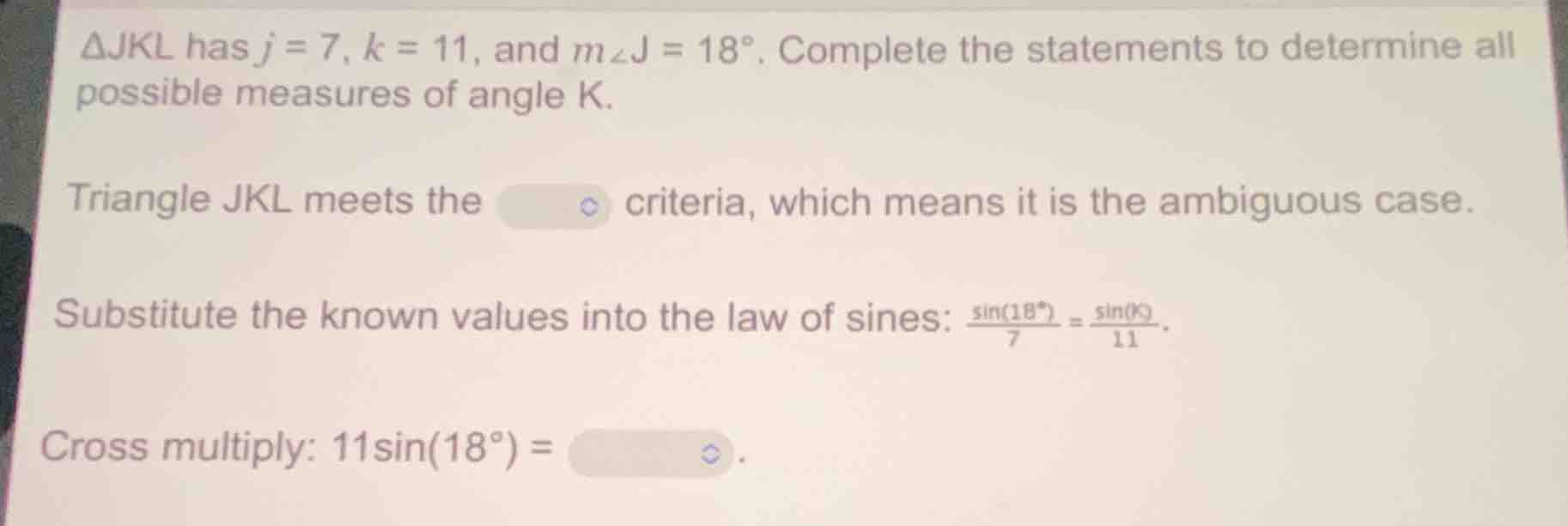
\\(\delta jkl\\) has \\(j = 7\\), \\(k = 11\\), and \\(m\angle j = 18^{\circ}\\). complete the statements to determine all possible measures of angle k.
triangle jkl meets the criteria, which means it is the ambiguous case.
substitute the known values into the law of sines: \\(\frac{\sin(18^{\circ})}{7} = \frac{\sin(k)}{11}\\).
cross multiply: \\(11\sin(18^{\circ}) = \\) .
🆕 New Concept Discovered: Law of Sines Ambiguous Case
Solving triangles with two sides and a non-included angle.
Step 1: Identify the triangle criteria
We are given two sides, \(j = 7\) and \(k = 11\), and one non-included angle, \(m\angle J = 18^\circ\).
This configuration is known as Side-Side-Angle, or SSA. In trigonometry, the SSA scenario is called the "ambiguous case" because it can result in zero, one, or two possible triangles.
Step 2: Cross multiply the Law of Sines equation
We start with the given Law of Sines proportion:
To cross-multiply, we multiply the numerator of each side by the denominator of the opposite side:

Snap & solve any problem in the app
Get step-by-step solutions on Sovi AI
Photo-based solutions with guided steps
Explore more problems and detailed explanations
- First blank: SSA
- Second blank: \(7\sin(K)\)