QUESTION IMAGE
Question
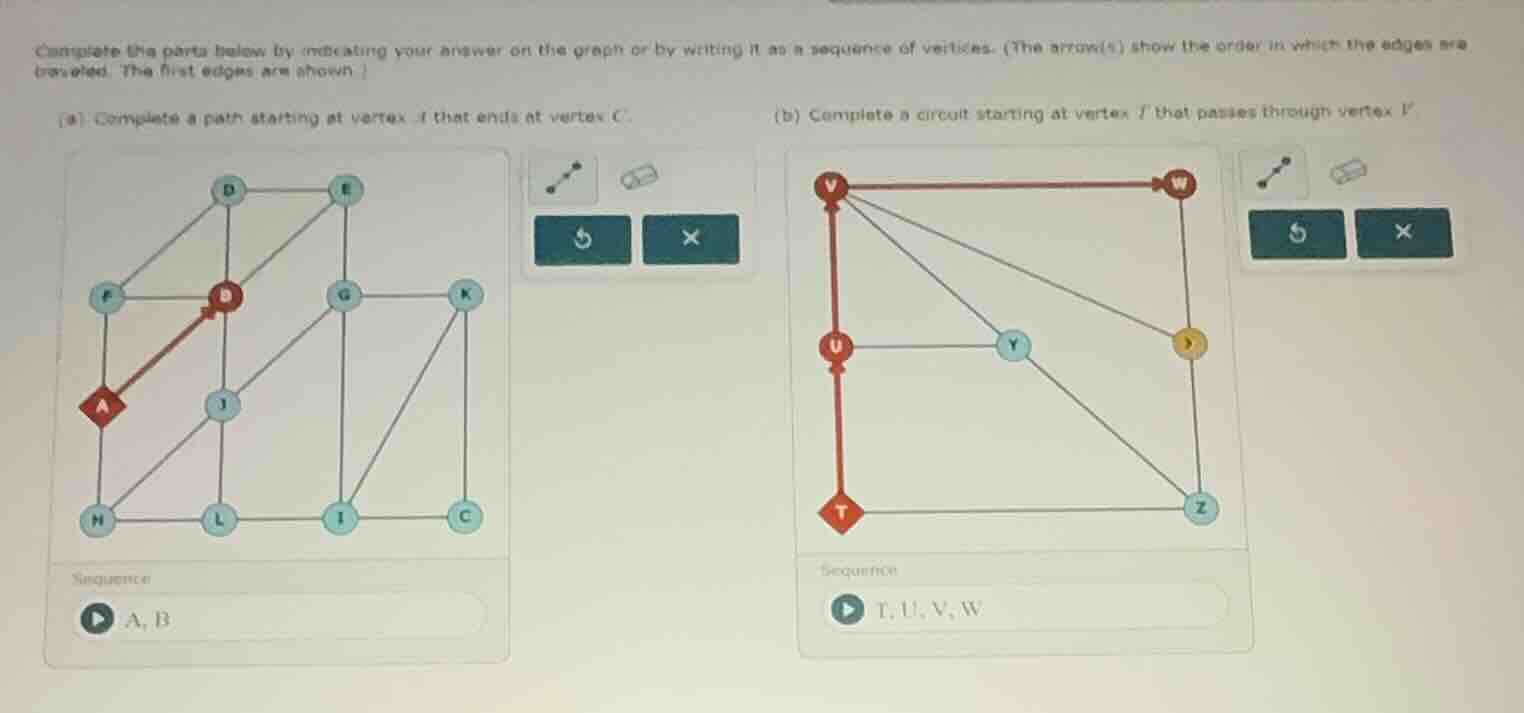
complete the parts below by indicating your answer on the graph or by writing it as a sequence of vertices. (the arrow(s) show the order in which the edges are traveled. the first edges are shown.)
(a) complete a path starting at vertex \\(a\\) that ends at vertex \\(c\\).
(b) complete a circuit starting at vertex \\(t\\) that passes through vertex \\(v\\).
Analyze part (a) requirements
We need to complete a path starting at vertex \(A\) that ends at vertex \(C\).
The first edges are already shown on the graph and listed in the sequence:
\(A, B\)
Let's examine the graph for part (a):
- Vertices: \(A, B, C, D, E, F, G, H, I, J, K, L\)
- The path starts at \(A\), goes to \(B\) (indicated by the red arrow from \(A\) to \(B\)).
- From \(B\), we need to find a path that eventually reaches \(C\).
- Let's look at the connections from \(B\):
- \(B\) is connected to \(D, E, F, J, H\).
- Let's trace a simple path from \(B\) to \(C\):
- From \(B\), we can go to \(E\).
- From \(E\), we can go to \(G\).
- From \(G\), we can go to \(I\).
- From \(I\), we can go to \(C\).
- This gives the sequence: \(A, B, E, G, I, C\).
- Let's verify the edges exist in the graph:
- \(A\) to \(B\): Yes (shown in red).
- \(B\) to \(E\): Yes, there is an edge between \(B\) and \(E\).
- \(E\) to \(G\): Yes, there is a vertical edge between \(E\) and \(G\).
- \(G\) to \(I\): Yes, there is a vertical edge between \(G\) and \(I\).
- \(I\) to \(C\): Yes, there is a horizontal edge between \(I\) and \(C\).
- Thus, one valid completed sequence is: \(A, B, E, G, I, C\).
Analyze part (b) requirements
We need to complete a circuit starting at vertex \(T\) that passes through vertex \(V\).
A circuit is a path that starts and ends at the same vertex (in this case, starting and ending at \(T\)).
The first edges are already shown on the graph and listed in the sequence:
\(T, U, V, W\)
Let's examine the graph for part (b):
- Vertices: \(T, U, V, W, X, Y, Z\)
- The sequence currently is: \(T, U, V, W\).
- This path already passes through \(V\).
- Now we need to continue from \(W\) and return to \(T\) to complete the circuit.
- Let's look at the connections from \(W\):
- \(W\) is connected to \(V, X\).
- Since we just came from \(V\), let's go to \(X\).
- From \(X\), we can go to \(Z\).
- From \(Z\), we can go to \(T\).
- Let's verify these edges:
- \(W\) to \(X\): Yes, vertical edge on the right.
- \(X\) to \(Z\): Yes, vertical edge on the right.
- \(Z\) to \(T\): Yes, horizontal edge at the bottom.
- This gives the sequence: \(T, U, V, W, X, Z, T\).
- Let's double check if there is an edge directly from \(X\) to \(T\) or other paths:
- Going \(W
ightarrow X
ightarrow Z
ightarrow T\) is extremely direct and valid.
- Let's verify the vertices: \(T, U, V, W, X, Z, T\) starts at \(T\), ends at \(T\), and passes through \(V\).

Snap & solve any problem in the app
Get step-by-step solutions on Sovi AI
Photo-based solutions with guided steps
Explore more problems and detailed explanations
Question 1
One valid completed sequence is:
\(A, B, E, G, I, C\)
Question 2
One valid completed sequence is:
\(T, U, V, W, X, Z, T\)