QUESTION IMAGE
Question
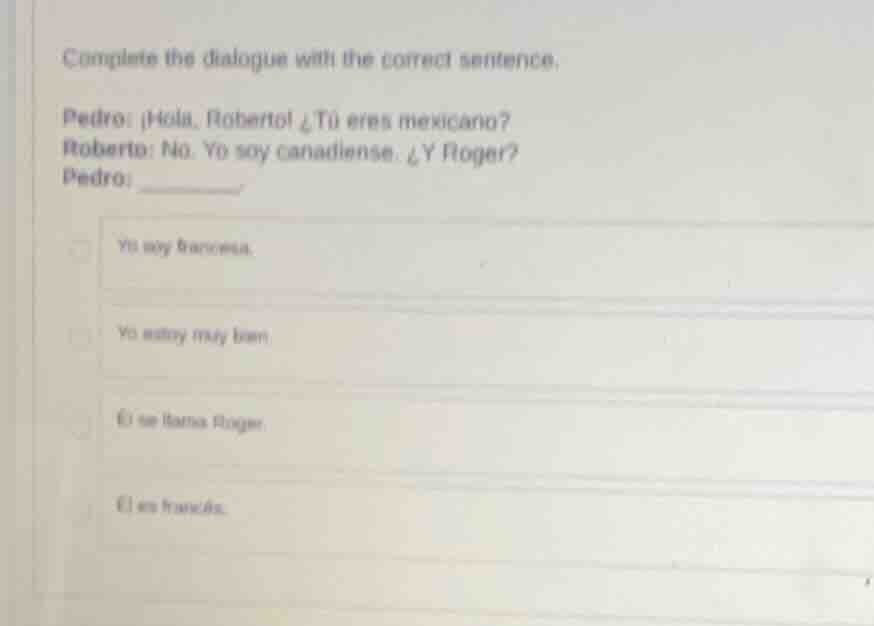
complete the dialogue with the correct sentence.
pedro: ¡hola, roberto! ¿tú eres mexicano?
roberto: no. yo soy canadiense. ¿y roger?
pedro: _________.
yo soy francesa.
yo estoy muy bien.
él se llama roger.
él es francés.
Analyze the dialogue context
Using the Reading Comprehension knowledge point, we translate and analyze the conversation:
- Pedro: "¡Hola, Roberto! ¿Tú eres mexicano?" (Hello, Roberto! Are you Mexican?)
- Roberto: "No. Yo soy canadiense. ¿Y Roger?" (No. I am Canadian. And Roger?)
- Pedro: [Blank]
Roberto asks about Roger's nationality or identity using "¿Y Roger?" (And Roger?). Since Roger is a third-person singular male subject ("he"), the response must refer to "él" (he) and describe his nationality or identity.
Evaluate the options
Using the Spanish Vocabulary knowledge point, we evaluate each option:
- "Yo soy francesa." (I am French [feminine]). This uses the first-person "Yo" and a feminine adjective, which does not answer a question about Roger (a male third person).
- "Yo estoy muy bien." (I am doing very well). This answers "How are you?", not a question about Roger's identity or origin.
- "Él se llama Roger." (His name is Roger). This is redundant because Roberto already knows his name is Roger.
- "Él es francés." (He is French). This correctly uses the third-person singular pronoun "él" (he) and the masculine nationality adjective "francés" to answer where Roger is from.
Determine the correct choice
The sentence "Él es francés" logically and grammatically completes the dialogue.

Snap & solve any problem in the app
Get step-by-step solutions on Sovi AI
Photo-based solutions with guided steps
Explore more problems and detailed explanations
- (A) Yo soy francesa.
- (B) Yo estoy muy bien.
- (C) Él se llama Roger.
- (D) Él es francés. (Correct answer)