QUESTION IMAGE
Question
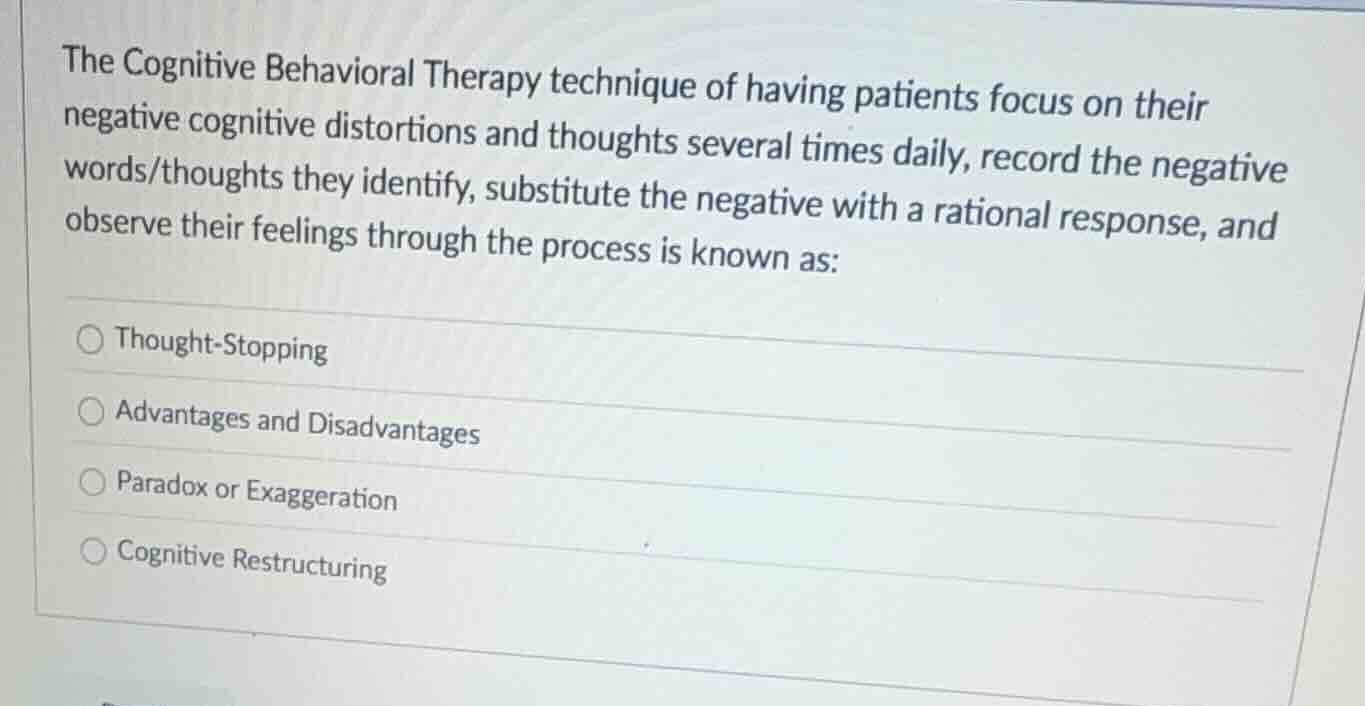
the cognitive behavioral therapy technique of having patients focus on their negative cognitive distortions and thoughts several times daily, record the negative words/thoughts they identify, substitute the negative with a rational response, and observe their feelings through the process is known as:
thought-stopping
advantages and disadvantages
paradox or exaggeration
cognitive restructuring
🆕 New Concept Discovered: Cognitive Restructuring
Identifying and replacing unhelpful thinking patterns.
Step 1: Analyze the described technique
The question describes a multi-step therapeutic process:
- Focusing on and identifying negative cognitive distortions and thoughts several times a day.
- Recording these identified thoughts.
- Substituting the negative, distorted thoughts with rational, balanced responses.
- Observing changes in emotional states and feelings throughout this process.
This process is a core intervention in Cognitive Behavioral Therapy (CBT) aimed at changing maladaptive thinking patterns.
Step 2: Evaluate the given options
- Thought-Stopping: This technique involves consciously interrupting repetitive, non-productive, or negative thoughts (e.g., by saying "Stop!" or snapping a rubber band on the wrist) rather than systematically recording and replacing them with rational alternatives.
- Advantages and Disadvantages: This is a decision-making or belief-challenging tool where a patient lists the pros and cons of maintaining a specific belief or behavior.
- Paradox or Exaggeration: This involves taking an anxious or distorted thought to its extreme, logical conclusion to highlight its absurdity or reduce its emotional power.
- Cognitive Restructuring: This is the overarching therapeutic process of identifying, challenging, and altering dysfunctional or distorted automatic thoughts and replacing them with more objective, realistic, and rational thoughts. The specific steps described in the prompt (identifying, recording, substituting with rational responses, and tracking emotional shifts) define this core CBT technique.

Snap & solve any problem in the app
Get step-by-step solutions on Sovi AI
Photo-based solutions with guided steps
Explore more problems and detailed explanations
Cognitive Restructuring