QUESTION IMAGE
Question
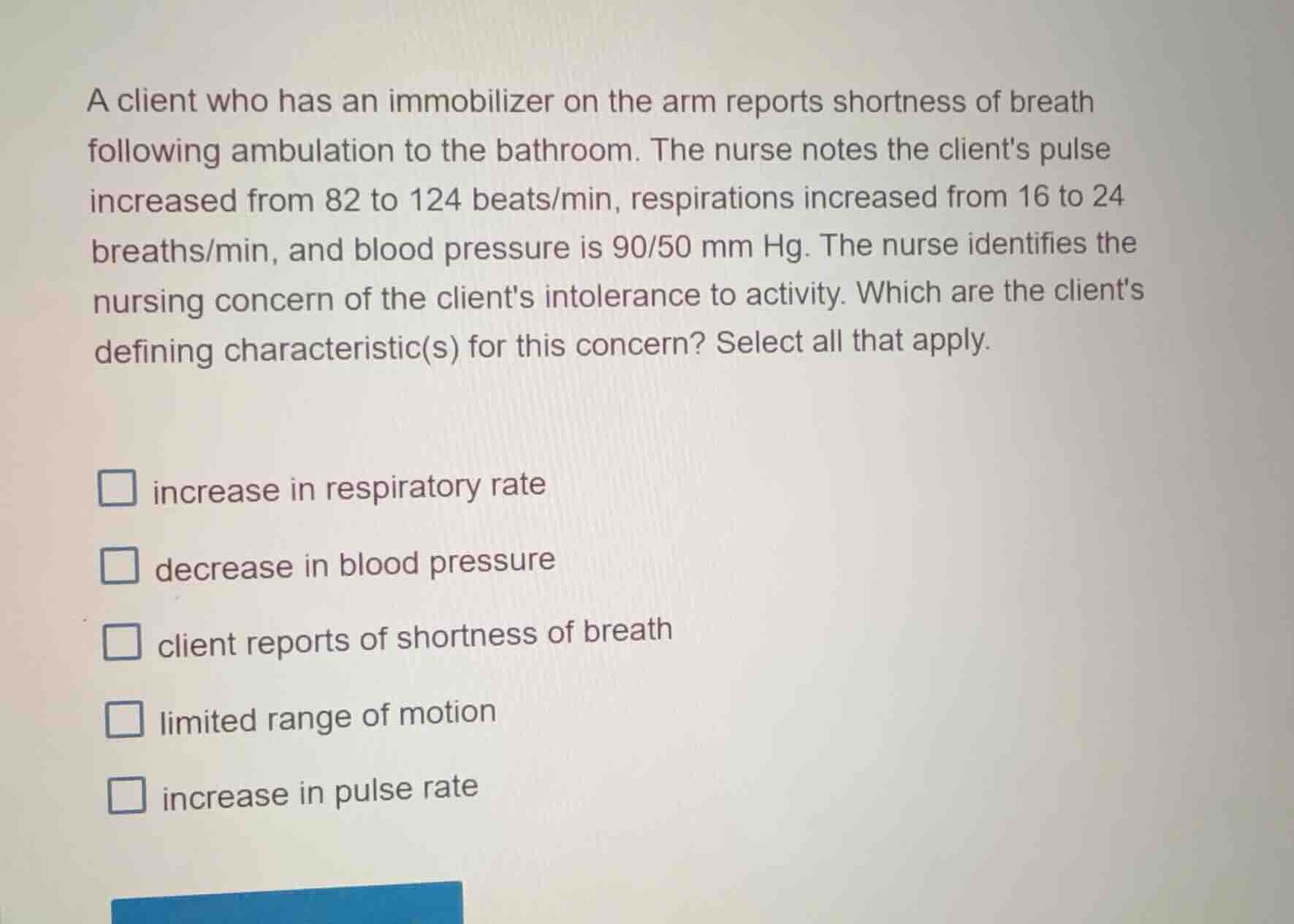
a client who has an immobilizer on the arm reports shortness of breath following ambulation to the bathroom. the nurse notes the clients pulse increased from 82 to 124 beats/min, respirations increased from 16 to 24 breaths/min, and blood pressure is 90/50 mm hg. the nurse identifies the nursing concern of the clients intolerance to activity. which are the clients defining characteristic(s) for this concern? select all that apply.
increase in respiratory rate
decrease in blood pressure
client reports of shortness of breath
limited range of motion
increase in pulse rate
Analyze the nursing concern
Using the Nursing Diagnosis knowledge point, we identify the diagnostic label as Activity Intolerance. This diagnosis is defined as insufficient physiological or psychological energy to endure or complete required or desired daily activities.
Identify defining characteristics
Using the Diagnostic Reasoning knowledge point, we analyze the clinical data (subjective and objective cues) that support this specific diagnosis:
- The client's respiratory rate increased from 16 to 24 breaths/min (abnormal response to activity).
- The client's pulse rate increased from 82 to 124 beats/min (abnormal response to activity).
- The client reports shortness of breath (dyspnea) following ambulation.
Evaluate remaining options
- decrease in blood pressure: While the blood pressure is low (\(90/50\text{ mm Hg}\)), there is no baseline blood pressure provided to confirm a decrease, nor is a decrease in blood pressure a standard defining characteristic of Activity Intolerance (typically, an abnormal increase or failure to increase is assessed, though orthostatic decrease can occur; however, without a baseline, a "decrease" cannot be established).
- limited range of motion: This is related to physical mobility impairment, not the physiological energy expenditure of Activity Intolerance.

Snap & solve any problem in the app
Get step-by-step solutions on Sovi AI
Photo-based solutions with guided steps
Explore more problems and detailed explanations
- increase in respiratory rate (Correct answer)
- decrease in blood pressure
- client reports of shortness of breath (Correct answer)
- limited range of motion
- increase in pulse rate (Correct answer)