QUESTION IMAGE
Question
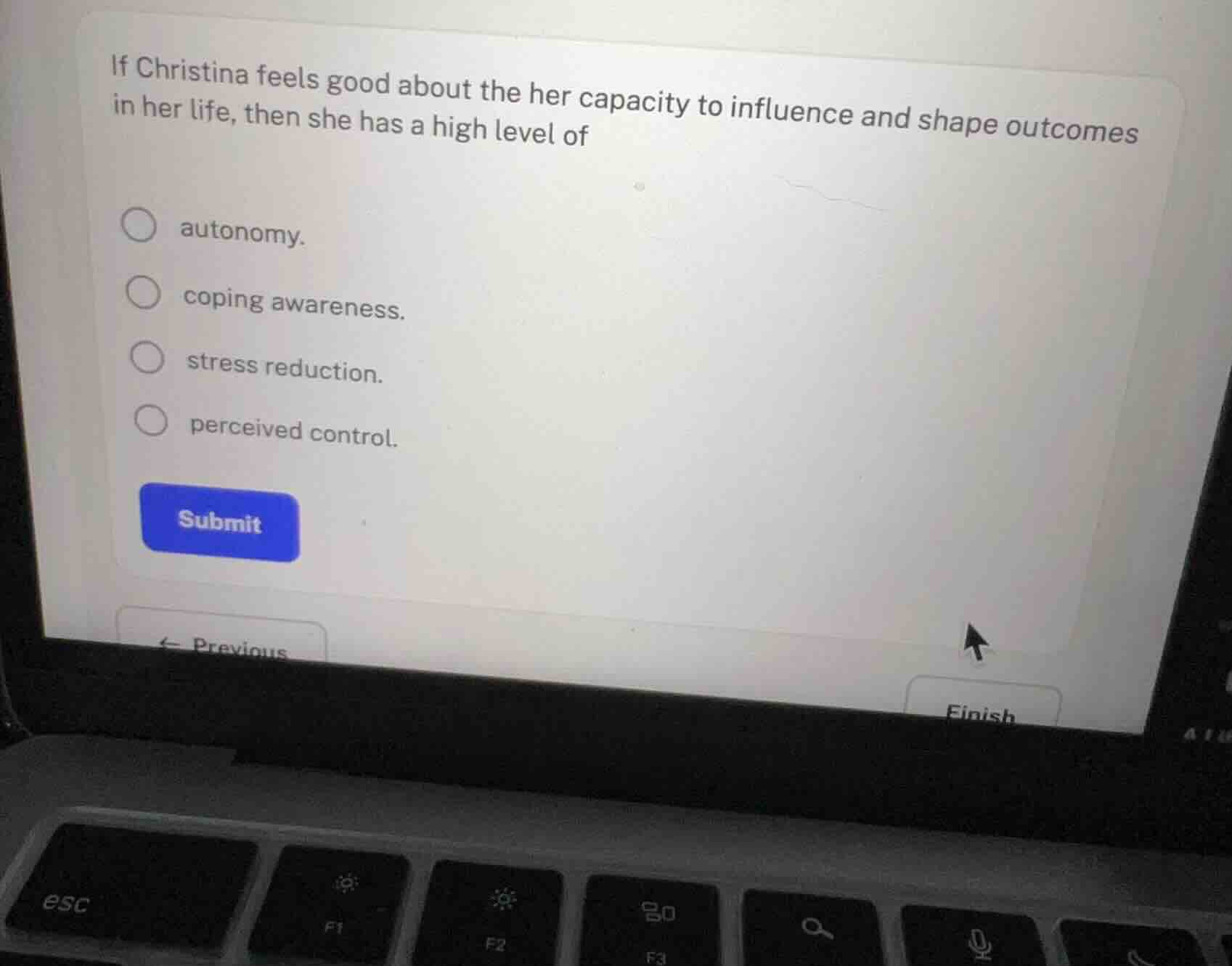
if christina feels good about the her capacity to influence and shape outcomes in her life, then she has a high level of
autonomy.
coping awareness.
stress reduction.
perceived control.
<pre_analysis>
{
"quality": "clear",
"question_count": 1,
"skills_matched": [
"direct_cot",
"multiple_choice_formatter",
"explain_then_answer",
"tutor"
],
"needs_drawing": false,
"concepts_used": [
"Coping Mechanisms"
],
"new_concepts": [
"Perceived Control",
"Locus of Control"
],
"current_concepts": [
"Coping Mechanisms",
"Perceived Control",
"Locus of Control"
]
}
</pre_analysis>
<reasoning>
Analyze the question prompt
The question asks about a person's belief in their capacity to influence and shape outcomes in their life. This refers to a psychological construct regarding personal agency and the belief that one has power over their own life events.
Evaluate the options
- autonomy: While related to independence and self-governance, autonomy refers more to the freedom to make choices rather than the specific belief in one's capacity to influence and shape external outcomes.
- coping awareness: This refers to being aware of how one manages stress, which does not directly define the capacity to shape life outcomes.
- stress reduction: This is an outcome or a process of lowering stress levels, not a belief about personal influence.
- perceived control: In psychology, perceived control is defined as the belief that one can determine one's own internal states and behavior, influence one's environment, and/or bring about desired outcomes. This matches the prompt perfectly.
Relate to psychological concepts
Using the Coping Mechanisms knowledge point, we understand that having a high level of perceived control is a crucial cognitive resource that helps individuals manage stress and actively shape their life circumstances.
</reasoning>
<answer>
<mcq-option>(A) autonomy.</mcq-option>
<mcq-option>(B) coping awareness.</mcq-option>
<mcq-option>(C) stress reduction.</mcq-correct>
<mcq-correct>(D) perceived control.</mcq-correct>
</answer>
<post_analysis>
{
"subject": "Social Science",
"question_type": "Multiple Choice",
"knowledge_point": [
"Social Science",
"Psychology",
"Stress and Coping"
]
}
</post_analysis>
Snap & solve any problem in the app
Get step-by-step solutions on Sovi AI
Photo-based solutions with guided steps
Explore more problems and detailed explanations
<pre_analysis>
{
"quality": "clear",
"question_count": 1,
"skills_matched": [
"direct_cot",
"multiple_choice_formatter",
"explain_then_answer",
"tutor"
],
"needs_drawing": false,
"concepts_used": [
"Coping Mechanisms"
],
"new_concepts": [
"Perceived Control",
"Locus of Control"
],
"current_concepts": [
"Coping Mechanisms",
"Perceived Control",
"Locus of Control"
]
}
</pre_analysis>
<reasoning>
Analyze the question prompt
The question asks about a person's belief in their capacity to influence and shape outcomes in their life. This refers to a psychological construct regarding personal agency and the belief that one has power over their own life events.
Evaluate the options
- autonomy: While related to independence and self-governance, autonomy refers more to the freedom to make choices rather than the specific belief in one's capacity to influence and shape external outcomes.
- coping awareness: This refers to being aware of how one manages stress, which does not directly define the capacity to shape life outcomes.
- stress reduction: This is an outcome or a process of lowering stress levels, not a belief about personal influence.
- perceived control: In psychology, perceived control is defined as the belief that one can determine one's own internal states and behavior, influence one's environment, and/or bring about desired outcomes. This matches the prompt perfectly.
Relate to psychological concepts
Using the Coping Mechanisms knowledge point, we understand that having a high level of perceived control is a crucial cognitive resource that helps individuals manage stress and actively shape their life circumstances.
</reasoning>
<answer>
<mcq-option>(A) autonomy.</mcq-option>
<mcq-option>(B) coping awareness.</mcq-option>
<mcq-option>(C) stress reduction.</mcq-correct>
<mcq-correct>(D) perceived control.</mcq-correct>
</answer>
<post_analysis>
{
"subject": "Social Science",
"question_type": "Multiple Choice",
"knowledge_point": [
"Social Science",
"Psychology",
"Stress and Coping"
]
}
</post_analysis>