QUESTION IMAGE
Question
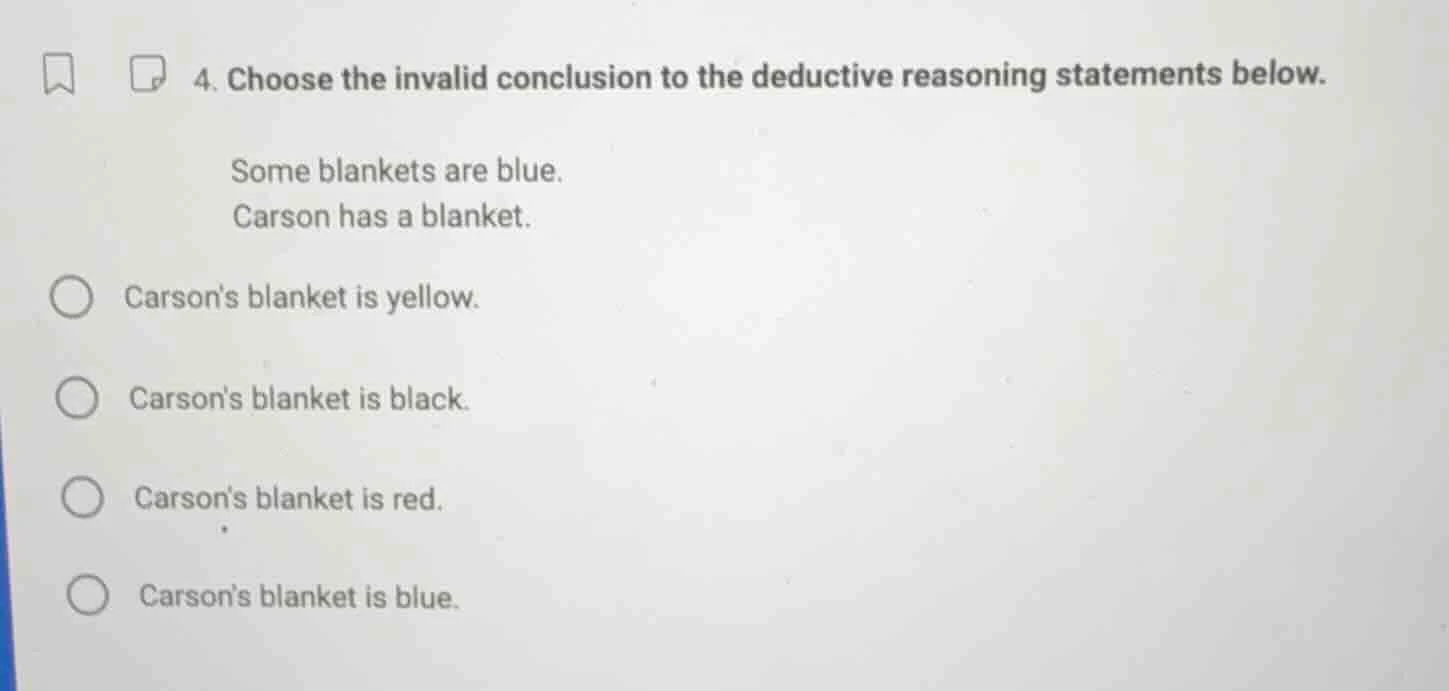
- choose the invalid conclusion to the deductive reasoning statements below.
some blankets are blue.
carson has a blanket.
○ carsons blanket is yellow.
○ carsons blanket is black.
○ carsons blanket is red.
○ carsons blanket is blue.
The given statements are "Some blankets are blue" and "Carson has a blanket". The statement "Some blankets are blue" means only a portion of blankets are blue, not all. However, we cannot be certain that Carson's blanket is blue (or any specific non - blue color) with absolute certainty from the given premises. But the question is to find the invalid conclusion. Wait, actually, all the non - blue color conclusions (yellow, black, red) and the blue conclusion are all possible? No, wait, the key is that the premise "Some blankets are blue" does not allow us to conclude for sure that Carson's blanket is blue. But actually, the question is about which conclusion is invalid. Wait, no, let's re - examine. The premise is "Some blankets are blue" (so there are blankets that are blue and blankets that are not blue) and "Carson has a blanket". So Carson's blanket could be blue or any other color. But the conclusion "Carson's blanket is blue" is not necessarily true (because only some blankets are blue), while the other conclusions (yellow, black, red) are also not necessarily true. Wait, maybe I misread. Wait, the question is to choose the invalid conclusion. Wait, no, maybe the intended reasoning is that since only some blankets are blue, we can't conclude that Carson's blanket is blue. But actually, all the options (yellow, black, red, blue) are possible, but the conclusion that is invalid (i.e., cannot be deduced) is "Carson's blanket is blue" because the premise only says some blankets are blue, not that Carson's blanket is blue. Wait, no, that's not right. Wait, the other options (yellow, black, red) are also not deducible. Wait, maybe the question has a different angle. Wait, the first premise is "Some blankets are blue" – this means that there exists at least one blue blanket, but not all blankets are blue. Carson has a blanket. So the conclusion "Carson's blanket is blue" is a possible conclusion (since there are blue blankets, Carson's could be one of them), but it's not a necessary conclusion. However, the other conclusions (yellow, black, red) are also possible. Wait, maybe the question is flawed, but according to the standard deductive reasoning, when we have "Some A are B" (some blankets are blue) and "x is an A" (Carson's blanket is a blanket), we cannot deduce that "x is B" (Carson's blanket is blue). So the conclusion "Carson's blanket is blue" is invalid because we can't be sure of it from the given premises. The other conclusions (yellow, black, red) are also invalid in the sense that we can't be sure, but maybe the question considers "Carson's blanket is blue" as the invalid one because the premise is "some" not "all".

Snap & solve any problem in the app
Get step-by-step solutions on Sovi AI
Photo-based solutions with guided steps
Explore more problems and detailed explanations
Carson's blanket is blue.