Sovi.AI - AI Math Tutor

Scan to solve math questions

QUESTION IMAGE

choose the correct participle to complete the statement. -\\(\\text{\\t…

Question

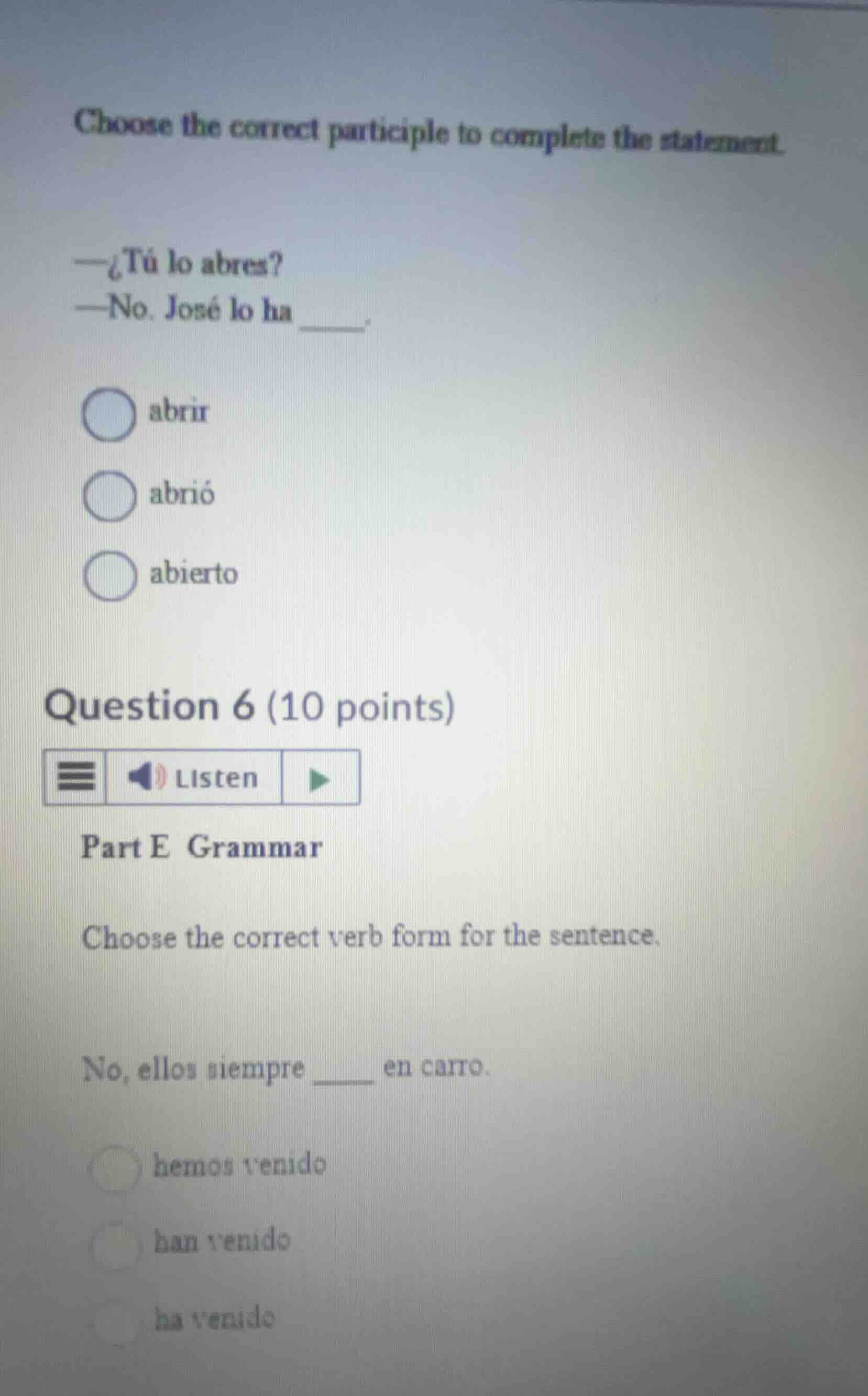
choose the correct participle to complete the statement.

-\\(\text{\textquestiondown t\acute{u} lo abres?}\\)
-no, jos\\(\acute{\text{e}}\\). lo ha ______.

abrir
abri\\(\acute{\text{o}}\\)
abierto

question 6 (10 points)
part e grammar

choose the correct verb form for the sentence.

no, ellos siempre ______ en carro.

hemos venido
han venido
ha venido

Explanation:

Response

<pre_analysis>
{
"quality": "clear",
"question_count": 2,
"skills_matched": [
"direct_cot",
"multiple_choice_formatter",
"explain_then_answer",
"quick"
],
"needs_drawing": false,
"concepts_used": [],
"new_concepts": [
"Spanish Past Participles",
"Spanish Present Perfect"
],
"current_concepts": [
"Spanish Past Participles",
"Spanish Present Perfect"
]
}
</pre_analysis>

<reasoning>

Identify the correct participle for the first question

The sentence is: "—¿Tú lo abres? —No, José lo ha _____."
The auxiliary verb "ha" (from "haber") requires a past participle to form the present perfect tense.
The verb is "abrir" (to open), which has an irregular past participle: "abierto".
Therefore, the correct option is "abierto".

Identify the correct verb form for Question 6

The sentence is: "No, ellos siempre _____ en carro."
The subject is "ellos" (third-person plural).
The options are present perfect forms of "venir" (to come): "hemos venido" (we), "han venido" (they), and "ha venido" (he/she/it/you formal).
The form corresponding to "ellos" is "han venido".
Therefore, the correct option is "han venido".
</reasoning>

<answer>

Question 1

<mcq-option>abrir</mcq-option>
<mcq-option>abrió</mcq-option>
<mcq-correct>abierto</mcq-correct>

Question 2

<mcq-option>hemos venido</mcq-option>
<mcq-correct>han venido</mcq-correct>
<mcq-option>ha venido</mcq-option>
</answer>

<post_analysis>
{
"subject": "Others",
"question_type": "Multiple Choice",
"knowledge_point": [
"Others",
"Spanish",
"Spanish Grammar"
]
}
</post_analysis>

Answer:

<pre_analysis>
{
"quality": "clear",
"question_count": 2,
"skills_matched": [
"direct_cot",
"multiple_choice_formatter",
"explain_then_answer",
"quick"
],
"needs_drawing": false,
"concepts_used": [],
"new_concepts": [
"Spanish Past Participles",
"Spanish Present Perfect"
],
"current_concepts": [
"Spanish Past Participles",
"Spanish Present Perfect"
]
}
</pre_analysis>

<reasoning>

Identify the correct participle for the first question

The sentence is: "—¿Tú lo abres? —No, José lo ha _____."
The auxiliary verb "ha" (from "haber") requires a past participle to form the present perfect tense.
The verb is "abrir" (to open), which has an irregular past participle: "abierto".
Therefore, the correct option is "abierto".

Identify the correct verb form for Question 6

The sentence is: "No, ellos siempre _____ en carro."
The subject is "ellos" (third-person plural).
The options are present perfect forms of "venir" (to come): "hemos venido" (we), "han venido" (they), and "ha venido" (he/she/it/you formal).
The form corresponding to "ellos" is "han venido".
Therefore, the correct option is "han venido".
</reasoning>

<answer>

Question 1

<mcq-option>abrir</mcq-option>
<mcq-option>abrió</mcq-option>
<mcq-correct>abierto</mcq-correct>

Question 2

<mcq-option>hemos venido</mcq-option>
<mcq-correct>han venido</mcq-correct>
<mcq-option>ha venido</mcq-option>
</answer>

<post_analysis>
{
"subject": "Others",
"question_type": "Multiple Choice",
"knowledge_point": [
"Others",
"Spanish",
"Spanish Grammar"
]
}
</post_analysis>