QUESTION IMAGE
Question
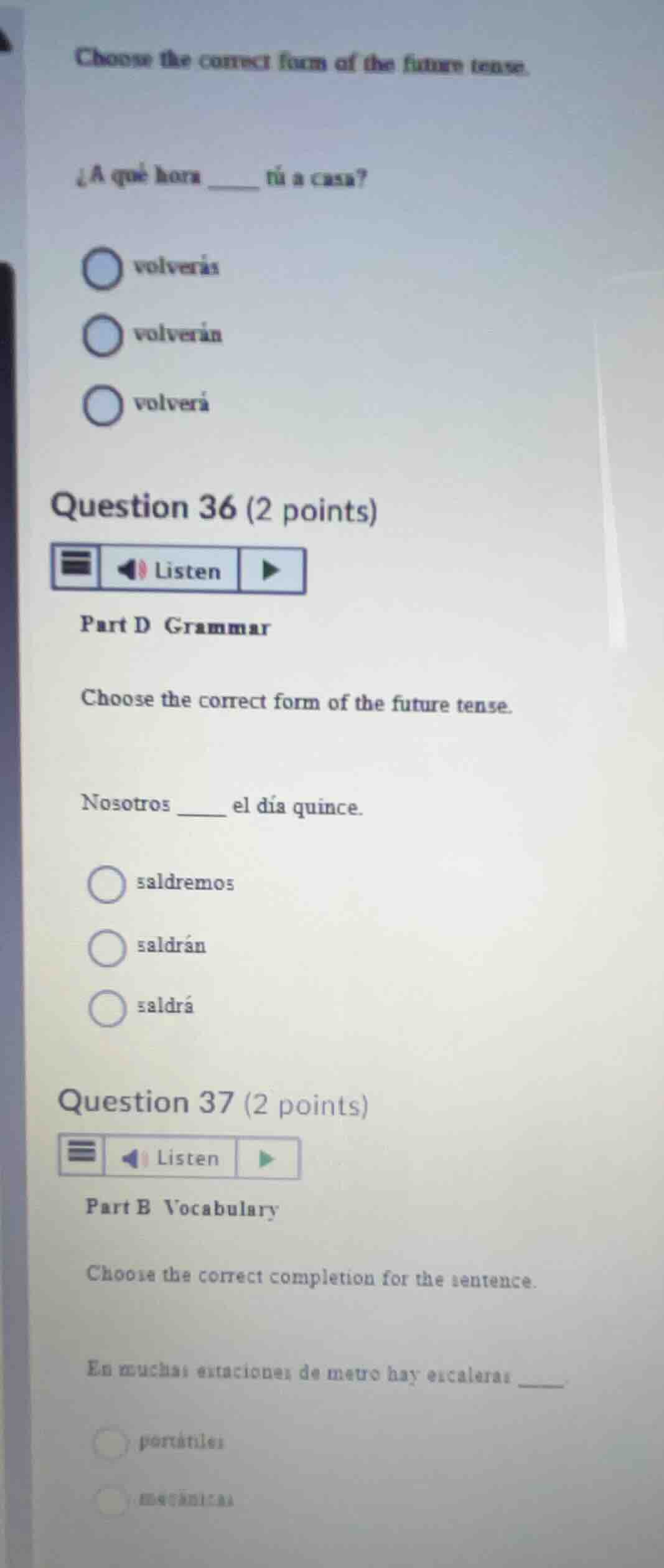
choose the correct form of the future tense.
\\(\text{¿a qué hora \\_\\_\\_\\_\\_ tú a casa?}\\)
- volverás
- volverán
- volverá
question 36 (2 points)
part d grammar
choose the correct form of the future tense.
\\(\text{nosotros \\_\\_\\_\\_\\_ el día quince.}\\)
- saldremos
- saldrán
- saldrá
question 37 (2 points)
part b vocabulary
choose the correct completion for the sentence.
\\(\text{en muchas estaciones de metro hay escaleras \\_\\_\\_\\_\\_}\\)
- portátiles
- mecánicas
<pre_analysis>
{
"quality": "clear",
"question_count": 3,
"skills_matched": [
"direct_cot",
"multiple_choice_formatter",
"explain_then_answer",
"tutor"
],
"needs_drawing": false,
"concepts_used": [],
"new_concepts": [
"Spanish Future Tense",
"Spanish Subject Verb Agreement",
"Spanish Vocabulary"
],
"current_concepts": [
"Spanish Future Tense",
"Spanish Subject Verb Agreement",
"Spanish Vocabulary"
]
}
</pre_analysis>
<reasoning>
Analyze the first question
The first question asks to choose the correct form of the future tense to complete the sentence:
"¿A qué hora ________ tú a casa?"
- The subject pronoun is tú (second-person singular).
- The verb is volver (to return).
- In the Spanish future tense, the endings are added directly to the infinitive. For tú, the ending is -ás.
- Therefore, the correct conjugation is volverás.
- volverán is for ellos/ellas/ustedes.
- volverá is for él/ella/usted.
Analyze Question 36
The second question asks to choose the correct form of the future tense to complete the sentence:
"Nosotros ________ el día quince."
- The subject pronoun is nosotros (first-person plural).
- The verb is salir (to leave/go out), which has an irregular future stem saldr-.
- In the future tense, the ending for nosotros is -emos.
- Combining the stem saldr- with -emos gives saldremos.
- saldrán is for ellos/ellas/ustedes.
- saldrá is for él/ella/usted.
Analyze Question 37
The third question asks to choose the correct completion for the sentence:
"En muchas estaciones de metro hay escaleras ________"
- The sentence translates to: "In many subway stations there are ________ stairs."
- The noun escaleras (stairs) is feminine and plural.
- The options are portátiles (portable) and mecánicas (mechanical/escalators).
- "Escaleras mecánicas" is the standard Spanish term for "escalators," which are commonly found in subway stations.
- Therefore, mecánicas is the correct vocabulary choice.
</reasoning>
<answer>
Question 1
<mcq-correct>volverás</mcq-correct>
<mcq-option>volverán</mcq-option>
<mcq-option>volverá</mcq-option>
Question 36
<mcq-correct>saldremos</mcq-correct>
<mcq-option>saldrán</mcq-option>
<mcq-option>saldrá</mcq-option>
Question 37
<mcq-option>portátiles</mcq-option>
<mcq-correct>mecánicas</mcq-correct>
</answer>
<post_analysis>
{
"subject": "Others",
"question_type": "Multiple Choice",
"knowledge_point": [
"Others",
"Spanish",
"Spanish Grammar and Vocabulary"
]
}
</post_analysis>
Snap & solve any problem in the app
Get step-by-step solutions on Sovi AI
Photo-based solutions with guided steps
Explore more problems and detailed explanations
<pre_analysis>
{
"quality": "clear",
"question_count": 3,
"skills_matched": [
"direct_cot",
"multiple_choice_formatter",
"explain_then_answer",
"tutor"
],
"needs_drawing": false,
"concepts_used": [],
"new_concepts": [
"Spanish Future Tense",
"Spanish Subject Verb Agreement",
"Spanish Vocabulary"
],
"current_concepts": [
"Spanish Future Tense",
"Spanish Subject Verb Agreement",
"Spanish Vocabulary"
]
}
</pre_analysis>
<reasoning>
Analyze the first question
The first question asks to choose the correct form of the future tense to complete the sentence:
"¿A qué hora ________ tú a casa?"
- The subject pronoun is tú (second-person singular).
- The verb is volver (to return).
- In the Spanish future tense, the endings are added directly to the infinitive. For tú, the ending is -ás.
- Therefore, the correct conjugation is volverás.
- volverán is for ellos/ellas/ustedes.
- volverá is for él/ella/usted.
Analyze Question 36
The second question asks to choose the correct form of the future tense to complete the sentence:
"Nosotros ________ el día quince."
- The subject pronoun is nosotros (first-person plural).
- The verb is salir (to leave/go out), which has an irregular future stem saldr-.
- In the future tense, the ending for nosotros is -emos.
- Combining the stem saldr- with -emos gives saldremos.
- saldrán is for ellos/ellas/ustedes.
- saldrá is for él/ella/usted.
Analyze Question 37
The third question asks to choose the correct completion for the sentence:
"En muchas estaciones de metro hay escaleras ________"
- The sentence translates to: "In many subway stations there are ________ stairs."
- The noun escaleras (stairs) is feminine and plural.
- The options are portátiles (portable) and mecánicas (mechanical/escalators).
- "Escaleras mecánicas" is the standard Spanish term for "escalators," which are commonly found in subway stations.
- Therefore, mecánicas is the correct vocabulary choice.
</reasoning>
<answer>
Question 1
<mcq-correct>volverás</mcq-correct>
<mcq-option>volverán</mcq-option>
<mcq-option>volverá</mcq-option>
Question 36
<mcq-correct>saldremos</mcq-correct>
<mcq-option>saldrán</mcq-option>
<mcq-option>saldrá</mcq-option>
Question 37
<mcq-option>portátiles</mcq-option>
<mcq-correct>mecánicas</mcq-correct>
</answer>
<post_analysis>
{
"subject": "Others",
"question_type": "Multiple Choice",
"knowledge_point": [
"Others",
"Spanish",
"Spanish Grammar and Vocabulary"
]
}
</post_analysis>