Sovi.AI - AI Math Tutor

Scan to solve math questions

QUESTION IMAGE

a child has just stopped seizing from a high fever. a rescuer should im…

Question

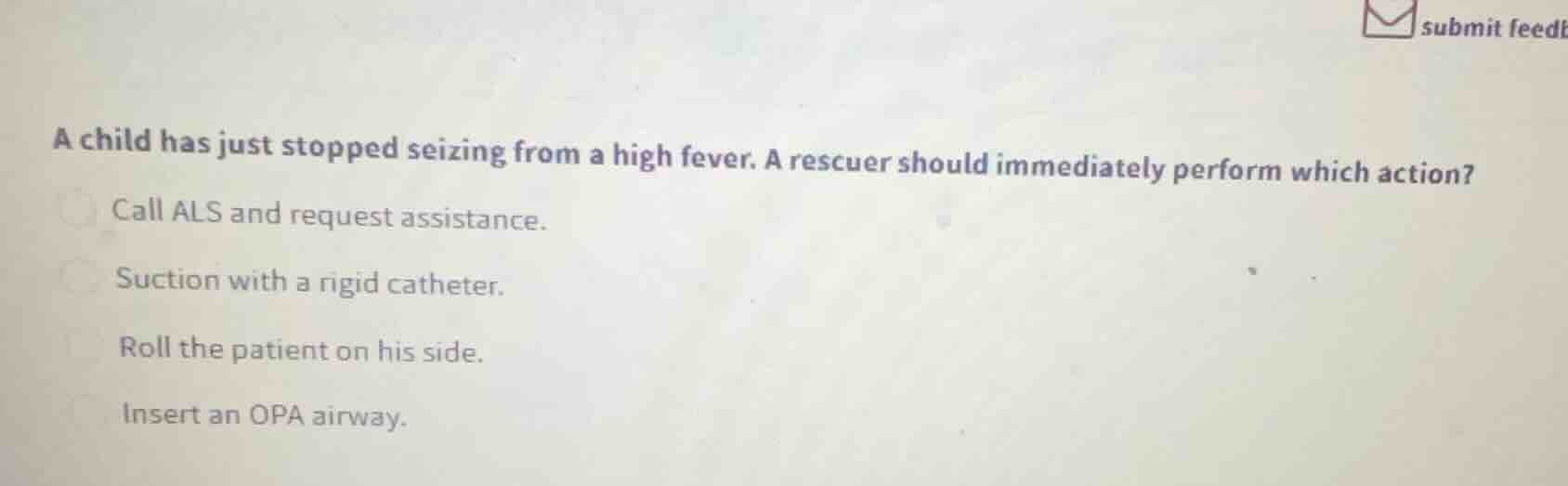
a child has just stopped seizing from a high fever. a rescuer should immediately perform which action?

call als and request assistance.
suction with a rigid catheter.
roll the patient on his side.
insert an opa airway.

Explanation:

Response

<pre_analysis>
{
"quality": "clear",
"question_count": 1,
"skills_matched": [
"direct_cot",
"multiple_choice_formatter",
"explain_then_answer",
"tutor",
"mastery_adaptive_brevity"
],
"needs_drawing": false,
"concepts_used": [
"Postictal Care Protocols",
"Patient Positioning"
],
"new_concepts": [
"Febrile Seizure Management"
],
"current_concepts": [
"Postictal Care Protocols",
"Patient Positioning",
"Febrile Seizure Management"
]
}
</pre_analysis>

<reasoning>

Assess the patient's immediate postictal state

The clinical scenario describes a pediatric patient who has just stopped seizing from a high fever (a febrile seizure). Following a seizure, the patient enters the postictal phase, during which they often have a decreased level of consciousness, relaxed airway muscles, and a high risk of airway obstruction from the tongue or secretions (such as saliva or vomit).

Determine the priority intervention

Using the Postictal Care Protocols and Patient Positioning knowledge points

  • Airway protection is the immediate priority for any postictal patient.
  • Placing the patient in the recovery position (rolling them onto their side) helps keep the airway open by allowing gravity to prevent the tongue from blocking the pharynx and facilitates the drainage of secretions to prevent aspiration.
  • Other interventions like suctioning are only performed if active secretions are blocking the airway, and invasive airway adjuncts like an OPA (oropharyngeal airway) are contraindicated if the patient has a gag reflex. Calling ALS is important but secondary to immediate airway protection.

Select the correct option

Based on standard emergency care protocols, the immediate action is to roll the patient onto his side (recovery position) to protect the airway.
</reasoning>

<answer>
<mcq-option>Call ALS and request assistance.</mcq-option>
<mcq-option>Suction with a rigid catheter.</mcq-option>
<mcq-correct>Roll the patient on his side.</mcq-correct>
<mcq-option>Insert an OPA airway.</mcq-option>
</answer>

<post_analysis>
{
"subject": "Natural Science",
"question_type": "Multiple Choice",
"knowledge_point": [
"Natural Science",
"Medicine",
"Emergency Medical Services"
]
}
</post_analysis>

Answer:

<pre_analysis>
{
"quality": "clear",
"question_count": 1,
"skills_matched": [
"direct_cot",
"multiple_choice_formatter",
"explain_then_answer",
"tutor",
"mastery_adaptive_brevity"
],
"needs_drawing": false,
"concepts_used": [
"Postictal Care Protocols",
"Patient Positioning"
],
"new_concepts": [
"Febrile Seizure Management"
],
"current_concepts": [
"Postictal Care Protocols",
"Patient Positioning",
"Febrile Seizure Management"
]
}
</pre_analysis>

<reasoning>

Assess the patient's immediate postictal state

The clinical scenario describes a pediatric patient who has just stopped seizing from a high fever (a febrile seizure). Following a seizure, the patient enters the postictal phase, during which they often have a decreased level of consciousness, relaxed airway muscles, and a high risk of airway obstruction from the tongue or secretions (such as saliva or vomit).

Determine the priority intervention

Using the Postictal Care Protocols and Patient Positioning knowledge points

  • Airway protection is the immediate priority for any postictal patient.
  • Placing the patient in the recovery position (rolling them onto their side) helps keep the airway open by allowing gravity to prevent the tongue from blocking the pharynx and facilitates the drainage of secretions to prevent aspiration.
  • Other interventions like suctioning are only performed if active secretions are blocking the airway, and invasive airway adjuncts like an OPA (oropharyngeal airway) are contraindicated if the patient has a gag reflex. Calling ALS is important but secondary to immediate airway protection.

Select the correct option

Based on standard emergency care protocols, the immediate action is to roll the patient onto his side (recovery position) to protect the airway.
</reasoning>

<answer>
<mcq-option>Call ALS and request assistance.</mcq-option>
<mcq-option>Suction with a rigid catheter.</mcq-option>
<mcq-correct>Roll the patient on his side.</mcq-correct>
<mcq-option>Insert an OPA airway.</mcq-option>
</answer>

<post_analysis>
{
"subject": "Natural Science",
"question_type": "Multiple Choice",
"knowledge_point": [
"Natural Science",
"Medicine",
"Emergency Medical Services"
]
}
</post_analysis>