QUESTION IMAGE
Question
check all that apply
flattened, abstract style
fresco
halo identifying royal stature
mosaic
realist style
Identify the artwork
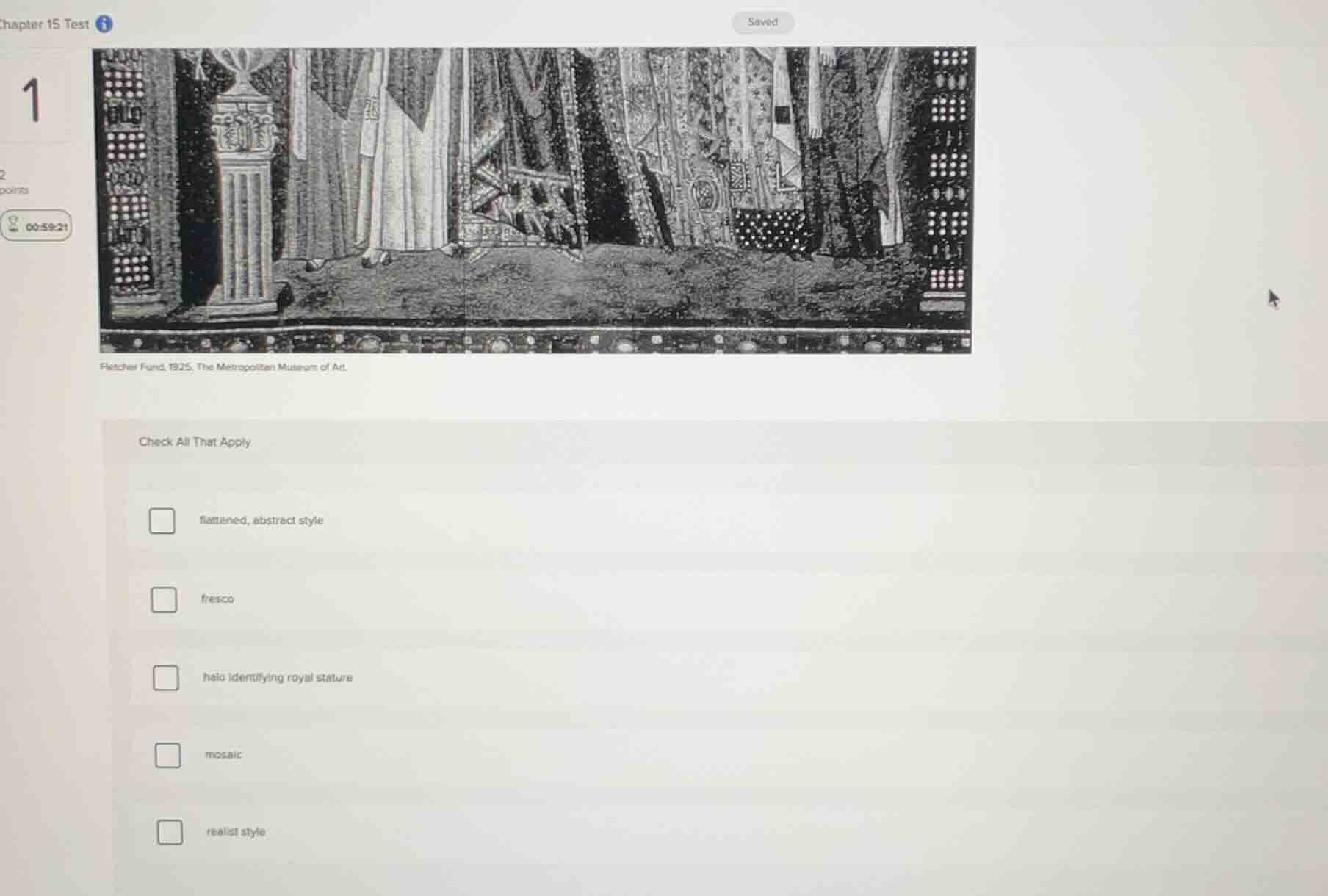
The image shows a detail of the famous Byzantine mosaic from the Basilica of San Vitale in Ravenna, Italy, specifically depicting Empress Theodora and her retinue (dating to around 547 CE). The caption notes "Fletcher Fund, 1925. The Metropolitan Museum of Art," which refers to a high-quality copy or reproduction of this famous work held in their collection.
Analyze medium and style
Using the Fresco vs Mosaic knowledge point, we can identify the medium of this Byzantine masterpiece.
- It is a mosaic made of glass and stone tesserae, not a fresco (which is painted on wet plaster).
- The style of Byzantine art during this period is characterized by a flattened, abstract style where figures appear weightless, frontal, and two-dimensional, rather than a realist style which emphasizes naturalistic depth, volume, and anatomical accuracy.
- The figures, particularly Empress Theodora and Emperor Justinian in their respective panels, are depicted with a halo identifying royal stature (and divine right/sacred status).
Evaluate the options
- flattened, abstract style: Correct. Byzantine mosaics are highly stylized, flat, and abstract.
- fresco: Incorrect. The medium is mosaic.
- halo identifying royal stature: Correct. The empress is depicted with a prominent halo to signify her imperial and sacred authority.
- mosaic: Correct. This is a classic example of Byzantine mosaic art.
- realist style: Incorrect. The style deliberately moves away from classical Greco-Roman realism.

Snap & solve any problem in the app
Get step-by-step solutions on Sovi AI
Photo-based solutions with guided steps
Explore more problems and detailed explanations
- flattened, abstract style (Correct answer)
- fresco
- halo identifying royal stature (Correct answer)
- mosaic (Correct answer)
- realist style