Sovi.AI - AI Math Tutor

Scan to solve math questions

QUESTION IMAGE

the channel tunnel (also called the chunnel) is an underwater tunnel th…

Question

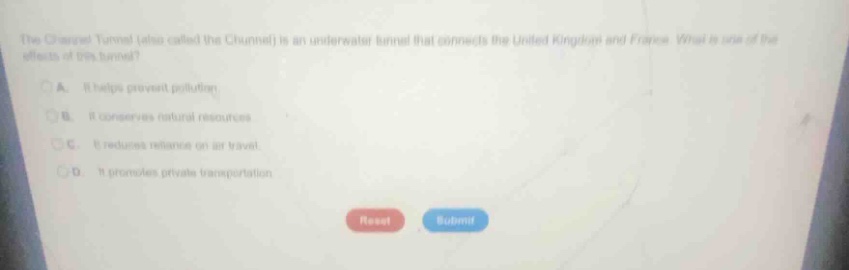
the channel tunnel (also called the chunnel) is an underwater tunnel that connects the united kingdom and france. what is one of the effects of this tunnel?

a. it helps prevent pollution.
b. it conserves natural resources.
c. it reduces reliance on air travel.
d. it promotes private transportation.

Explanation:

Response

<pre_analysis>
{
"quality": "clear",
"question_count": 1,
"skills_matched": [
"direct_cot",
"multiple_choice_formatter",
"explain_then_answer",
"tutor"
],
"needs_drawing": false,
"concepts_used": [
"Technological Evolution"
],
"new_concepts": [
"Transportation Infrastructure",
"European Geography"
],
"current_concepts": [
"Technological Evolution",
"Transportation Infrastructure",
"European Geography"
]
}
</pre_analysis>

<reasoning>

Analyze the question

The question asks for one of the effects of the Channel Tunnel (Chunnel), which connects the United Kingdom and France.

Evaluate the options

  • Option A: "It helps prevent pollution." Building a massive underwater rail tunnel does not directly prevent pollution, although trains are generally more efficient than planes.
  • Option B: "It conserves natural resources." The construction and operation of the tunnel do not directly conserve natural resources.
  • Option C: "It reduces reliance on air travel." By providing a direct high-speed rail link (Eurostar) between London, Paris, and Brussels, the tunnel offers a highly competitive alternative to short-haul flights, thereby reducing reliance on air travel. This is a classic example of Technological Evolution in transportation infrastructure.
  • Option D: "It promotes private transportation." The Chunnel primarily carries passenger and freight trains, as well as vehicle shuttle trains, rather than promoting individual private car travel over public transit.

Select the correct answer

Option C is the most direct and historically accurate effect of the Channel Tunnel.
</reasoning>

<answer>
<mcq-option>(A) It helps prevent pollution.</mcq-option>
<mcq-option>(B) It conserves natural resources.</mcq-option>
<mcq-correct>(C) It reduces reliance on air travel.</mcq-correct>
<mcq-option>(D) It promotes private transportation.</mcq-option>
</answer>

<post_analysis>
{
"subject": "Social Science",
"question_type": "Multiple Choice",
"knowledge_point": [
"Social Science",
"Geography",
"Transportation Infrastructure"
]
}
</post_analysis>

Answer:

<pre_analysis>
{
"quality": "clear",
"question_count": 1,
"skills_matched": [
"direct_cot",
"multiple_choice_formatter",
"explain_then_answer",
"tutor"
],
"needs_drawing": false,
"concepts_used": [
"Technological Evolution"
],
"new_concepts": [
"Transportation Infrastructure",
"European Geography"
],
"current_concepts": [
"Technological Evolution",
"Transportation Infrastructure",
"European Geography"
]
}
</pre_analysis>

<reasoning>

Analyze the question

The question asks for one of the effects of the Channel Tunnel (Chunnel), which connects the United Kingdom and France.

Evaluate the options

  • Option A: "It helps prevent pollution." Building a massive underwater rail tunnel does not directly prevent pollution, although trains are generally more efficient than planes.
  • Option B: "It conserves natural resources." The construction and operation of the tunnel do not directly conserve natural resources.
  • Option C: "It reduces reliance on air travel." By providing a direct high-speed rail link (Eurostar) between London, Paris, and Brussels, the tunnel offers a highly competitive alternative to short-haul flights, thereby reducing reliance on air travel. This is a classic example of Technological Evolution in transportation infrastructure.
  • Option D: "It promotes private transportation." The Chunnel primarily carries passenger and freight trains, as well as vehicle shuttle trains, rather than promoting individual private car travel over public transit.

Select the correct answer

Option C is the most direct and historically accurate effect of the Channel Tunnel.
</reasoning>

<answer>
<mcq-option>(A) It helps prevent pollution.</mcq-option>
<mcq-option>(B) It conserves natural resources.</mcq-option>
<mcq-correct>(C) It reduces reliance on air travel.</mcq-correct>
<mcq-option>(D) It promotes private transportation.</mcq-option>
</answer>

<post_analysis>
{
"subject": "Social Science",
"question_type": "Multiple Choice",
"knowledge_point": [
"Social Science",
"Geography",
"Transportation Infrastructure"
]
}
</post_analysis>