QUESTION IMAGE
Question
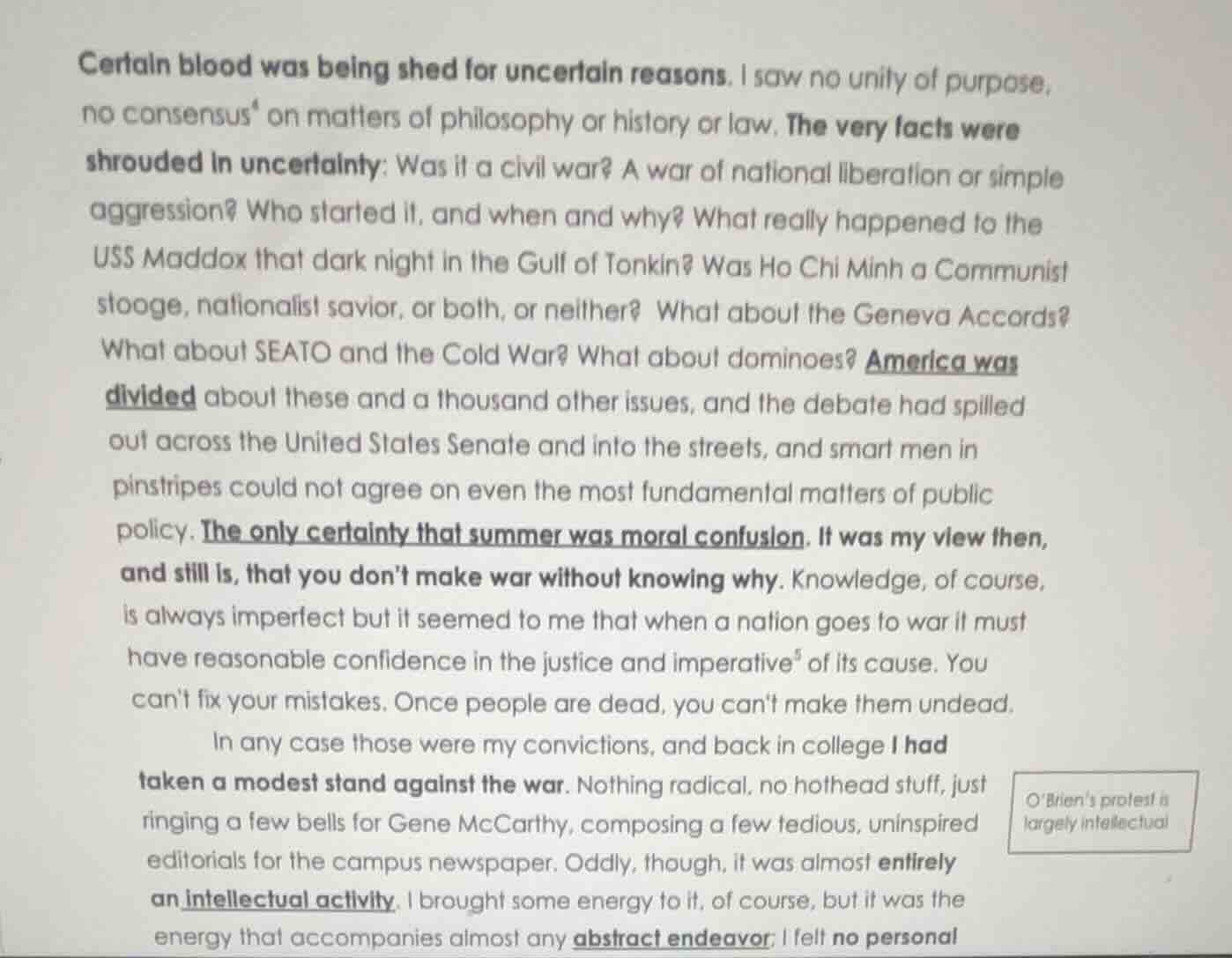
certain blood was being shed for uncertain reasons. i saw no unity of purpose, no consensus on matters of philosophy or history or law. the very facts were shrouded in uncertainty: was it a civil war? a war of national liberation or simple aggression? who started it, and when and why? what really happened to the uss maddox that dark night in the gulf of tonkin? was ho chi minh a communist stooge, nationalist savior, or both, or neither? what about the geneva accords? what about seato and the cold war? what about dominoes? america was divided about these and a thousand other issues, and the debate had spilled out across the united states senate and into the streets, and smart men in pinstripes could not agree on even the most fundamental matters of public policy. the only certainty that summer was moral confusion. it was my view then, and still is, that you dont make war without knowing why. knowledge, of course, is always imperfect but it seemed to me that when a nation goes to war it must have reasonable confidence in the justice and imperative of its cause. you cant fix your mistakes. once people are dead, you cant make them undead.
in any case those were my convictions, and back in college i had taken a modest stand against the war. nothing radical, no hothead stuff, just ringing a few bells for gene mccarthy, composing a few tedious, uninspired editorials for the campus newspaper. oddly, though, it was almost entirely an intellectual activity. i brought some energy to it, of course, but it was the energy that accompanies almost any abstract endeavor; i felt no personal
Analyze the author's central argument
The author reflects on the Vietnam War, arguing that a nation must not wage war without a clear, consensus-driven purpose and moral certainty. He emphasizes that "you don't make war without knowing why" because the consequences (death) are irreversible.
Examine the role of intellectual protest
Using Literary Analysis, we examine how the author characterizes his college-era opposition to the war. He describes it as a "modest stand" and "almost entirely an intellectual activity" consisting of "abstract endeavor" rather than deep personal or emotional conviction.
Connect the text to the margin note
The margin note states, "O'Brien's protest is largely intellectual." This directly aligns with the text where he describes his actions as "ringing a few bells," writing "tedious, uninspired editorials," and feeling "no personal" connection to the physical reality of the conflict at that time.

Snap & solve any problem in the app
Get step-by-step solutions on Sovi AI
Photo-based solutions with guided steps
Explore more problems and detailed explanations
The passage argues that waging war requires absolute moral clarity and a shared national purpose, as the human cost of war is permanent and irreversible ("Once people are dead, you can't make them undead"). The author characterizes his early opposition to the Vietnam War as a detached, "intellectual activity" and an "abstract endeavor" rather than a deeply felt personal or radical crusade, which directly supports the margin note stating his protest was "largely intellectual."