QUESTION IMAGE
Question
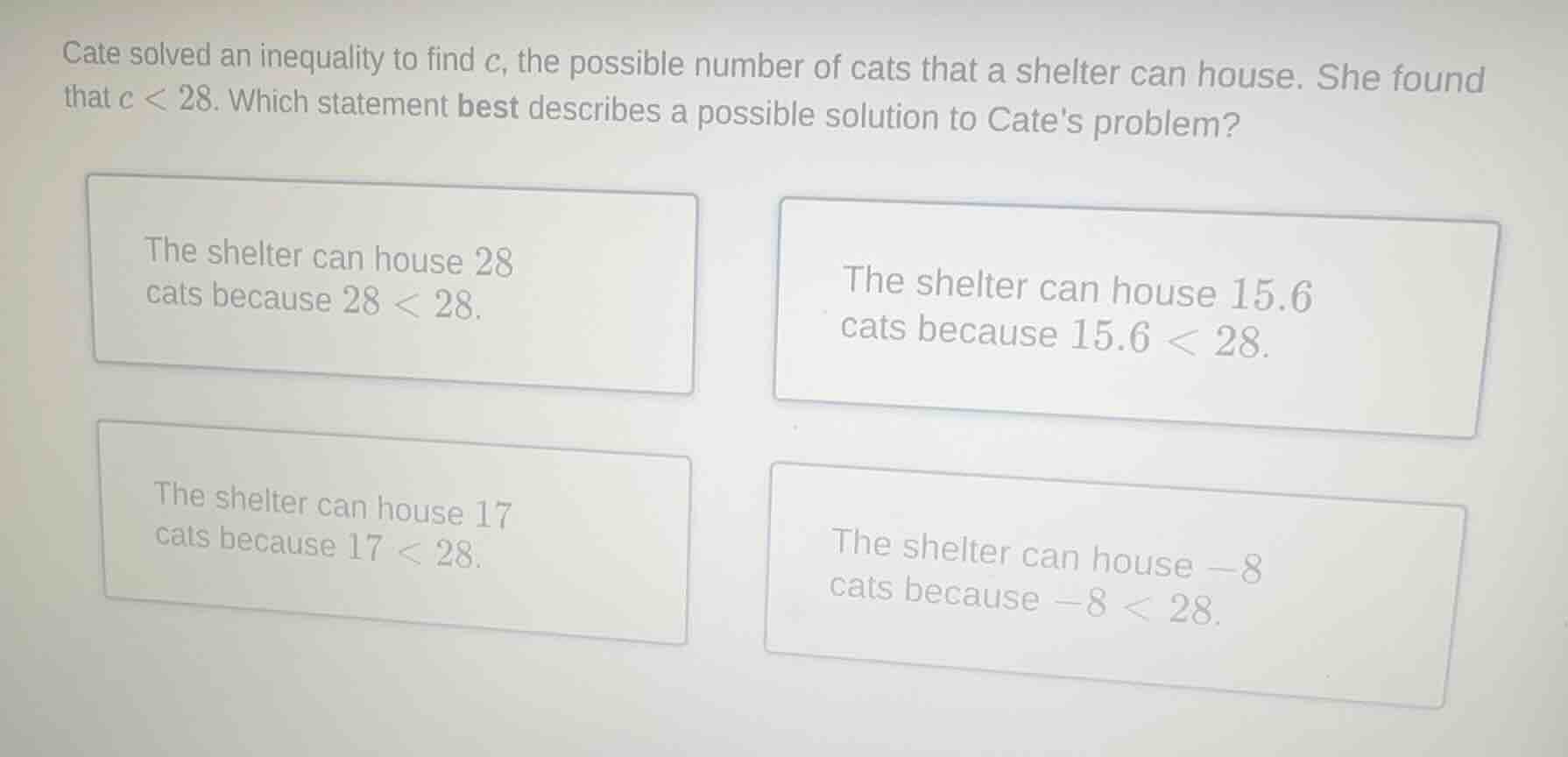
cate solved an inequality to find (c), the possible number of cats that a shelter can house. she found that (c < 28). which statement best describes a possible solution to cates problem?
- the shelter can house 28 cats because (28 < 28).
- the shelter can house 15.6 cats because (15.6 < 28).
- the shelter can house 17 cats because (17 < 28).
- the shelter can house (-8) cats because (-8 < 28).
Analyze the mathematical constraint
Using the Real-world Inequality Constraints knowledge point, we identify that the variable \(c\) represents the number of cats a shelter can house. The solved inequality is:
Evaluate real-world context constraints
Using the Real-world Inequality Constraints knowledge point, we must apply physical constraints to the variable \(c\). Since \(c\) represents a count of living animals (cats), it must satisfy two real-world conditions:
- It must be a non-negative value (\(c \ge 0\)).
- It must be a whole number (an integer), as you cannot have a fraction of a cat.
Verify each option against constraints
Using the Solution Set Verification knowledge point, we test each given statement:
- Option 1: "The shelter can house 28 cats because \(28 < 28\)."
This is mathematically false because \(28\) is not strictly less than \(28\).
- Option 2: "The shelter can house 15.6 cats because \(15.6 < 28\)."
While mathematically true, a shelter cannot house a fractional number of cats (\(15.6\)).
- Option 3: "The shelter can house 17 cats because \(17 < 28\)."
This is mathematically true (\(17 < 28\)) and physically possible since \(17\) is a non-negative whole number.
- Option 4: "The shelter can house \(-8\) cats because \(-8 < 28\)."
While mathematically true, a shelter cannot house a negative number of cats (\(-8\)).
Select the best statement
Using the Solution Set Verification knowledge point, we conclude that housing 17 cats is the only mathematically valid and physically realistic solution.

Snap & solve any problem in the app
Get step-by-step solutions on Sovi AI
Photo-based solutions with guided steps
Explore more problems and detailed explanations
- (A) The shelter can house 28 cats because \(28 < 28\).
- (B) The shelter can house 15.6 cats because \(15.6 < 28\).
- (C) The shelter can house 17 cats because \(17 < 28\). (Correct answer)
- (D) The shelter can house \(-8\) cats because \(-8 < 28\).