QUESTION IMAGE
Question
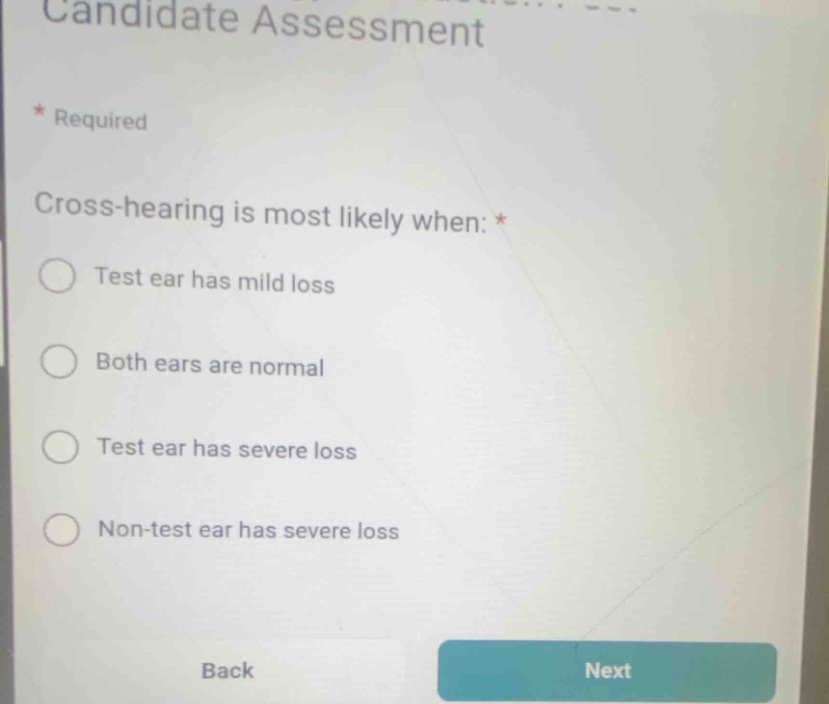
candidate assessment
- required
cross-hearing is most likely when: *
test ear has mild loss
both ears are normal
test ear has severe loss
non-test ear has severe loss
<pre_analysis>
{
"quality": "clear",
"question_count": 1,
"skills_matched": [
"direct_cot",
"multiple_choice_formatter",
"explain_then_answer",
"tutor"
],
"needs_drawing": false,
"concepts_used": [
"Interaural Attenuation",
"Clinical Audiometry"
],
"new_concepts": [],
"current_concepts": [
"Interaural Attenuation",
"Clinical Audiometry",
"Cross-hearing"
]
}
</pre_analysis>
<reasoning>
Define cross-hearing and interaural attenuation
Cross-hearing occurs when a stimulus presented to the test ear (TE) is transmitted across the skull via bone conduction and is perceived by the cochlea of the non-test ear (NTE). This crossover of acoustic energy is limited by Interaural Attenuation, which is the loss of energy as sound travels from one side of the head to the other.
Analyze the role of the test ear
Using the Clinical Audiometry knowledge point, when a signal is presented to a test ear with a severe hearing loss, the presentation level must be raised significantly to reach the patient's threshold. Because the signal level in the test ear is very high, the amount of sound crossing over to the non-test ear is much more likely to exceed the bone-conduction threshold of the non-test ear, making cross-hearing highly probable.
Evaluate the options
- Test ear has mild loss: Presentation levels remain relatively low, making crossover unlikely to exceed the non-test ear's threshold.
- Both ears are normal: Presentation levels are low, so cross-hearing is highly unlikely.
- Test ear has severe loss: Presentation levels must be very high, which significantly increases the likelihood that the crossed-over signal will be heard by the non-test ear.
- Non-test ear has severe loss: If the non-test ear has a severe hearing loss, its threshold is very high, making it much less likely to detect any crossed-over sound.
</reasoning>
<answer>
<mcq-option>Test ear has mild loss</mcq-option>
<mcq-option>Both ears are normal</mcq-option>
<mcq-correct>Test ear has severe loss</mcq-correct>
<mcq-option>Non-test ear has severe loss</mcq-option>
</answer>
<post_analysis>
{
"subject": "Natural Science",
"question_type": "Multiple Choice",
"knowledge_point": [
"Natural Science",
"Medicine",
"Audiology"
]
}
</post_analysis>
Snap & solve any problem in the app
Get step-by-step solutions on Sovi AI
Photo-based solutions with guided steps
Explore more problems and detailed explanations
<pre_analysis>
{
"quality": "clear",
"question_count": 1,
"skills_matched": [
"direct_cot",
"multiple_choice_formatter",
"explain_then_answer",
"tutor"
],
"needs_drawing": false,
"concepts_used": [
"Interaural Attenuation",
"Clinical Audiometry"
],
"new_concepts": [],
"current_concepts": [
"Interaural Attenuation",
"Clinical Audiometry",
"Cross-hearing"
]
}
</pre_analysis>
<reasoning>
Define cross-hearing and interaural attenuation
Cross-hearing occurs when a stimulus presented to the test ear (TE) is transmitted across the skull via bone conduction and is perceived by the cochlea of the non-test ear (NTE). This crossover of acoustic energy is limited by Interaural Attenuation, which is the loss of energy as sound travels from one side of the head to the other.
Analyze the role of the test ear
Using the Clinical Audiometry knowledge point, when a signal is presented to a test ear with a severe hearing loss, the presentation level must be raised significantly to reach the patient's threshold. Because the signal level in the test ear is very high, the amount of sound crossing over to the non-test ear is much more likely to exceed the bone-conduction threshold of the non-test ear, making cross-hearing highly probable.
Evaluate the options
- Test ear has mild loss: Presentation levels remain relatively low, making crossover unlikely to exceed the non-test ear's threshold.
- Both ears are normal: Presentation levels are low, so cross-hearing is highly unlikely.
- Test ear has severe loss: Presentation levels must be very high, which significantly increases the likelihood that the crossed-over signal will be heard by the non-test ear.
- Non-test ear has severe loss: If the non-test ear has a severe hearing loss, its threshold is very high, making it much less likely to detect any crossed-over sound.
</reasoning>
<answer>
<mcq-option>Test ear has mild loss</mcq-option>
<mcq-option>Both ears are normal</mcq-option>
<mcq-correct>Test ear has severe loss</mcq-correct>
<mcq-option>Non-test ear has severe loss</mcq-option>
</answer>
<post_analysis>
{
"subject": "Natural Science",
"question_type": "Multiple Choice",
"knowledge_point": [
"Natural Science",
"Medicine",
"Audiology"
]
}
</post_analysis>