QUESTION IMAGE
Question
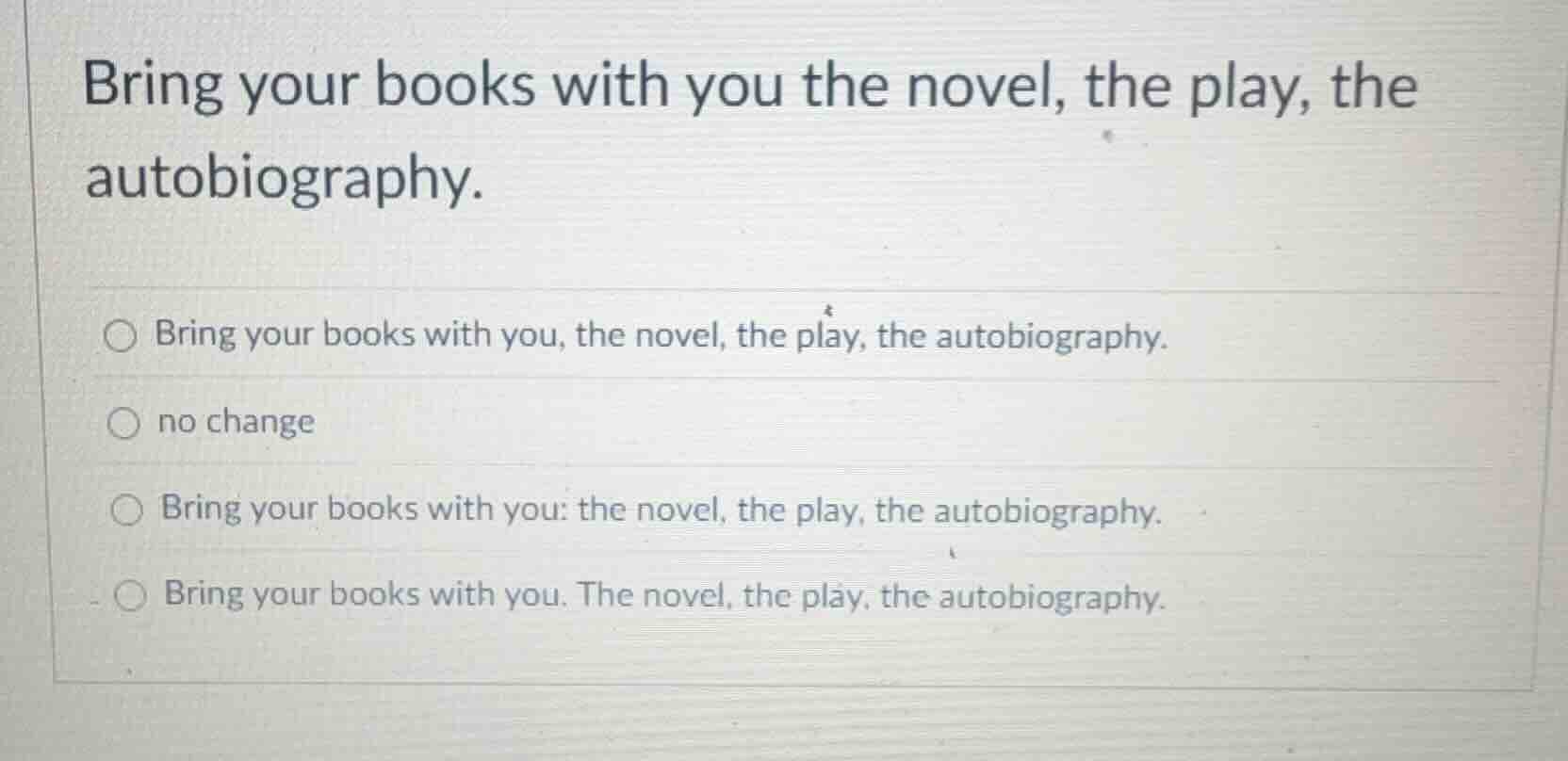
bring your books with you the novel, the play, the autobiography.
- bring your books with you, the novel, the play, the autobiography.
- no change
- bring your books with you: the novel, the play, the autobiography.
- bring your books with you. the novel, the play, the autobiography.
<pre_analysis>
{
"quality": "clear",
"question_count": 1,
"skills_matched": [
"direct_cot",
"multiple_choice_formatter",
"explain_then_answer",
"quick"
],
"needs_drawing": false,
"concepts_used": [
"Punctuation Rules"
],
"new_concepts": [
"Colon Usage"
],
"current_concepts": [
"Punctuation Rules",
"Colon Usage"
]
}
</pre_analysis>
<reasoning>
Analyze the sentence structure
The original sentence contains an independent clause followed by a list of items that explains or defines the noun "books":
"Bring your books with you the novel, the play, the autobiography."
Evaluate punctuation rules for lists
An independent clause introducing a list requires a colon to separate the main clause from the list. A comma creates a run-on or lacks proper separation, while a period creates a sentence fragment ("The novel, the play, the autobiography.").
Compare the options
- Option 1 uses a comma, which is incorrect because "the novel, the play, the autobiography" is an appositive list clarifying "books" and needs stronger separation than a single comma when following a complete clause.
- "no change" lacks any punctuation between "you" and "the novel".
- Option 3 uses a colon, which correctly joins the independent clause to the list.
- Option 4 uses a period, creating an incomplete sentence fragment.
</reasoning>
<answer>
<mcq-option>Bring your books with you, the novel, the play, the autobiography.</mcq-option>
<mcq-option>no change</mcq-option>
<mcq-correct>Bring your books with you: the novel, the play, the autobiography.</mcq-correct>
<mcq-option>Bring your books with you. The novel, the play, the autobiography.</mcq-option>
</answer>
<post_analysis>
{
"subject": "Others",
"question_type": "Multiple Choice",
"knowledge_point": [
"Others",
"English Grammar",
"Punctuation Rules"
]
}
</post_analysis>
Snap & solve any problem in the app
Get step-by-step solutions on Sovi AI
Photo-based solutions with guided steps
Explore more problems and detailed explanations
<pre_analysis>
{
"quality": "clear",
"question_count": 1,
"skills_matched": [
"direct_cot",
"multiple_choice_formatter",
"explain_then_answer",
"quick"
],
"needs_drawing": false,
"concepts_used": [
"Punctuation Rules"
],
"new_concepts": [
"Colon Usage"
],
"current_concepts": [
"Punctuation Rules",
"Colon Usage"
]
}
</pre_analysis>
<reasoning>
Analyze the sentence structure
The original sentence contains an independent clause followed by a list of items that explains or defines the noun "books":
"Bring your books with you the novel, the play, the autobiography."
Evaluate punctuation rules for lists
An independent clause introducing a list requires a colon to separate the main clause from the list. A comma creates a run-on or lacks proper separation, while a period creates a sentence fragment ("The novel, the play, the autobiography.").
Compare the options
- Option 1 uses a comma, which is incorrect because "the novel, the play, the autobiography" is an appositive list clarifying "books" and needs stronger separation than a single comma when following a complete clause.
- "no change" lacks any punctuation between "you" and "the novel".
- Option 3 uses a colon, which correctly joins the independent clause to the list.
- Option 4 uses a period, creating an incomplete sentence fragment.
</reasoning>
<answer>
<mcq-option>Bring your books with you, the novel, the play, the autobiography.</mcq-option>
<mcq-option>no change</mcq-option>
<mcq-correct>Bring your books with you: the novel, the play, the autobiography.</mcq-correct>
<mcq-option>Bring your books with you. The novel, the play, the autobiography.</mcq-option>
</answer>
<post_analysis>
{
"subject": "Others",
"question_type": "Multiple Choice",
"knowledge_point": [
"Others",
"English Grammar",
"Punctuation Rules"
]
}
</post_analysis>