QUESTION IMAGE
Question
bookwork code: 6a
calculator allowed
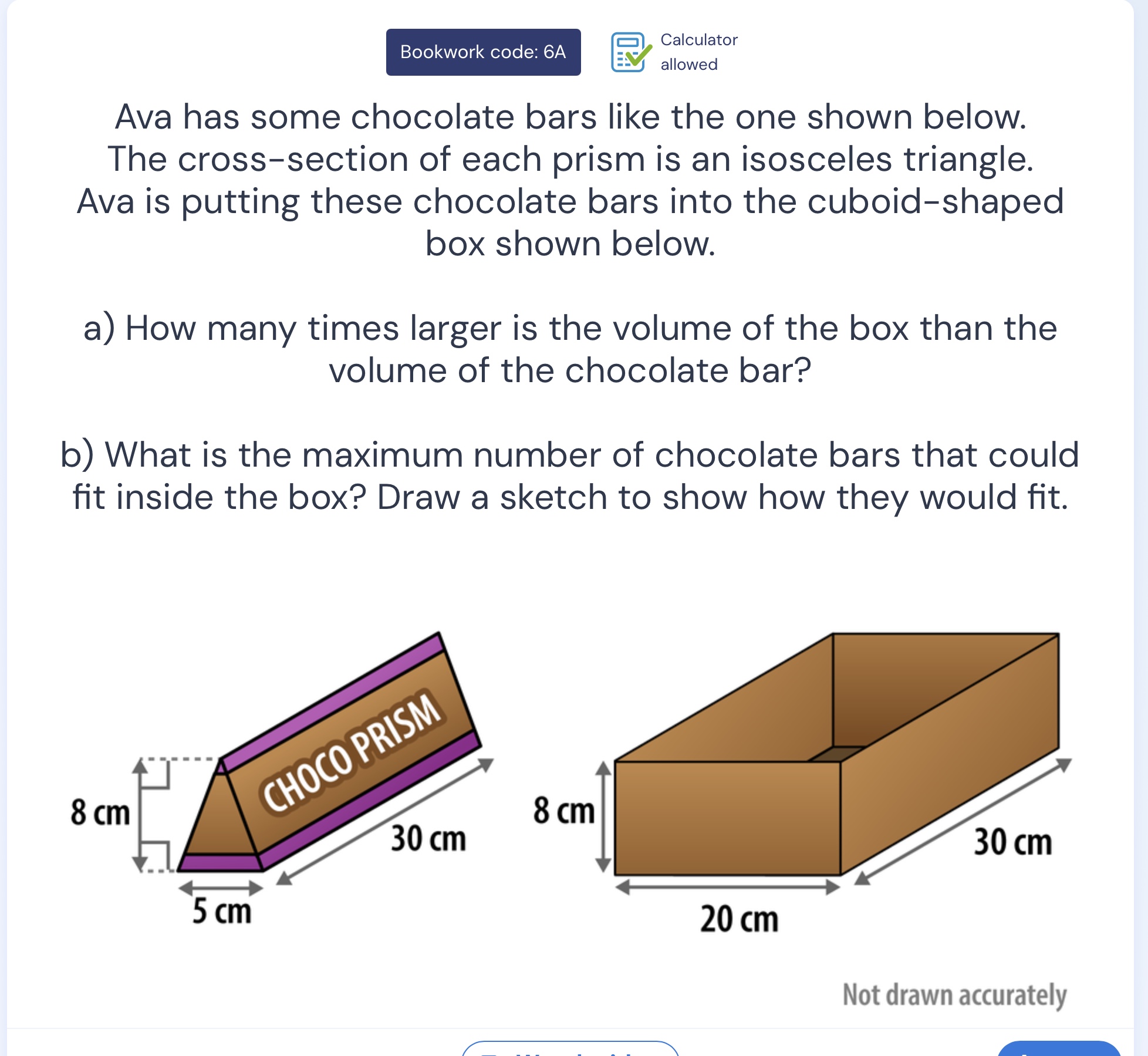
ava has some chocolate bars like the one shown below. the cross-section of each prism is an isosceles triangle. ava is putting these chocolate bars into the cuboid-shaped box shown below.
a) how many times larger is the volume of the box than the volume of the chocolate bar?
b) what is the maximum number of chocolate bars that could fit inside the box? draw a sketch to show how they would fit.
⚡ Using what you learned: volume of prisms, pyramids, cylinders, cones, spheres
Step 1: Calculate the volume of the chocolate bar
The chocolate bar is a triangular prism. Its volume is the area of its triangular cross-section multiplied by its length.
The cross-section is an isosceles triangle with a base of \( 5\text{ cm} \) and a height of \( 8\text{ cm} \).
Step 2: Calculate the volume of the box
The box is a cuboid (rectangular prism).
Step 3: Determine how many times larger the box's volume is
Divide the volume of the box by the volume of a single chocolate bar:
The volume of the box is \( 8 \) times larger than the volume of the chocolate bar.
Step 4: Determine the maximum number of bars that can fit
We want to see if we can pack the chocolate bars to completely fill the box without leaving empty space.
The box has a width of \( 20\text{ cm} \), a height of \( 8\text{ cm} \), and a length of \( 30\text{ cm} \).
Each chocolate bar has a length of \( 30\text{ cm} \), so they can all lie flat along the \( 30\text{ cm} \) length of the box.
Now we look at the cross-section of the box, which is a rectangle of \( 20\text{ cm} \times 8\text{ cm} \).
The cross-section of each bar is an isosceles triangle with a base of \( 5\text{ cm} \) and a height of \( 8\text{ cm} \).
We can fit these triangular cross-sections into the rectangular cross-section of the box:
- Along the \( 20\text{ cm} \) width, we can place \( 4 \) triangles pointing upwards side-by-side (since \( 4 \times 5\text{ cm} = 20\text{ cm} \)).
- In the gaps between these upward-pointing triangles, we can fit \( 4 \) downward-pointing triangles upside down. Each upside-down triangle also has a base of \( 5\text{ cm} \) and a height of \( 8\text{ cm} \), perfectly interlocking to form a solid rectangular block of \( 20\text{ cm} \times 8\text{ cm} \).
This arrangement uses exactly \( 4 + 4 = 8 \) bars. Since the total volume of \( 8 \) bars is exactly equal to the volume of the box (\( 4800\text{ cm}^3 \)), we can fit a maximum of \( 8 \) chocolate bars inside the box with zero wasted space.
Sketch of the arrangement:
Looking at the front face of the box (\( 20\text{ cm} \) wide by \( 8\text{ cm} \) high):
 _________________________________________
| \     / \     / \     / \     / \     / |
|  \   /   \   /   \   /   \   /   \   /  |
|   \ /     \ /     \ /     \ /     \ /   |  8 cm
|    V       V       V       V       V    |
|____|_______|_______|_______|_______|____|
                   20 cm
(4 triangles pointing up, interlocking with 4 triangles pointing down)

Snap & solve any problem in the app
Get step-by-step solutions on Sovi AI
Photo-based solutions with guided steps
Explore more problems and detailed explanations
a) 8 times larger
b) Maximum number of chocolate bars: 8
Sketch description:
Place the bars along the \( 30\text{ cm} \) length of the box. Looking at the front \( 20\text{ cm} \times 8\text{ cm} \) face, arrange \( 4 \) bars pointing upwards side-by-side along the bottom, and interlock them with \( 4 \) bars pointing downwards from the top to completely fill the rectangular space.