QUESTION IMAGE
Question
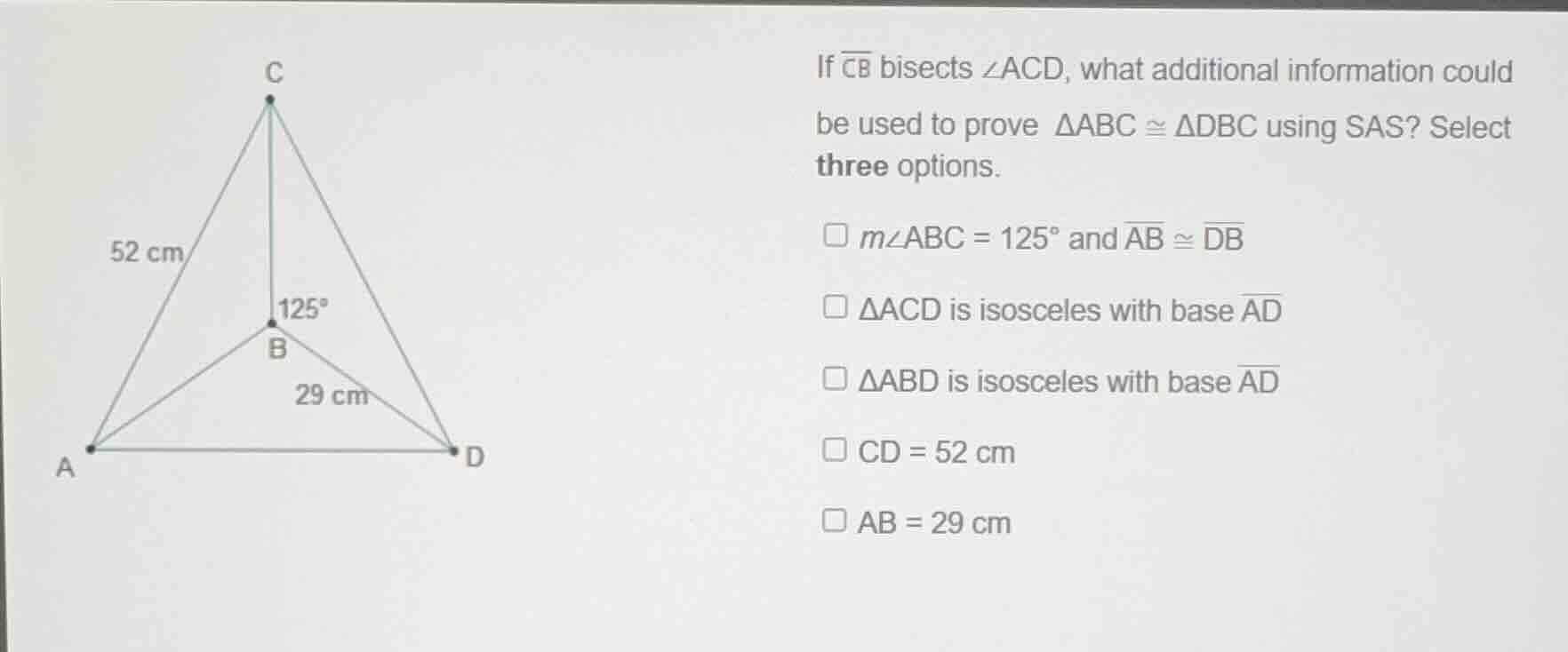
if \\(\overline{cb}\\) bisects \\(\angle acd\\), what additional information could be used to prove \\(\delta abc \cong \delta dbc\\) using sas? select three options.
\\(m\angle abc = 125^\circ\\) and \\(\overline{ab} \cong \overline{db}\\)
\\(\delta acd\\) is isosceles with base \\(\overline{ad}\\)
\\(\delta abd\\) is isosceles with base \\(\overline{ad}\\)
\\(cd = 52\text{ cm}\\)
\\(ab = 29\text{ cm}\\)
Identify given congruent parts
Using the Reflexive Property of Congruence knowledge point
Using the definition of an angle bisector, since \(\overline{CB}\) bisects \(\angle ACD\):
Determine required SAS components
Using the SAS Congruence Postulate knowledge point
To prove \(\Delta ABC \cong \Delta DBC\) using SAS, we need:
- Side: \(\overline{CB} \cong \overline{CB}\) (already established)
- Included Angle: \(\angle ACB \cong \angle DCB\) (already established)
- Side: \(\overline{AC} \cong \overline{DC}\)
Thus, any information that proves \(\overline{AC} \cong \overline{DC}\) (or \(AC = DC = 52\text{ cm}\)) is a correct option.
Evaluate the given options
- Option 1: \(m\angle ABC = 125^\circ\) and \(\overline{AB} \cong \overline{DB}\). This provides SSA, which does not prove congruence.
- Option 2: \(\Delta ACD\) is isosceles with base \(\overline{AD}\). By definition, this means \(\overline{AC} \cong \overline{DC}\), which is correct.
- Option 3: \(\Delta ABD\) is isosceles with base \(\overline{AD}\). This means \(\overline{AB} \cong \overline{DB}\), which does not help prove SAS for \(\Delta ABC \cong \Delta DBC\).
- Option 4: \(CD = 52\text{ cm}\). Since \(AC = 52\text{ cm}\), this means \(AC = CD\), so \(\overline{AC} \cong \overline{DC}\), which is correct.
- Option 5: \(AB = 29\text{ cm}\). Since \(BD = 29\text{ cm}\), this means \(AB = BD\), so \(\overline{AB} \cong \overline{DB}\). Along with \(m\angle ABC = 125^\circ\) (which is equal to \(m\angle DBC\) by symmetry/reflection), this gives SAS using sides \(\overline{CB}\), \(\overline{AB}\) and included angle \(\angle ABC\). Thus, this is also correct.

Snap & solve any problem in the app
Get step-by-step solutions on Sovi AI
Photo-based solutions with guided steps
Explore more problems and detailed explanations
- \(m\angle ABC = 125^\circ\) and \(\overline{AB} \cong \overline{DB}\)
- \(\Delta ACD\) is isosceles with base \(\overline{AD}\) (Correct answer)
- \(\Delta ABD\) is isosceles with base \(\overline{AD}\)
- \(CD = 52\text{ cm}\) (Correct answer)
- \(AB = 29\text{ cm}\) (Correct answer)