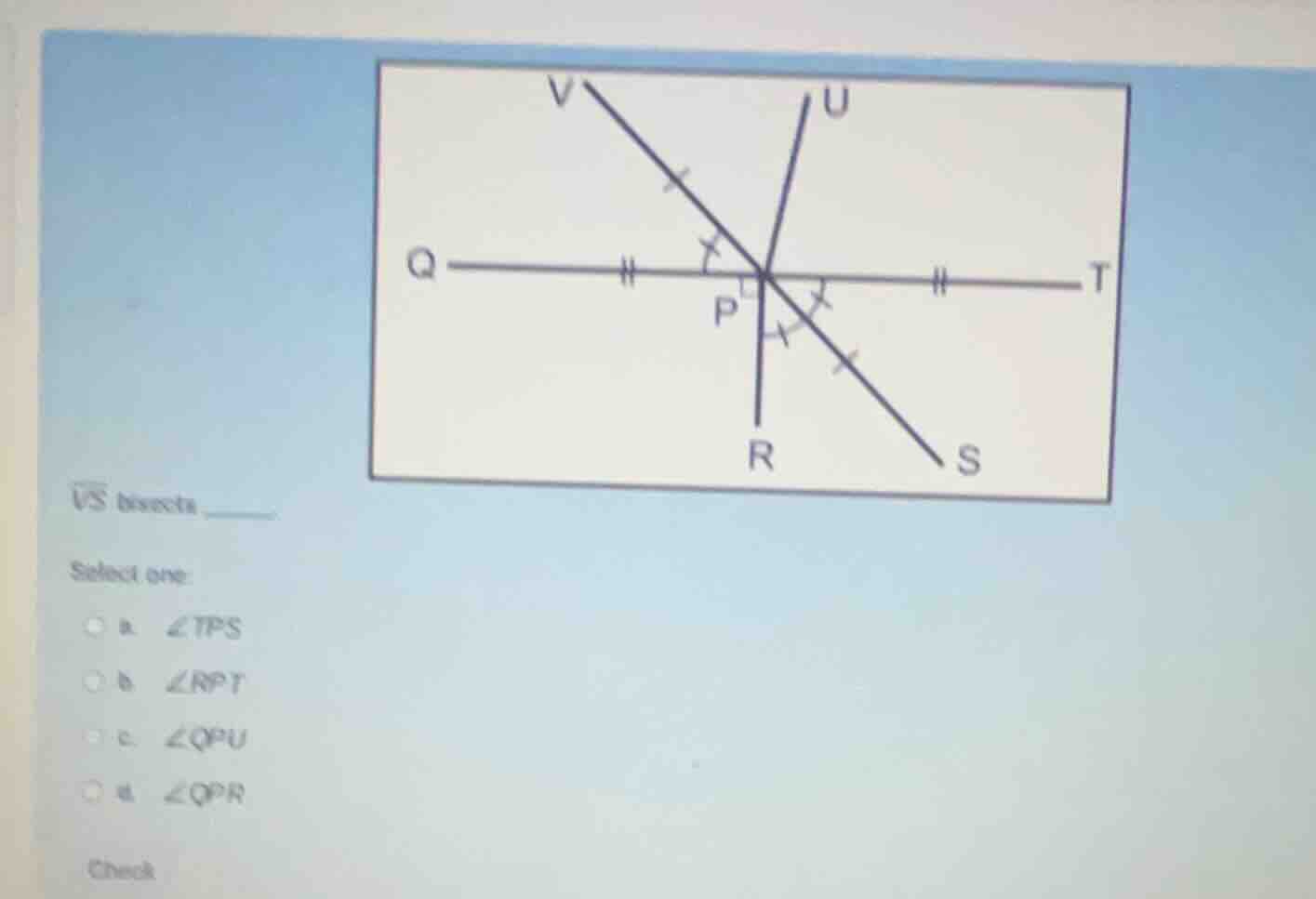
QUESTION IMAGE
Question
\overleftrightarrow{vs} bisects _______
select one:
a. \angle tps
b. \angle rpt
c. \angle qpu
d. \angle qpr
<pre_analysis>
{
"quality": "clear",
"question_count": 1,
"skills_matched": [
"step_cot",
"multiple_choice_formatter",
"explain_then_answer",
"tutor"
],
"needs_drawing": false,
"concepts_used": [],
"new_concepts": [
"Angle Bisector",
"Vertical Angles"
],
"current_concepts": [
"Angle Bisector",
"Vertical Angles",
"Geometric Markings"
]
}
</pre_analysis>
<reasoning>
Analyze the geometric markings
We observe the markings on the angles around the intersection point \(P\).
The line segment or line \(VS\) passes through \(P\).
The angles \(\angle VPQ\) and \(\angle SPT\) are vertical angles, so \(\angle VPQ \cong \angle SPT\).
Looking at the tick marks on the angles:
- \(\angle VPQ\) has a single arc marking.
- \(\angle VPU\) has a single arc marking with a tick mark, which is congruent to \(\angle SPR\).
- Let's look closely at the bisector question: "\(\overleftrightarrow{VS}\) bisects \(\underline{\quad\quad}\)".
- The ray \(PV\) and ray \(PS\) form the line \(VS\).
- There are congruency markings on \(\angle VPQ\) and \(\angle VPU\). Both of these angles have a single arc with a tick mark.
- This means \(\angle VPQ \cong \angle VPU\).
Apply the definition of an angle bisector
An angle bisector is a ray that divides an angle into two congruent adjacent angles.
Since \(\angle VPQ \cong \angle VPU\), the ray \(PV\) (which is part of the line \(VS\)) divides the larger angle \(\angle QPU\) into two congruent angles.
Therefore, the line \(\overleftrightarrow{VS}\) bisects \(\angle QPU\).
Match with the given options
Let's check the multiple-choice options:
- a. \(\angle TPS\)
- b. \(\angle RPT\)
- c. \(\angle QPU\)
- d. \(\angle QPR\)
The correct option is c, which corresponds to \(\angle QPU\).
</reasoning>
<answer>
<mcq-option>a. \(\angle TPS\)</mcq-option>
<mcq-option>b. \(\angle RPT\)</mcq-option>
<mcq-correct>c. \(\angle QPU\)</mcq-correct>
<mcq-option>d. \(\angle QPR\)</mcq-option>
</answer>
<post_analysis>
{
"subject": "Mathematics",
"question_type": "Multiple Choice",
"knowledge_point": [
"Mathematics",
"Geometry",
"Angle Bisector"
]
}
</post_analysis>
Snap & solve any problem in the app
Get step-by-step solutions on Sovi AI
Photo-based solutions with guided steps
Explore more problems and detailed explanations
<pre_analysis>
{
"quality": "clear",
"question_count": 1,
"skills_matched": [
"step_cot",
"multiple_choice_formatter",
"explain_then_answer",
"tutor"
],
"needs_drawing": false,
"concepts_used": [],
"new_concepts": [
"Angle Bisector",
"Vertical Angles"
],
"current_concepts": [
"Angle Bisector",
"Vertical Angles",
"Geometric Markings"
]
}
</pre_analysis>
<reasoning>
Analyze the geometric markings
We observe the markings on the angles around the intersection point \(P\).
The line segment or line \(VS\) passes through \(P\).
The angles \(\angle VPQ\) and \(\angle SPT\) are vertical angles, so \(\angle VPQ \cong \angle SPT\).
Looking at the tick marks on the angles:
- \(\angle VPQ\) has a single arc marking.
- \(\angle VPU\) has a single arc marking with a tick mark, which is congruent to \(\angle SPR\).
- Let's look closely at the bisector question: "\(\overleftrightarrow{VS}\) bisects \(\underline{\quad\quad}\)".
- The ray \(PV\) and ray \(PS\) form the line \(VS\).
- There are congruency markings on \(\angle VPQ\) and \(\angle VPU\). Both of these angles have a single arc with a tick mark.
- This means \(\angle VPQ \cong \angle VPU\).
Apply the definition of an angle bisector
An angle bisector is a ray that divides an angle into two congruent adjacent angles.
Since \(\angle VPQ \cong \angle VPU\), the ray \(PV\) (which is part of the line \(VS\)) divides the larger angle \(\angle QPU\) into two congruent angles.
Therefore, the line \(\overleftrightarrow{VS}\) bisects \(\angle QPU\).
Match with the given options
Let's check the multiple-choice options:
- a. \(\angle TPS\)
- b. \(\angle RPT\)
- c. \(\angle QPU\)
- d. \(\angle QPR\)
The correct option is c, which corresponds to \(\angle QPU\).
</reasoning>
<answer>
<mcq-option>a. \(\angle TPS\)</mcq-option>
<mcq-option>b. \(\angle RPT\)</mcq-option>
<mcq-correct>c. \(\angle QPU\)</mcq-correct>
<mcq-option>d. \(\angle QPR\)</mcq-option>
</answer>
<post_analysis>
{
"subject": "Mathematics",
"question_type": "Multiple Choice",
"knowledge_point": [
"Mathematics",
"Geometry",
"Angle Bisector"
]
}
</post_analysis>