QUESTION IMAGE
Question
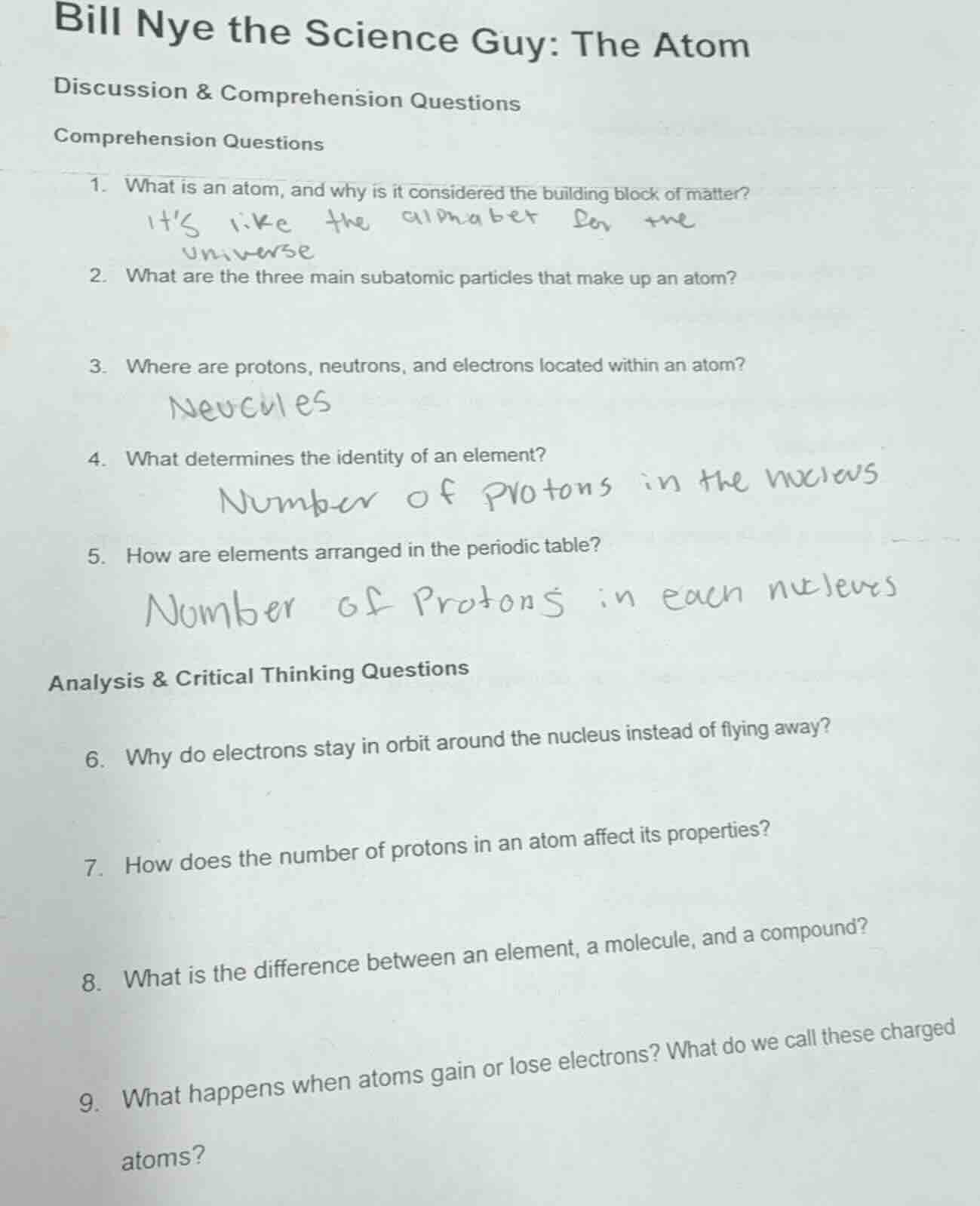
bill nye the science guy: the atom
discussion & comprehension questions
comprehension questions
- what is an atom, and why is it considered the building block of matter?
- what are the three main subatomic particles that make up an atom?
- where are protons, neutrons, and electrons located within an atom?
- what determines the identity of an element?
- how are elements arranged in the periodic table?
analysis & critical thinking questions
- why do electrons stay in orbit around the nucleus instead of flying away?
- how does the number of protons in an atom affect its properties?
- what is the difference between an element, a molecule, and a compound?
- what happens when atoms gain or lose electrons? what do we call these charged atoms?
Define atomic building blocks
An atom is the basic unit of a chemical element. It is considered the building block of matter because everything physical in the universe is made of atoms.
Identify subatomic particles
The three main subatomic particles are protons, neutrons, and electrons. Protons and neutrons reside in the central nucleus, while electrons orbit in the surrounding electron cloud.
Determine elemental identity
The number of protons in the nucleus (the atomic number) uniquely determines the identity of an element. The periodic table arranges elements in order of increasing atomic number.
Explain electromagnetic attraction
Electrons stay in orbit because of the electromagnetic force. The negatively charged electrons are attracted to the positively charged protons in the nucleus.
Distinguish matter classifications
An element consists of only one type of atom. A molecule is two or more atoms chemically bonded. A compound is a molecule containing different elements. When atoms gain or lose electrons, they become charged particles called ions.

Snap & solve any problem in the app
Get step-by-step solutions on Sovi AI
Photo-based solutions with guided steps
Explore more problems and detailed explanations
Question 1
An atom is the basic unit of a chemical element. It is considered the building block of matter because all physical substances in the universe are composed of combinations of these tiny units.
Question 2
The three main subatomic particles that make up an atom are protons, neutrons, and electrons.
Question 3
Protons and neutrons are located inside the nucleus at the center of the atom, while electrons are located in the electron cloud orbiting the nucleus.
Question 4
The number of protons in the nucleus (the atomic number) determines the identity of an element.
Question 5
Elements are arranged in the periodic table in order of increasing atomic number (number of protons).
Question 6
Electrons stay in orbit because of the electromagnetic attraction between the negatively charged electrons and the positively charged protons in the nucleus.
Question 7
The number of protons determines the atomic number, which dictates the number of electrons in a neutral atom. This electron configuration determines how the atom bonds and interacts chemically with other elements.
Question 8
An element is a pure substance made of only one type of atom. A molecule is formed when two or more atoms are chemically bonded together. A compound is a specific type of molecule that contains atoms of two or more different elements.
Question 9
When atoms gain or lose electrons, they acquire an electrical charge. These charged atoms are called ions.