QUESTION IMAGE
Question
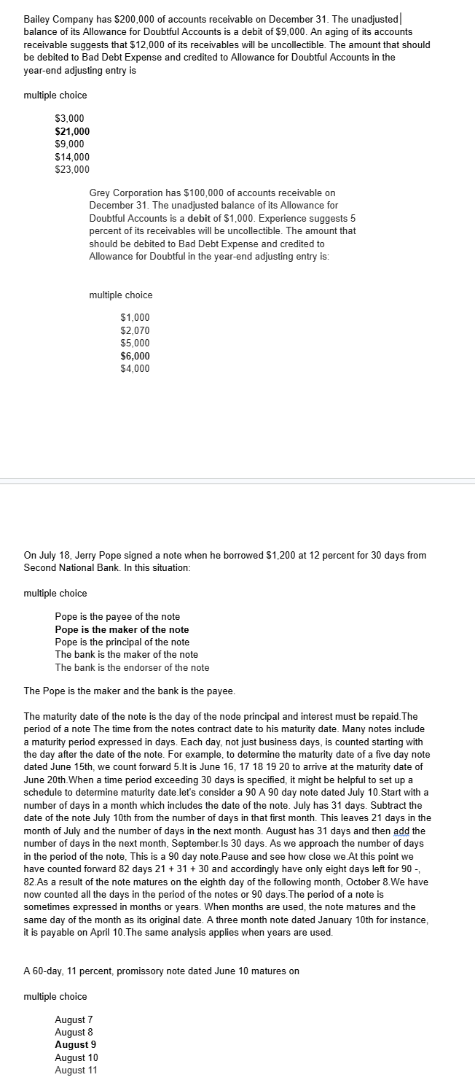
bailey company has \\$200,000 of accounts receivable on december 31. the unadjusted balance of its allowance for doubtful accounts is a debit of \\$9,000. an aging of its accounts receivable suggests that \\$12,000 of its receivables will be uncollectible. the amount that should be debited to bad debt expense and credited to allowance for doubtful accounts in the year-end adjusting entry is
multiple choice
\\$3,000
\\$21,000
\\$9,000
\\$14,000
\\$23,000
grey corporation has \\$100,000 of accounts receivable on december 31. the unadjusted balance of its allowance for doubtful accounts is a debit of \\$1,000. experience suggests 5 percent of its receivables will be uncollectible. the amount that should be debited to bad debt expense and credited to allowance for doubtful accounts in the year-end adjusting entry is:
multiple choice
\\$1,000
\\$2,070
\\$5,000
\\$6,000
\\$4,000
on july 18, jerry pope signed a note when he borrowed \\$1,200 at 12 percent for 30 days from second national bank. in this situation:
multiple choice
pope is the payee of the note
pope is the maker of the note
pope is the principal of the note
the bank is the maker of the note
the bank is the endorser of the note
the pope is the maker and the bank is the payee.
the maturity date of the note is the day of the node principal and interest must be repaid. the period of a note the time from the notes contract date to his maturity date. many notes include a maturity period expressed in days. each day, not just business days, is counted starting with the day after the date of the note. for example, to determine the maturity date of a five day note dated june 15th, we count forward 5. it is june 16, 17 18 19 20 to arrive at the maturity date of june 20th. when a time period exceeding 30 days is specified, it might be helpful to set up a schedule to determine maturity date. lets consider a 90 a 90 day note dated july 10. start with a number of days in a month which includes the date of the note. july has 31 days. subtract the date of the note july 10th from the number of days in that first month. this leaves 21 days in the month of july and the number of days in the next month. august has 31 days and then add the number of days in the next month, september. is 30 days. as we approach the number of days in the period of the note, this is a 90 day note. pause and see how close we. at this point we have counted forward 82 days 21 + 31 + 30 and accordingly have only eight days left for 90 - 82. as a result of the note matures on the eighth day of the following month, october 8. we have now counted all the days in the period of the notes or 90 days. the period of a note is sometimes expressed in months or years. when months are used, the note matures and the same day of the month as its original date. a three month note dated january 10th for instance, is payable on april 10. the same analysis applies when years are used.
a 60-day, 11 percent, promissory note dated june 10 matures on
multiple choice
august 7
august 8
august 9
august 10
august 11
🆕 New Concept Discovered: Allowance Method for Bad Debts
Adjusting for uncollectible accounts using the balance sheet approach.
Step 1: Analyze Bailey Company's Account Balances
The Allowance for Doubtful Accounts is a contra-asset account that normally carries a credit balance.
- Unadjusted Balance: Debit of \( \$9,000 \) (represented as a negative balance of \( -\$9,000 \) relative to its normal credit state).
- Target Ending Balance (from aging): Credit of \( \$12,000 \) (the estimated uncollectible amount).
To find the required adjusting entry to Bad Debt Expense, we calculate the adjustment needed to move the account from a \( \$9,000 \) debit balance to a \( \$12,000 \) credit balance:
Thus, the adjusting entry requires a debit to Bad Debt Expense of \$21,000** and a credit to Allowance for Doubtful Accounts of **\$21,000.
---
Step 2: Analyze Grey Corporation's Account Balances
- Unadjusted Balance: Debit of \( \$1,000 \) (represented as \( -\$1,000 \)).
- Target Ending Balance: \( 5\% \) of Accounts Receivable.
To find the required adjusting entry:
Thus, the adjusting entry requires a debit to Bad Debt Expense of \$6,000** and a credit to Allowance for Doubtful Accounts of **\$6,000.
---
Step 3: Determine the Maturity Date of the Promissory Note
We need to find the maturity date of a 60-day, \( 11\% \) promissory note dated June 10.
- Total days in the note: 60 days
- Days remaining in June:
June has 30 days.
- Days remaining after June:
- Days in July:
July has 31 days. Since 40 days is greater than 31, we use all of July:
Therefore, the note matures on August 9.

Snap & solve any problem in the app
Get step-by-step solutions on Sovi AI
Photo-based solutions with guided steps
Explore more problems and detailed explanations
- Bailey Company: \$21,000
- Grey Corporation: \$6,000
- Maturity Date: August 9