QUESTION IMAGE
Question
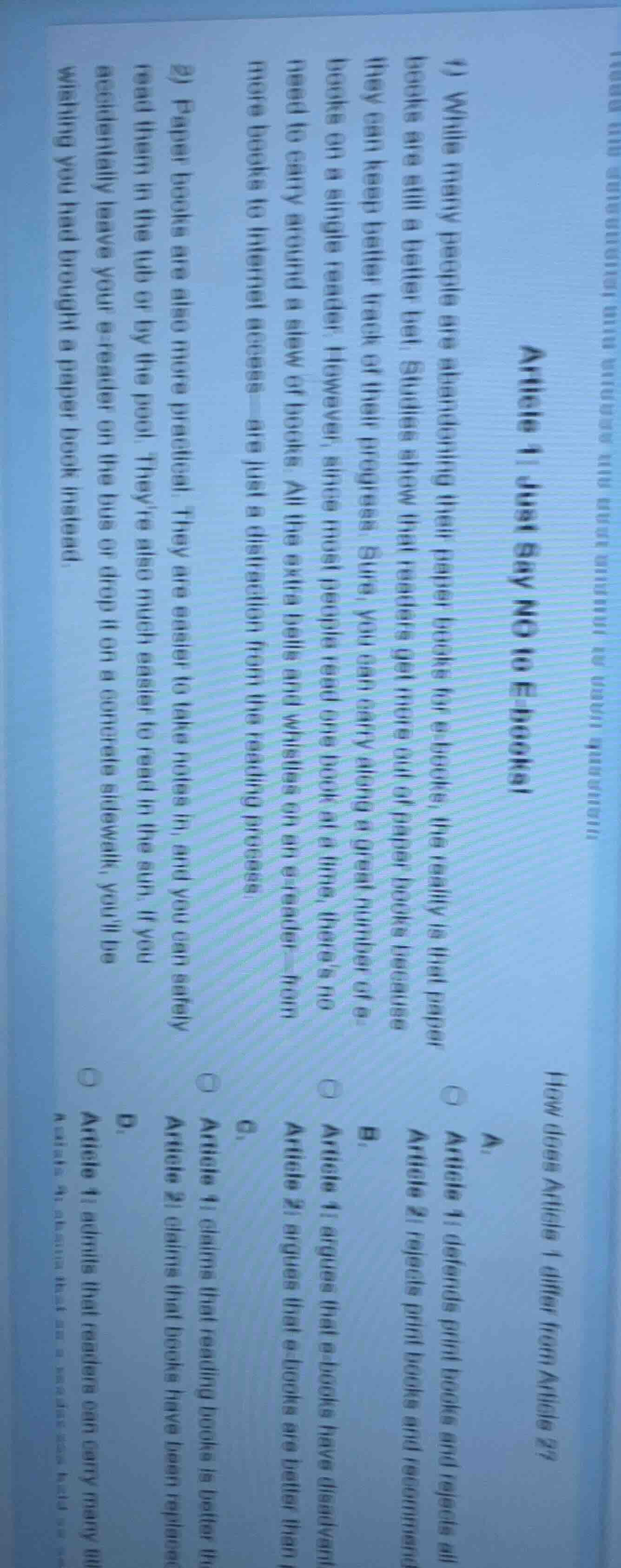
article 1 | just say no to e - books!
- while many people are abandoning their paper books for e - books, the reality is that paper books are still a better bet. studies show that readers get more out of paper books because they can keep better track of their progress. sure, you can carry along a great number of e - books on a single reader. however, since most people read one book at a time, there’s no need to carry around a slew of books. all the extra bells and whistles on an e - reader—from more books to internet access—are just a distraction from the reading process.
- paper books are also more practical. they are easier to take notes in, and you can safely read them in the tub or by the pool. they’re also much easier to read in the sun. if you accidentally leave your e - reader on the bus or drop it on a concrete sidewalk, you’ll be wishing you had brought a paper book instead.
how does article 1 differ from article 2?
a. article 1 defends print books and rejects all article 2 rejects part books and recommend
b. article 1 argues that e - books have disadvant article 2 argues that e - books are better than
c. article 1 claims that reading books is better th article 2 claims that books have been replace
d. article 1 admits that readers can carry many b article 4: admission that...
To solve this, we analyze Article 1 (from the text: "While many people are abandoning their paper books for e - books, the reality is that paper books are still a better bet...") and assume Article 2 (not fully shown, but from the options). Option A: Article 1 defends print books (says they are better) and rejects e - books? No, it says e - books can carry many, but paper is better. Wait, re - reading Article 1: it says paper books are better (defends print) and while e - books have a use (carry many), it still says paper is better. But the option A says "defends print books and rejects all Article 2..." No, let's check the options again. Wait, the question is how Article 1 differs from Article 2. Let's analyze each option:
- Option A: Article 1 defends print and rejects all? No, Article 1 says e - books can carry many, so it doesn't reject all e - book aspects.
- Option B: Article 1 argues e - books have a disadvantage (more books on e - reader is a distraction? Wait, Article 1: "since most people read one book at a time, there's no need to carry around a slew of books. All the extra bells and whistles on an e - reader—from more books to internet access—are just a distraction from the reading process." So it argues e - books have disadvantages. Article 2 (from option B: "Article 2 argues that e - books are better than...") If Article 1 says e - books have disadvantages and Article 2 says e - books are better, that's a difference. But wait, let's check the other options.
- Option C: Article 1 claims reading books is better than... No, it's about paper vs e - books, not reading books (paper) vs something else.
- Option D: Article 1 admits readers can carry many on e - reader (yes, "you can carry along a great number of e - books on a single reader") and Article 2... But the option D says "admits that readers can carry many on e - reader"—Article 1 does admit that, but we need the difference. Wait, the correct option should be A? Wait no, re - reading the Article 1: "the reality is that paper books are still a better bet"—so it defends print books. And if Article 2 (not shown, but from the options) is different. Wait, the correct answer is A? Wait, no, let's re - evaluate. The first part of Article 1: defends print books (says they are better) and rejects e - books? No, it says e - books have a use (carry many) but paper is better. But the option A says "Article 1 defends print books and rejects all Article 2..." Maybe the intended answer is A. Wait, maybe I misread. Let's check the options again. The question is "How does Article 1 differ from Article 2?"
Option A: Article 1 defends print books (says they are better) and rejects all (maybe Article 2 is pro - e - book). So if Article 1 is pro - print and Article 2 is pro - e - book, then A is correct.

Snap & solve any problem in the app
Get step-by-step solutions on Sovi AI
Photo-based solutions with guided steps
Explore more problems and detailed explanations
A. Article 1 defends print books and rejects all Article 2 rejects print books and recommends e - books