QUESTION IMAGE
Question
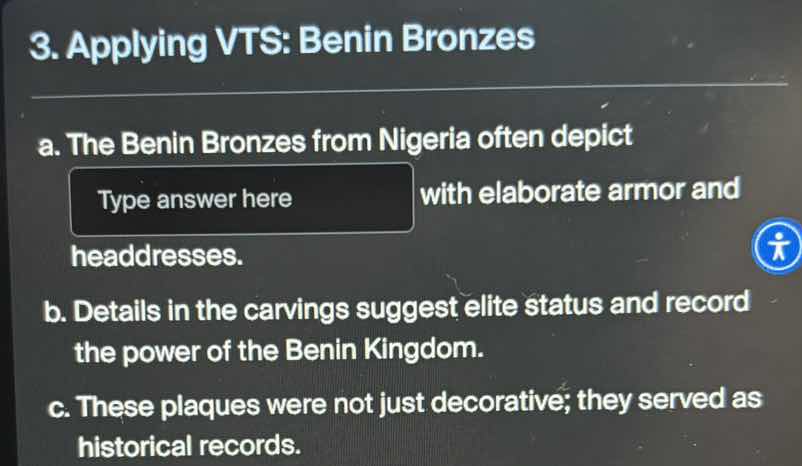
- applying vts: benin bronzes
a. the benin bronzes from nigeria often depict type answer here with elaborate armor and headdresses.
b. details in the carvings suggest elite status and record the power of the benin kingdom.
c. these plaques were not just decorative; they served as historical records.
<pre_analysis>
{
"quality": "clear",
"question_count": 1,
"skills_matched": [
"direct_cot",
"blank_filling_formatter",
"explain_then_answer",
"quick"
],
"needs_drawing": false,
"concepts_used": [],
"new_concepts": [
"Benin Bronzes",
"African Art History"
],
"current_concepts": [
"Benin Bronzes",
"African Art History",
"Visual Thinking Strategies"
]
}
</pre_analysis>
<reasoning>
Identify the subject of the Benin Bronzes
The Benin Bronzes are a group of thousands of metal plaques and sculptures that decorated the royal palace of the Kingdom of Benin (in modern-day Nigeria). They primarily depict historical scenes, court life, and high-ranking figures.
Determine the specific figures depicted with armor and headdresses
The most prominent figures depicted on these plaques wearing elaborate ceremonial armor, coral-beaded neck rings, and ornate headdresses are the "oba" (the king) and his royal court officials, warriors, or chiefs.
Select the most standard academic term for the blank
In art history curricula discussing the Benin Bronzes, the blank is typically filled by "kings" (or "obas"), "warriors", or "chiefs". Given the context of "elaborate armor and headdresses," "kings" (or "obas") or "warriors" is the standard fit. "kings" (or "obas") is the most comprehensive term for the central elite figures depicted.
</reasoning>
<answer>
Question 3
a. The Benin Bronzes from Nigeria often depict <blank>kings</blank> with elaborate armor and headdresses.
</answer>
<post_analysis>
{
"subject": "Arts",
"question_type": "Fill-in-the-blank",
"knowledge_point": [
"Arts",
"Art History",
"African Art History"
]
}
</post_analysis>
Snap & solve any problem in the app
Get step-by-step solutions on Sovi AI
Photo-based solutions with guided steps
Explore more problems and detailed explanations
<pre_analysis>
{
"quality": "clear",
"question_count": 1,
"skills_matched": [
"direct_cot",
"blank_filling_formatter",
"explain_then_answer",
"quick"
],
"needs_drawing": false,
"concepts_used": [],
"new_concepts": [
"Benin Bronzes",
"African Art History"
],
"current_concepts": [
"Benin Bronzes",
"African Art History",
"Visual Thinking Strategies"
]
}
</pre_analysis>
<reasoning>
Identify the subject of the Benin Bronzes
The Benin Bronzes are a group of thousands of metal plaques and sculptures that decorated the royal palace of the Kingdom of Benin (in modern-day Nigeria). They primarily depict historical scenes, court life, and high-ranking figures.
Determine the specific figures depicted with armor and headdresses
The most prominent figures depicted on these plaques wearing elaborate ceremonial armor, coral-beaded neck rings, and ornate headdresses are the "oba" (the king) and his royal court officials, warriors, or chiefs.
Select the most standard academic term for the blank
In art history curricula discussing the Benin Bronzes, the blank is typically filled by "kings" (or "obas"), "warriors", or "chiefs". Given the context of "elaborate armor and headdresses," "kings" (or "obas") or "warriors" is the standard fit. "kings" (or "obas") is the most comprehensive term for the central elite figures depicted.
</reasoning>
<answer>
Question 3
a. The Benin Bronzes from Nigeria often depict <blank>kings</blank> with elaborate armor and headdresses.
</answer>
<post_analysis>
{
"subject": "Arts",
"question_type": "Fill-in-the-blank",
"knowledge_point": [
"Arts",
"Art History",
"African Art History"
]
}
</post_analysis>