QUESTION IMAGE
Question
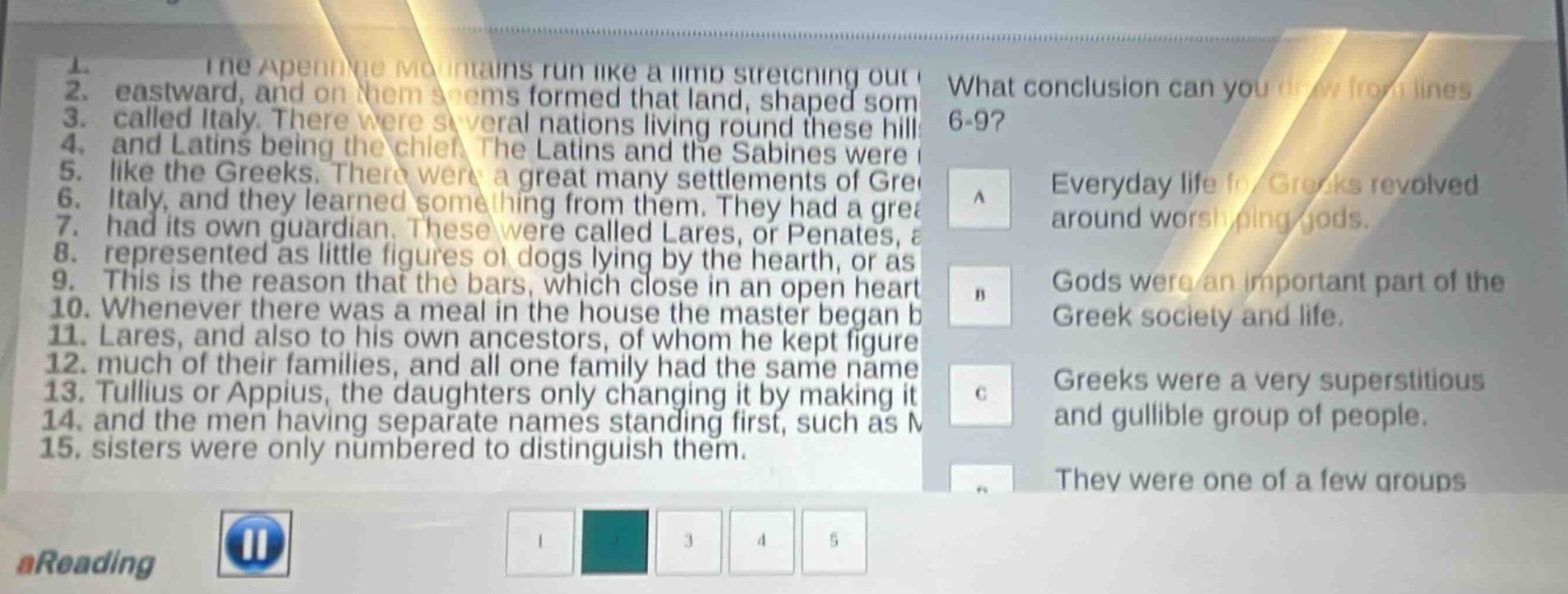
- the apennine mountains run like a limp stretching out eastward, and on them seems formed that land, shaped some called italy. there were several nations living round these hills and latins being the chief. the latins and the sabines were like the greeks. there were a great many settlements of gre italy, and they learned something from them. they had a gre had its own guardian. these were called lares, or penates, represented as little figures of dogs lying by the hearth, or as this is the reason that the bars, which close in an open heart whenever there was a meal in the house the master began b lares, and also to his own ancestors, of whom he kept figure much of their families, and all one family had the same name tullius or appius, the daughters only changing it by making it and the men having separate names standing first, such as m sisters were only numbered to distinguish them.
what conclusion can you draw from lines 6 - 9?
a everyday life for greeks revolved around worshipping gods.
b gods were an important part of the greek society and life.
c greeks were a very superstitious and gullible group of people.
d they were one of a few groups
To solve this, we analyze lines 6 - 9. Line 6 mentions Greeks in Italy and learning from them. Lines 7 - 9 talk about guardians (Lares/Penates) related to their life. Option A focuses on "everyday life revolving around worship" but the text doesn't emphasize "everyday life" as revolving around it. Option B: The mention of guardians (related to gods) and their role in life shows gods were important. Option C: "Superstitious and gullible" is not supported (the text is about cultural/religious practices, not superstition or gullibility). Option D is incomplete. So B is correct as it aligns with the importance of gods in their society/life.

Snap & solve any problem in the app
Get step-by-step solutions on Sovi AI
Photo-based solutions with guided steps
Explore more problems and detailed explanations
B. Gods were an important part of the Greek society and life.