QUESTION IMAGE
Question
ap chemistry: chapter 14 practice test
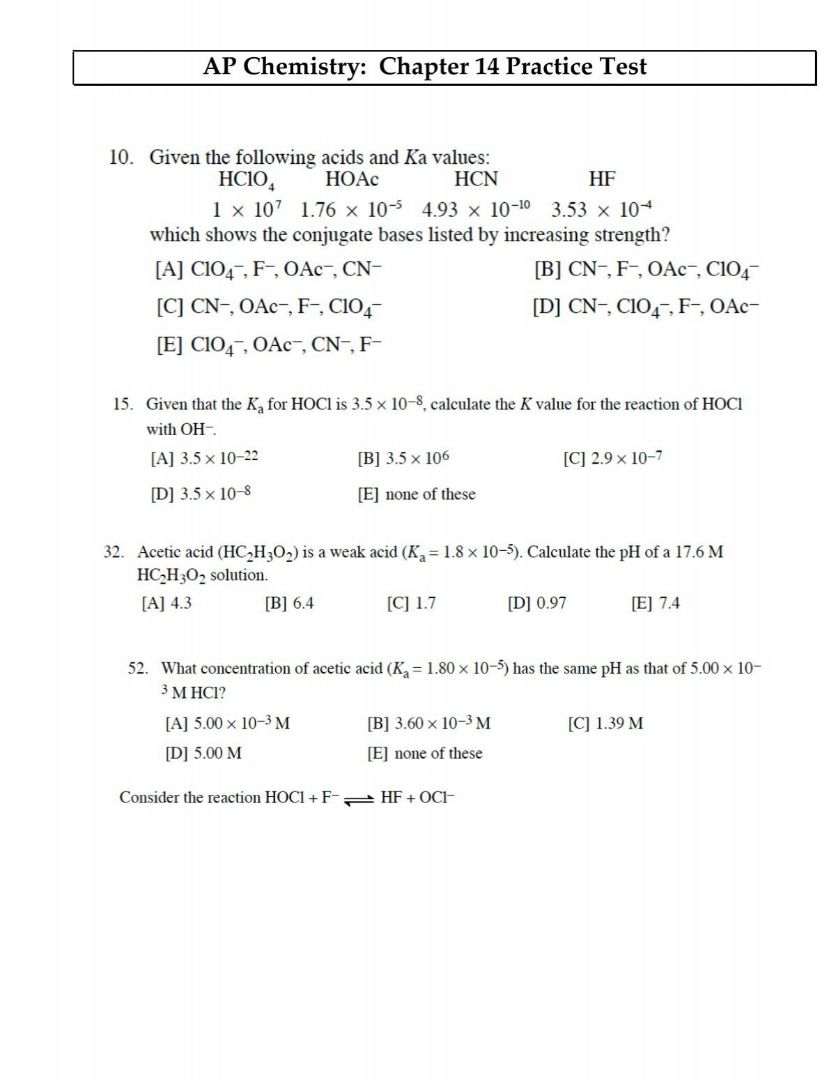
- given the following acids and \\(k_a\\) values:
\\(\text{hclo}_4\\) \\(\text{hoac}\\) \\(\text{hcn}\\) \\(\text{hf}\\)
\\(1 \times 10^7\\) \\(1.76 \times 10^{-5}\\) \\(4.93 \times 10^{-10}\\) \\(3.53 \times 10^{-4}\\)
which shows the conjugate bases listed by increasing strength?
a \\(\text{clo}_4^-\\), \\(\text{f}^-\\), \\(\text{oac}^-\\), \\(\text{cn}^-\\)
b \\(\text{cn}^-\\), \\(\text{f}^-\\), \\(\text{oac}^-\\), \\(\text{clo}_4^-\\)
c \\(\text{cn}^-\\), \\(\text{oac}^-\\), \\(\text{f}^-\\), \\(\text{clo}_4^-\\)
d \\(\text{cn}^-\\), \\(\text{clo}_4^-\\), \\(\text{f}^-\\), \\(\text{oac}^-\\)
e \\(\text{clo}_4^-\\), \\(\text{oac}^-\\), \\(\text{cn}^-\\), \\(\text{f}^-\\)
- given that the \\(k_a\\) for \\(\text{hocl}\\) is \\(3.5 \times 10^{-8}\\), calculate the \\(k\\) value for the reaction of \\(\text{hocl}\\) with \\(\text{oh}^-\\).
a \\(3.5 \times 10^{-22}\\)
b \\(3.5 \times 10^6\\)
c \\(2.9 \times 10^{-7}\\)
d \\(3.5 \times 10^{-8}\\)
e none of these
- acetic acid (\\(\text{hc}_2\text{h}_3\text{o}_2\\)) is a weak acid (\\(k_a = 1.8 \times 10^{-5}\\)). calculate the ph of a \\(17.6\text{ m}\\) \\(\text{hc}_2\text{h}_3\text{o}_2\\) solution.
a \\(4.3\\)
b \\(6.4\\)
c \\(1.7\\)
d \\(0.97\\)
e \\(7.4\\)
- what concentration of acetic acid (\\(k_a = 1.80 \times 10^{-5}\\)) has the same ph as that of \\(5.00 \times 10^{-3}\text{ m } \text{hcl}\\)?
a \\(5.00 \times 10^{-3}\text{ m}\\)
b \\(3.60 \times 10^{-3}\text{ m}\\)
c \\(1.39\text{ m}\\)
d \\(5.00\text{ m}\\)
e none of these
consider the reaction \\(\text{hocl} + \text{f}^- \
ightleftharpoons \text{hf} + \text{ocl}^-\\)
🆕 New Concept Discovered: Acid-Base Conjugate Strength
The stronger the acid, the weaker its conjugate base.
Step 1: Understand the relationship between acid and conjugate base strength
An acid's strength is directly measured by its acid dissociation constant, \( K_a \). The larger the \( K_a \) value, the stronger the acid.
The strength of an acid and its conjugate base are inversely related:
- A stronger acid has a weaker conjugate base (lower \( K_b \)).
- A weaker acid has a stronger conjugate base (higher \( K_b \)).
The relationship is quantitatively defined by:
Step 2: Arrange the acids by increasing strength
Let's list the given acids and their corresponding \( K_a \) values:
- \( \text{HCN} \): \( K_a = 4.93 \times 10^{-10} \)
- \( \text{HOAc} \): \( K_a = 1.76 \times 10^{-5} \)
- \( \text{HF} \): \( K_a = 3.53 \times 10^{-4} \)
- \( \text{HClO}_4 \): \( K_a = 1 \times 10^{7} \)
Comparing these values, we can order the acids from weakest to strongest:
Step 3: Determine the order of conjugate bases by increasing strength
Since conjugate base strength is inversely related to acid strength, the order of conjugate base strength will be the exact opposite of the acid strength order.
The conjugate bases of the given acids are:
- \( \text{HCN}
ightarrow \text{CN}^- \)
- \( \text{HOAc}
ightarrow \text{OAc}^- \)
- \( \text{HF}
ightarrow \text{F}^- \)
- \( \text{HClO}_4
ightarrow \text{ClO}_4^- \)
Since \( \text{HClO}_4 \) is the strongest acid, its conjugate base \( \text{ClO}_4^- \) is the weakest base. Since \( \text{HCN} \) is the weakest acid, its conjugate base \( \text{CN}^- \) is the strongest base.
Ordering the conjugate bases from weakest to strongest (increasing strength):
This matches option [A].

Snap & solve any problem in the app
Get step-by-step solutions on Sovi AI
Photo-based solutions with guided steps
Explore more problems and detailed explanations
[A] \( \text{ClO}_4^- \), \( \text{F}^- \), \( \text{OAc}^- \), \( \text{CN}^- \)