QUESTION IMAGE
Question
answer the question correctly to continue:
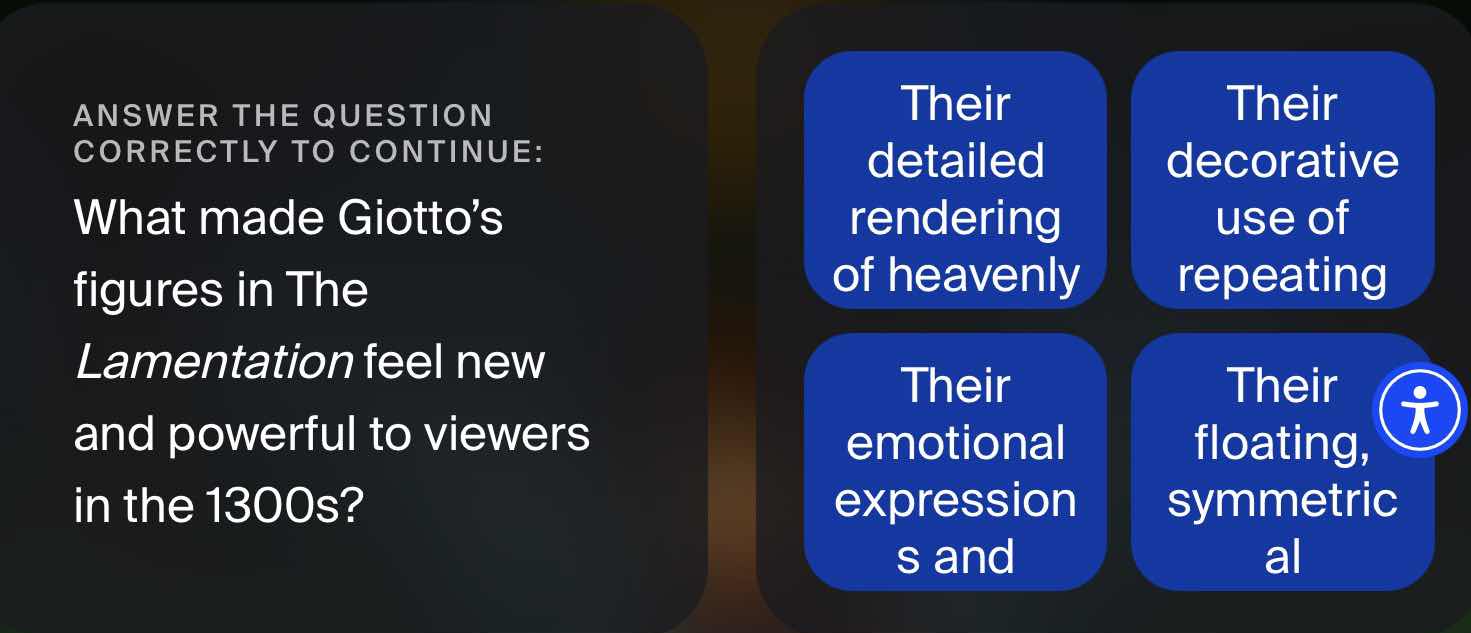
what made giottos figures in the lamentation feel new and powerful to viewers in the 1300s?
- their detailed rendering of heavenly
- their decorative use of repeating
- their emotional expressions and
- their floating, symmetrical
Analyze the historical context of Giotto's style
In the early 1300s (Proto-Renaissance), medieval Byzantine art dominated, characterized by flat, stylized, floating, and emotionally detached figures. Giotto di Bondone revolutionized Western painting by introducing three-dimensional volume, physical weight, and intense human emotion.
Evaluate the given options
- "Their detailed rendering of heavenly" (incomplete text, likely referring to traditional medieval focus on the divine rather than human realism).
- "Their decorative use of repeating" (describes Byzantine pattern-making, not Giotto's innovation).
- "Their emotional expressions and" (incomplete text, but directly points to Giotto's groundbreaking emotional realism, human drama, and physical presence/weight of the figures).
- "Their floating, symmetrical" (describes the older Byzantine style that Giotto rejected).
Select the correct option
The option "Their emotional expressions and" represents the core of Giotto's revolutionary style in The Lamentation, where figures display genuine, individualized human grief and physical gravity.

Snap & solve any problem in the app
Get step-by-step solutions on Sovi AI
Photo-based solutions with guided steps
Explore more problems and detailed explanations
- Their detailed rendering of heavenly
- Their decorative use of repeating
- Their emotional expressions and (Correct answer)
- Their floating, symmetrical