QUESTION IMAGE
Question
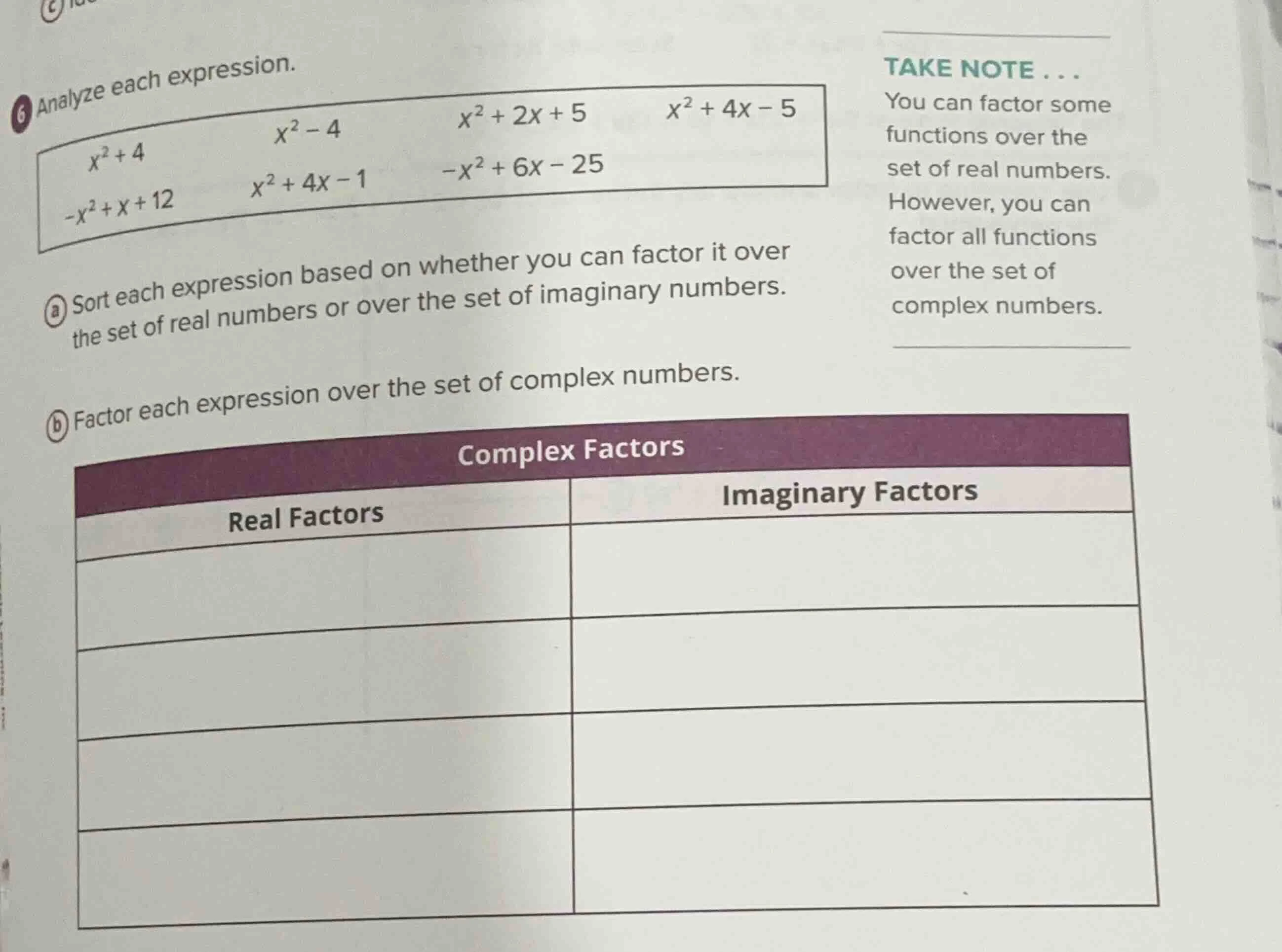
6 analyze each expression.
$x^2 + 4$ $x^2 - 4$ $x^2 + 2x + 5$ $x^2 + 4x - 5$
$-x^2 + x + 12$ $x^2 + 4x - 1$ $-x^2 + 6x - 25$
(a) sort each expression based on whether you can factor it over the set of real numbers or over the set of imaginary numbers.
(b) factor each expression over the set of complex numbers.
take note...
you can factor some functions over the set of real numbers.
however, you can factor all functions over the set of complex numbers.
complex factors
real factors imaginary factors
Part (a) Sorting Expressions
To determine if a quadratic \( ax^2 + bx + c \) factors over \(\mathbb{R}\) or \(\mathbb{C}\) (imaginary), we use the discriminant \( D = b^2 - 4ac \):
- If \( D \geq 0 \), it factors over \(\mathbb{R}\) (real factors).
- If \( D < 0 \), it factors over \(\mathbb{C}\) (imaginary factors, using complex roots).
1. \( x^2 + 4 \)
\( a=1, b=0, c=4 \)
\( D = 0^2 - 4(1)(4) = -16 < 0 \) → Imaginary Factors
2. \( x^2 - 4 \)
\( a=1, b=0, c=-4 \)
\( D = 0^2 - 4(1)(-4) = 16 \geq 0 \) → Real Factors (difference of squares: \( (x-2)(x+2) \))
3. \( x^2 + 2x + 5 \)
\( a=1, b=2, c=5 \)
\( D = 2^2 - 4(1)(5) = 4 - 20 = -16 < 0 \) → Imaginary Factors
4. \( x^2 + 4x - 5 \)
\( a=1, b=4, c=-5 \)
\( D = 4^2 - 4(1)(-5) = 16 + 20 = 36 \geq 0 \) → Real Factors (factors as \( (x+5)(x-1) \))
5. \( -x^2 + x + 12 \) (rewrite as \( x^2 - x - 12 \) for discriminant)
\( a=1, b=-1, c=-12 \)
\( D = (-1)^2 - 4(1)(-12) = 1 + 48 = 49 \geq 0 \) → Real Factors (factors as \( -(x+3)(x-4) \))
6. \( x^2 + 4x - 1 \)
\( a=1, b=4, c=-1 \)
\( D = 4^2 - 4(1)(-1) = 16 + 4 = 20 > 0 \) → Real Factors (roots \( x = -2 \pm \sqrt{5} \), factors as \( (x + 2 - \sqrt{5})(x + 2 + \sqrt{5}) \))
7. \( -x^2 + 6x - 25 \) (rewrite as \( x^2 - 6x + 25 \) for discriminant)
\( a=1, b=-6, c=25 \)
\( D = (-6)^2 - 4(1)(25) = 36 - 100 = -64 < 0 \) → Imaginary Factors
Part (b) Factoring Over \(\mathbb{C}\)
For quadratics with \( D < 0 \), use the quadratic formula \( x = \frac{-b \pm \sqrt{D}}{2a} \), where \( \sqrt{D} = \sqrt{-|D|} = i\sqrt{|D|} \).
1. \( x^2 + 4 \)
\( D = -16 \), roots \( x = \frac{0 \pm \sqrt{-16}}{2} = \pm 2i \)
Factor: \( (x - 2i)(x + 2i) \)
2. \( x^2 + 2x + 5 \)
\( D = -16 \), roots \( x = \frac{-2 \pm \sqrt{-16}}{2} = -1 \pm 2i \)
Factor: \( (x + 1 - 2i)(x + 1 + 2i) \)
3. \( -x^2 + 6x - 25 \) (rewrite as \( x^2 - 6x + 25 \))
\( D = -64 \), roots \( x = \frac{6 \pm \sqrt{-64}}{2} = 3 \pm 4i \)
Factor: \( -(x - 3 + 4i)(x - 3 - 4i) \) (or \( ( -x + 3 - 4i)( -x + 3 + 4i) \))
Final Table (Part a)
| Real Factors | Imaginary Factors |
|---|---|
| \( x^2 + 4x - 5 \) | \( x^2 + 2x + 5 \) |
| \( -x^2 + x + 12 \) | \( -x^2 + 6x - 25 \) |
| \( x^2 + 4x - 1 \) |
Factored Forms (Part b)
- \( x^2 + 4 = (x - 2i)(x + 2i) \)
- \( x^2 + 2x + 5 = (x + 1 - 2i)(x + 1 + 2i) \)
- \( -x^2 + 6x - 25 = -(x - 3 + 4i)(x - 3 - 4i) \)
- \( x^2 - 4 = (x - 2)(x + 2) \)
- \( x^2 + 4x - 5 = (x + 5)(x - 1) \)
- \( -x^2 + x + 12 = -(x + 3)(x - 4) \)
- \( x^2 + 4x - 1 = (x + 2 - \sqrt{5})(x + 2 + \sqrt{5}) \)
(Note: The table in the problem can be filled with the sorted expressions from Part a, and factored forms from Part b.)

Snap & solve any problem in the app
Get step-by-step solutions on Sovi AI
Photo-based solutions with guided steps
Explore more problems and detailed explanations
Part (a) Sorting Expressions
To determine if a quadratic \( ax^2 + bx + c \) factors over \(\mathbb{R}\) or \(\mathbb{C}\) (imaginary), we use the discriminant \( D = b^2 - 4ac \):
- If \( D \geq 0 \), it factors over \(\mathbb{R}\) (real factors).
- If \( D < 0 \), it factors over \(\mathbb{C}\) (imaginary factors, using complex roots).
1. \( x^2 + 4 \)
\( a=1, b=0, c=4 \)
\( D = 0^2 - 4(1)(4) = -16 < 0 \) → Imaginary Factors
2. \( x^2 - 4 \)
\( a=1, b=0, c=-4 \)
\( D = 0^2 - 4(1)(-4) = 16 \geq 0 \) → Real Factors (difference of squares: \( (x-2)(x+2) \))
3. \( x^2 + 2x + 5 \)
\( a=1, b=2, c=5 \)
\( D = 2^2 - 4(1)(5) = 4 - 20 = -16 < 0 \) → Imaginary Factors
4. \( x^2 + 4x - 5 \)
\( a=1, b=4, c=-5 \)
\( D = 4^2 - 4(1)(-5) = 16 + 20 = 36 \geq 0 \) → Real Factors (factors as \( (x+5)(x-1) \))
5. \( -x^2 + x + 12 \) (rewrite as \( x^2 - x - 12 \) for discriminant)
\( a=1, b=-1, c=-12 \)
\( D = (-1)^2 - 4(1)(-12) = 1 + 48 = 49 \geq 0 \) → Real Factors (factors as \( -(x+3)(x-4) \))
6. \( x^2 + 4x - 1 \)
\( a=1, b=4, c=-1 \)
\( D = 4^2 - 4(1)(-1) = 16 + 4 = 20 > 0 \) → Real Factors (roots \( x = -2 \pm \sqrt{5} \), factors as \( (x + 2 - \sqrt{5})(x + 2 + \sqrt{5}) \))
7. \( -x^2 + 6x - 25 \) (rewrite as \( x^2 - 6x + 25 \) for discriminant)
\( a=1, b=-6, c=25 \)
\( D = (-6)^2 - 4(1)(25) = 36 - 100 = -64 < 0 \) → Imaginary Factors
Part (b) Factoring Over \(\mathbb{C}\)
For quadratics with \( D < 0 \), use the quadratic formula \( x = \frac{-b \pm \sqrt{D}}{2a} \), where \( \sqrt{D} = \sqrt{-|D|} = i\sqrt{|D|} \).
1. \( x^2 + 4 \)
\( D = -16 \), roots \( x = \frac{0 \pm \sqrt{-16}}{2} = \pm 2i \)
Factor: \( (x - 2i)(x + 2i) \)
2. \( x^2 + 2x + 5 \)
\( D = -16 \), roots \( x = \frac{-2 \pm \sqrt{-16}}{2} = -1 \pm 2i \)
Factor: \( (x + 1 - 2i)(x + 1 + 2i) \)
3. \( -x^2 + 6x - 25 \) (rewrite as \( x^2 - 6x + 25 \))
\( D = -64 \), roots \( x = \frac{6 \pm \sqrt{-64}}{2} = 3 \pm 4i \)
Factor: \( -(x - 3 + 4i)(x - 3 - 4i) \) (or \( ( -x + 3 - 4i)( -x + 3 + 4i) \))
Final Table (Part a)
| Real Factors | Imaginary Factors |
|---|---|
| \( x^2 + 4x - 5 \) | \( x^2 + 2x + 5 \) |
| \( -x^2 + x + 12 \) | \( -x^2 + 6x - 25 \) |
| \( x^2 + 4x - 1 \) |
Factored Forms (Part b)
- \( x^2 + 4 = (x - 2i)(x + 2i) \)
- \( x^2 + 2x + 5 = (x + 1 - 2i)(x + 1 + 2i) \)
- \( -x^2 + 6x - 25 = -(x - 3 + 4i)(x - 3 - 4i) \)
- \( x^2 - 4 = (x - 2)(x + 2) \)
- \( x^2 + 4x - 5 = (x + 5)(x - 1) \)
- \( -x^2 + x + 12 = -(x + 3)(x - 4) \)
- \( x^2 + 4x - 1 = (x + 2 - \sqrt{5})(x + 2 + \sqrt{5}) \)
(Note: The table in the problem can be filled with the sorted expressions from Part a, and factored forms from Part b.)