QUESTION IMAGE
Question
americans see the future of space exploration, 50 years after the first moon landing
how americans see the future of space exploration, 50 years after the first moon landing
by courtney johnson
before you read, take note of text features, genre characteristics, and text structure. highlight examples of text features in yellow and evidence of text structures in pink. use sticky notes to record notes about genre characteristics.
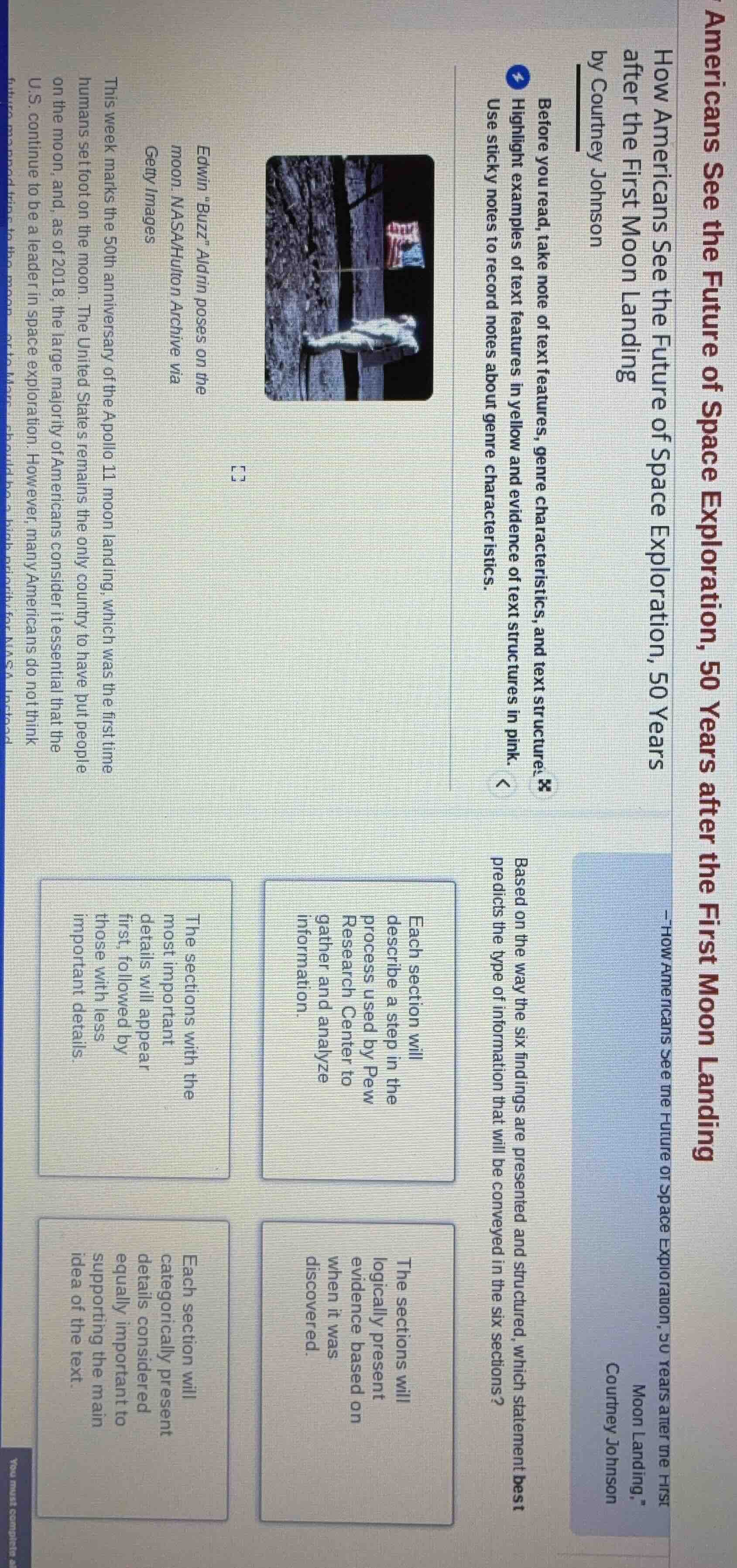
edwin \buzz\ aldrin poses on the moon. nasa/hulton archive via getty images
this week marks the 50th anniversary of the apollo 11 moon landing, which was the first time humans set foot on the moon. the united states remains the only country to have put people on the moon, and, as of 2018, the large majority of americans consider it essential that the u.s. continue to be a leader in space exploration. however, many americans do not think
based on the way the six findings are presented and structured, which statement best predicts the type of information that will be conveyed in the six sections?
each section will describe a step in the process used by pew research center to gather and analyze information.
the sections will logically present evidence based on when it was discovered.
the sections with the most important details will appear first, followed by those with less important details.
each section will categorically present details considered equally important to supporting the main idea of the text.
To solve this, we analyze the description of each section's purpose and match it to the given options:
Analyzing each option:
- "Each section will describe a step in the process used by the Pew Research Center to gather and analyze information."
This implies a sequential, step - by - step structure (like a procedure). If the sections outline the Pew Research Center’s research process (e.g., data collection, analysis steps), this fits.
- "The sections will logically present evidence based on when it was discovered."
This focuses on chronological organization of evidence. Unless the text is structured around the timeline of discovery, this is less likely.
- "The sections with the most important details will appear first, followed by those with less important details."
This is a priority - based (most to least important) structure. It’s less common for research - based text sections to follow this unless explicitly stated as a summary - like format.
- "Each section will categorically present details considered equally important to support the main idea of the text."
This is a categorical structure (grouping related details). If the sections are organized by themes or topics (not steps or time), this fits.
Matching to the Context:
The text is about “How Americans See the Future of Space Exploration, 50 Years after the First Moon Landing” and likely uses Pew Research data. Research - based text sections often follow a procedural structure (describing the research process: gathering, analyzing data) or a categorical structure (presenting findings by themes).
If the six sections describe the Pew Research Center’s process (e.g., how they surveyed Americans, analyzed responses), the first option is best. If they present findings by categories (e.g., attitudes on space leadership, future exploration), the fourth option is best.
Assuming the text outlines the research process (common in Pew Research reports), the most probable answer is:
The question asks to predict the information type in six sections. The first option describes a procedural (step - by - step) structure, which matches how research - based text (like Pew Research) often outlines its methodology (gathering/analyzing info). Other options (chronological, priority - based, categorical) are less aligned with typical research report structure.

Snap & solve any problem in the app
Get step-by-step solutions on Sovi AI
Photo-based solutions with guided steps
Explore more problems and detailed explanations
A. Each section will describe a step in the process used by the Pew Research Center to gather and analyze information.