QUESTION IMAGE
Question
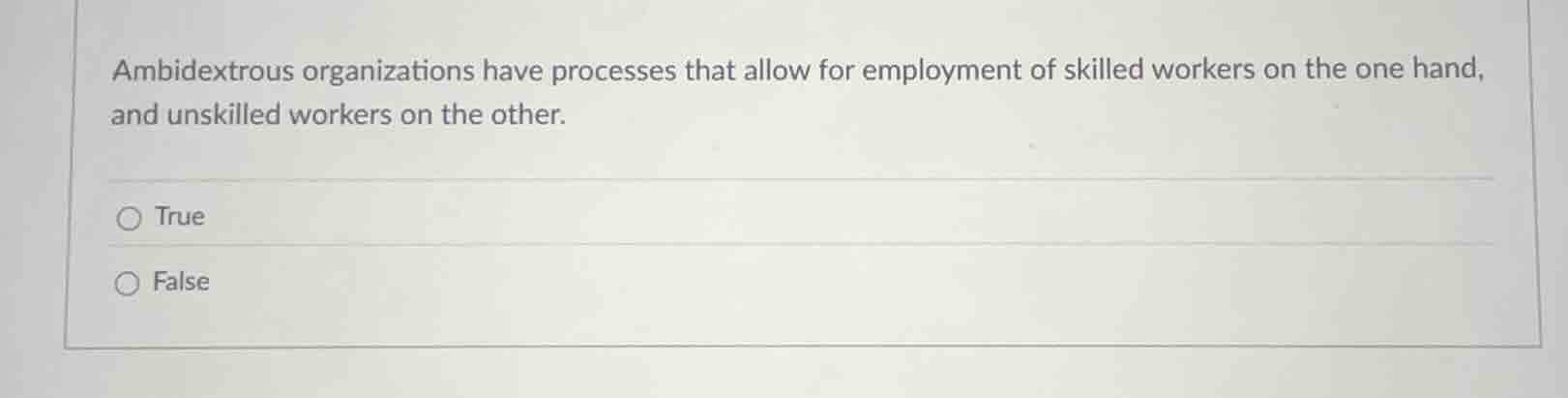
ambidextrous organizations have processes that allow for employment of skilled workers on the one hand, and unskilled workers on the other.
true
false
🆕 New Concept Discovered: Organizational Ambidexterity
Balancing exploitation of existing capabilities and exploration of new opportunities.
Step 1: Define organizational ambidexterity
In business and organizational theory, an ambidextrous organization refers to an organization's ability to be efficient in its management of today's business demands (exploitation) while simultaneously being adaptive to changes in the environment (exploration).
- Exploitation is about efficiency, control, certainty, and variance reduction (doing what we already do, but better).
- Exploration is about search, variation, risk-taking, experimentation, and innovation (discovering new ways of doing things).
Step 2: Evaluate the statement
The statement in the image claims: "Ambidextrous organizations have processes that allow for employment of skilled workers on the one hand, and unskilled workers on the other."
This is a common misconception or a play on the word "ambidextrous" (which literally means using both hands with equal ease). In an organizational context, "both hands" does not refer to employing "skilled" versus "unskilled" workers. Instead, it refers to balancing exploration (innovation and future growth) and exploitation (current operational efficiency). Both of these activities typically require skilled workforces, just with different focuses, structures, and cultures.
Therefore, defining organizational ambidexterity as balancing skilled and unskilled labor is incorrect.

Snap & solve any problem in the app
Get step-by-step solutions on Sovi AI
Photo-based solutions with guided steps
Explore more problems and detailed explanations
False